+44 75754 30035 help@rapidassignmenthelp.co.uk
offer
🎁Special Offer 🎁 Discounts - Up to 50% OFF!
🎁Special Offer 🎁 Discounts - Up to 50% OFF!

.jpg)
We all know that writing has a strong impact. If done in the right way, it can easily persuade anyone. If that’s the thing, the DAFOREST is a powerful technique. It is not something new, but a highly used acronym in English that serves as a module which you can follow to enhance your writing
Well, the technique is only highly effective when you use it in the right way by avoiding errors. Want to know how? This guide is for you. In this blog, we’ll give you a clear breakdown of the DAFOREST techniques, examples, common errors to avoid, and much more. So, make sure you keep reading and let’s dive into it.
For years, the DAFOREST technique has been used by professionals, writers, and students. The reason is its effectiveness in making words persuasive. It simply stands for:
This is an acronym used in English, and its major purpose is to make writing effective. It does by giving you a step-by-step process to follow when writing any sort of document. While the technique usage is vast, its significance can be majorly seen in essays, speeches, and advertisements. No matter what field you are in, if your goal is to persuade the reader, this technique serves the best. It is also a better way to connect with the audience by mixing logic and emotion together.
According to research, the biggest advantage of the technique is for students. As examiners look for writing that shows confidence, control, and persuasive power, the technique serves best here. But how? For this, you need to understand the depth of this technique, which is explained in the next section.
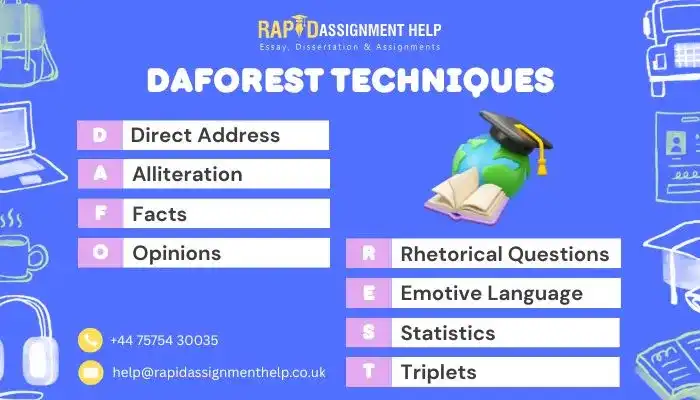
While using the DAFOREST technique, you need to understand what it is and how it influences writing from average to A. To give you a better comprehension, we’ve described the technique thoroughly while including examples. Have a closer look:
The first point of the technique simply explains addressing the reader directly. It is executed by adding ‘you’, ‘your’, ‘we’, ‘us’, types of words. When you are talking straight to the reader, it makes them feel truly connected and hard for them to ignore.
Example: Your future depends on you, so take action to build a great tomorrow.
Influence on the reader: They feel like part of the conversation and enjoy reading till the last. It also makes them read without skipping.
The most common lines that we remember are the ones that create a rhythm, and this is what Alliteration is all about. This is executed by using the same words that start with the same letter. These types of terminologies are common in speeches where the goal is to make the statement memorable.
Example: A Writer should turn words into bold, brilliant, and believable arguments.
Influence on the reader: It creates a hook in the reader's subconscious mind and makes the statement easy to remember.
The document is only valuable when it’s credible. At this point, you can include factual statements that are true or could be research-backed numbers. Adding sources and references is also a great way to build authority.
Example: Over 66% of UK students seek assignment help online due to heavy academic pressure.
Influence on the reader: When readers get the numbers and verify the details, it builds trust in the research and efforts.
In this part, you need to incorporate your opinions as a writer, but here is the reality. It could only be effective when you frame your opinions as authoritative. This is when your viewpoints will be more effectively impeccable for readers.
Example: The future is highly dependent on adapting technology for jobs.
Influence on the reader: When you give a statement that brings a ‘YES’ from the reader's mind, it states your view confidently to them.
This is when you have to stop and include the reader in the conversation. You do by asking a question that you know the answer to. This is what Rhetorical questions make the reader think for a minute.
Example: Would you prioritise assignment help when it could significantly boost your grades?
Influence on the reader: When readers get a chance to answer, they feel involved and it sparks interest to read more.
Nothing works better than igniting an emotion in a reader's mind. That’s what you do here by adding sentences or words that evoke a sense of feeling or emotion. You can even use something that you think is relatable to readers.
Example: Ever felt how good it would be to score the desired grades in your mathematics project?
Influence on the reader: It makes the reader imagine themselves in that situation and builds a strong connection.
This is also like facts, but here you make it even stronger by adding numbers or a matrix that builds credibility. The major purpose is to make readers trust your statement strongly by giving them data, statistics, or number-based evidence.
Example: You know that GCSE examiners can add up to 40% marks for a clear and persuasively written assignment.
Influence on the reader: Builds credibility and convinces the reader fast with credible numbers-based evidence.
At this point, the goal is to make the information easy to remember. It is executed by presenting ideas in three sounds. In simple terms, making a group of three related words or ideas and showcasing them in a series.
Example: Avail the simplest, affordable, and fastest assignment help this Christmas.
Influence on the reader: Grab the reader's attention and leave a lasting impact on them.
This is what the DAFOREST Technique is all about—making writing simple yet effective. But you know that students have the most benefit from this process in their academic writing. If you are not using it yet, find out next about why you should start using it right now.
As mentioned earlier, the DAFORST Technique is beneficial for making writing effective. And writing is something that is an essential part of a student's life. To give you a clearer idea, we mentioned some of the major reasons below:
In short, the DAFOREST Technique is beneficial for students in many aspects. It makes your writing smooth and stronger, which examiners look for and score higher grades. Now, let’s have a look at how it is better than PEEL’s Technique.
People often compare DAFOREST with PEEL (Point, Evidence, Explanation, Link), which is also a popular writing technique. However, when it comes to persuasive writing, things change. To break this down, we have given a clear comparison of both techniques:
| Purpose | PEEL Technique | DAFOREST Technique |
|---|---|---|
| Organisation | Structure your paragraphs | Makes writing compelling with tone and arguments |
| Writing Style | Analytical writing | Persuasive writing |
| Usage | Best for literature essays and academic analysis | Best for speeches, debates, opinion essays, and exam writing |
| Benefits | Provides analytical depth and logical structure | Adds creativity and personality by asking questions |
| Best for | Purely analytical-based writing | Persuasive and engagement-focused writing |
While both writing techniques are good, the best one depends on your usage and task requirements. However, when moving to the next section, let’s explore common errors to avoid when using the DAFOREST Technique.
As you have gained the breakthrough of how effective the DAFOREST technique is, it is still sensitive. If you want to get the most from the technique, you need to avoid some common errors, shown below:
Now, as you understand the common errors while using the DAFOREST Technique, there are also ways to make it effective. Let’s explore it in the next section.
The DAFOREST Technique can be beneficial when you use it properly. For your convenience, we have brought the top 5 ways to use the technique effectively, which you can read below:
Before using the devices, you need to understand why the paragraph exists. Based on persuading, explaining, and emphasising, choose the right device that maintains the flow.
The technique should not be implemented forcefully; instead, naturally. And as mentioned, use devices accordingly or 2-3 (e.g., a fact + emotive language + rhetorical question) to make the content convincing.
Whenever you add any strong points or make claims, back them with evidence. This is when devices like Facts, Statistics, and Expert Opinions help the most to add credibility for the reader.
Starting and ending are the most effective parts of any content. To make them impactful, ask a question with sentences that evoke a sense of emotion. It will be helpful to boost engagement drastically.
In the final part of your information, tell readers exactly what you want them to believe, feel, and do. You can do it by using a strong finish with persuasive sentences that leave a lasting impact on them.
By using our mentioned tips, you can leverage the DAFOREST Technique in the way it should be used. Now, it's time to end this blog with some useful findings.
To conclude, DAFOREST makes writing effective by adding emotional and logical touches to the information. Each device gives a new way to expand ideas and achieve the goal of making writing persuasive. By using it, you can definitely level up your writing from average to A and score better marks or a distinction as a student.
Furthermore, if you are still finding it challenging to implement, then stay relaxed. At Rapid Assignment Help, our experts will support you and even deliver a fully written assignment that effortlessly uses this persuasive technique. So, strengthen your writing without stress by taking our guidance.
Robert Caldwell is an academic communication specialist and educational content writer with expertise in persuasive writing, rhetorical strategies, and effective communication techniques. He creates practical resources on persuasive methods such as DAFOREST techniques, speech writing, argument development, and audience engagement strategies. Robert focuses on helping students understand how language choices, rhetorical devices, and structured arguments can strengthen their written and spoken communication. His work combines insights from English education and communication studies to provide clear, research-informed guidance that supports learners in developing confident, compelling, and impactful forms of expression.
DAFOREST is neither a language nor a structure. It is a persuasive writing technique or acronym used in English to make the information engaging to the reader. While it adds creativity and emotion, you still need a logical structure to make the writing impactful.
The popular 4 P’s of persuasive writing are:
No doubt, the DAFOREST is still relevant and widely used in the modern English Curriculum. As it showcases the effort and skills of writing, it appears consistently in marking schemes. In short, the technique is still useful, and you can use it.
The S in DAFOREST stands for Statistics. It refers to using numerical data, matrices, percentages, and facts that make arguments more credible. For example, “60% of scholars have scored an A+ grade in 2025”.
Get Extra 10% OFF on WhatsApp order!
use discountCopyright 2026 @ Rapid Assignment Help Services
.jpg)