+44 75754 30035 help@rapidassignmenthelp.co.uk
offer
🎁Special Offer 🎁 Discounts - Up to 50% OFF!
🎁Special Offer 🎁 Discounts - Up to 50% OFF!

Change is uncomfortable. Most people know this — including the ones leading it.
That's probably why so many transformation projects fail. Not because the strategy was wrong, but because the people side of it was handled poorly. Employees didn't understand what was happening. Leaders lost interest halfway through. Communication happened once, then stopped. And whatever momentum existed in week one was completely gone by month three.
John Kotter watched this play out across hundreds of organisations. His response was to build a framework around the actual problem — not the strategy, but the execution.
The result was an eight-step model that's now used everywhere from NHS trusts to FTSE 100 companies. If you're in HR, studying for CIPD, or currently trying to push through any kind of workplace change, it's worth understanding properly.
Kotter published his framework in 1995, based on research into why organisational change efforts kept failing. The model gives leaders a structured sequence to follow — not a theoretical checklist, but a practical guide built on real patterns of failure.
The central idea isn't complicated: change works when employees genuinely understand why it's needed, and when leadership stays actively involved from start to finish — not just at the announcement stage, but throughout the entire process. In the same way, structured assignment support helps students stay engaged, understand difficult topics more clearly, and improve their academic performance with consistent guidance.
What separates it from older frameworks is the emphasis on people, culture, engagement, resistance, and communication. These aren't soft extras. In Kotter's view, they're the whole game.
Kotter's starting point was a question: why do well-resourced, intelligent organisations keep getting this wrong?
The answer wasn't strategy. It was an implementation.
He kept seeing the same problems. Leaders who created urgency in the boardroom but never communicated it to the people actually doing the work. Employees who had no idea why things were changing. Projects that showed early promise, then quietly stalled after the first phase. And changes that, even when they succeeded temporarily, never actually became part of how the organisation operated day to day.
His conclusion was that transformation needs two things working together — a clear plan, and consistent leadership throughout. Neither one works without the other.
People don't change what they think is working. That's just human nature.
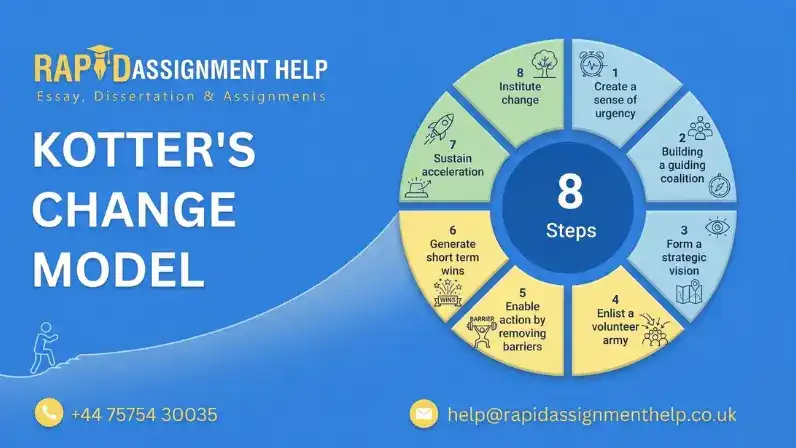
So before anything else, employees need to understand what's actually at stake. Not in vague corporate language — with real numbers, real context, and an honest picture of what happens if the organisation doesn't move.
A retail chain losing customers to online competitors doesn't help itself by keeping that information in the executive team. When managers share the data openly — falling footfall, declining revenue, what competitors are doing differently — employees start to see why the change isn't optional.
Skip this step, and you'll spend every subsequent step fighting inertia. People who don't feel the problem won't support the solution.
No single person can carry a transformation. Even a highly respected CEO can't do it alone.
What's needed is a group of people — spread across the organisation — who have genuine credibility, real influence, and the commitment to actively drive the change rather than just endorse it. There's a difference between someone who says they support it in meetings and someone who actually champions it on the ground.
When a hospital implements new patient record software, the project doesn't belong to one IT manager. It works when senior nurses, ward supervisors, and HR leads are all involved and invested — people whose opinions staff actually trust.
"We want to improve" is not a vision. It's a sentence that means nothing to the person trying to understand how their job is about to change.
The vision needs to be specific. Not aspirational waffle — something concrete that employees can actually picture. "Reduce average customer response time by 40% within six months using digital tools and structured training" tells people something. "Deliver better customer service" tells them nothing.
Without this clarity, employees fill the gap themselves — usually with speculation and worst-case assumptions. Neither tends to help.
This is where a lot of organisations fall short. They spend weeks developing a vision, announce it once in an all-staff email, and then wonder why employees don't seem engaged.
Communication isn't a one-time event. It's a continuous process. Employees need to hear the same message through multiple channels, from multiple people, over an extended period. And they need to see leadership actually behaving in line with it — not just saying the right things.
A company rolling out hybrid working that only communicates via a single policy update isn't communicating. Regular team briefings, live Q&As, visible manager involvement — that's what it actually takes.
By this point, employees know what's changing. The practical problem now is what's stopping them from adapting.
Sometimes it's outdated systems. Sometimes it's a lack of skills. Sometimes it's a manager three levels up who hasn't bought in and is quietly undermining everything. Whatever the obstacle, it needs to be identified and dealt with — not left for employees to navigate on their own.
A finance team rolling out automation software that discovers most staff have never used anything similar isn't facing a technology problem. It's facing a training problem. The fix isn't to push harder — it's to stop and address what's actually in the way.
Transformation projects take time. Months, sometimes years. And if employees don't see real, measurable progress during that time, even the most supportive ones start to lose faith.
Early wins matter. Not manufactured ones — genuine, visible milestones that show the change is actually working.
A customer service team that reduces response times by 15% in the first two months has something to point to. A manager who acknowledges that publicly — not with a party, just with honest recognition — keeps the energy going. That's what sustains belief in a long project.
Early success is where most transformations quietly die.
Things are going well. A few wins are in. Leadership feels like the hard part is over. Focus starts to drift to other priorities. And then, gradually, old habits come back. The transformation stalls. By the time anyone notices, the window to push forward has passed.
Kotter was direct about this: success in the first phase is not the finish line. It's the moment to accelerate. A company that successfully digitises one department has an opportunity to use that experience and move faster into the next. Waiting six months to evaluate whether it "really worked" is how momentum gets lost.
This is the step that determines whether the change actually lasts — and it's the one that gets the least attention.
Any change that doesn't become embedded in how the organisation works day to day will fade. People revert to what's comfortable. Old processes creep back in. The transformation becomes a memory.
Making it permanent means changing the structural things — how performance is measured, what behaviours are rewarded, how leaders actually act rather than what they say. A company serious about customer experience doesn't just run a campaign. It builds customer satisfaction metrics into performance reviews. It makes the priority structural, not seasonal.
The model shows up consistently across Cipd Level 3, 5, and 7 — and understanding it at the right depth for each level matters.
At Level 3, the focus is mostly on understanding the basics. Why does structured change management exist? What does a framework like this offer?
At Level 5, it gets more analytical. Students are expected to evaluate how organisations apply it, where leadership behaviour shapes employee responses, and what good implementation actually looks like versus what organisations claim.
At Level 7, critical thinking is the expectation. The model gets challenged — fairly — for being too linear in fast-moving environments, for its heavy dependence on top-down leadership, and for assuming that communication alone can reduce resistance. These criticisms are worth engaging with seriously, not just listing.
The model still holds up as a useful framework even at Level 7. But the discussion there is about where it works, where it falls short, and what a more experienced practitioner might do differently.
The model's strengths are genuine. It's clear, it's sequenced logically, and it keeps leadership involvement as a constant requirement rather than a phase-one activity. The focus on culture at the end — making change permanent rather than just implemented — is one of the things that separates it from shallower frameworks.
But the limitations are real too.
The linear structure is the most obvious one. Real change doesn't move neatly from step one to step eight. Organisations often find themselves going backwards, running multiple steps in parallel, or revisiting earlier stages when something doesn't land.
The reliance on top-down leadership is also a genuine constraint. In flatter organisations or genuinely agile environments, waiting for the leadership layer to drive and endorse every step can slow things down considerably. And communication — while necessary — isn't always sufficient. Some resistance runs deeper than information can fix.
None of this makes the model wrong. It makes it a tool that works better in some contexts than others.
The organisations that misuse Kotter's model tend to make the same errors:
Urgency that isn't real. Leadership talks about the need for change without ever giving employees the actual data or context behind it. Employees sense the gap and disengage.
A coalition that exists in name only. Stakeholders are assigned to a steering group. They attend a launch meeting. Then the change is left to one or two people to actually drive.
One round of communication. The vision is announced. Nothing follows. By the time the next update arrives, confusion has already set in.
Declaring victory too early. The first phase finishes reasonably well and leadership shifts focus. Momentum disappears and the transformation quietly stalls.
Skipping cultural embedding. The change technically happens but never gets built into policies, performance systems, or leadership behaviour. Within a year, the organisation has largely drifted back.
Against Lewin's Model
Lewin's three-stage model — Unfreeze, Change, Refreeze — is simpler and works well for contained changes with a clear beginning and end. It's a useful starting point, especially for smaller teams or more defined initiatives.
Kotter's model is more detailed and better suited to large-scale transformation, where leadership alignment and ongoing communication need active management throughout.
Against ADKAR
ADKAR works at the individual level — what does each person need to move through change successfully? Awareness, Desire, Knowledge, Ability, Reinforcement.
Kotter works at the organisational level — the structure, the leadership layers, the culture.
They address different questions. That's why many organisations use both — Kotter for the big picture, ADKAR to make sure the individuals inside the organisation are actually ready.
Thirty years on, Kotter's model is still widely referenced because it addresses the things that genuinely cause change to fail. Not the strategy. The people side of it.
Its limitations are real — it's too neat for messy environments, it leans heavily on hierarchical leadership, and the real world rarely moves through eight clean sequential steps. Anyone applying it rigidly is probably missing the point.
But as a framework for thinking through how transformation actually works — and why it so often doesn't — it still offers something useful. For CIPD students, the goal isn't to recite the steps. It's to understand what each one is solving for, and what the cost is when it gets skipped.
For practitioners, the honest takeaway is this: use it as a guide, not a checklist. The organisations that get real results with Kotter adapt it to their people and their context. The ones that follow it to the letter, without thinking, usually end up with a well-documented failure.
Daniel Worthington is an academic writer specializing in business management, organizational leadership, and strategic change. He produces well-researched educational content that simplifies complex management theories and helps students apply them in academic assignments and real-world business scenarios.
Kotter’s Change Model focuses on organisational change through leadership, while the ADKAR model focuses on individual change using five stages: awareness, desire, knowledge, ability, and reinforcement..
Yes, and especially if the change is structured and strategic. Although, modern organisations operate in agile environments, Kotter’s model is effective from a psychological side. It focuses on human resistance, leadership alignment, communication gaps, and cultural integration. By prioritising these key factors, the model remains relevant for adapting steps to fast-moving business contexts.
Many industries benefit from Kotter’s 8-step model, but it is highly relevant to a few endeavours. These include healthcare, the public sector, manufacturing, education, and corporate enterprises.
In CIPD assignments, Kotter’s model is used to explain, apply, and critically evaluate organisational change across Level 3, 5, and 7.
Get Extra 10% OFF on WhatsApp order!
use discountCopyright 2026 @ Rapid Assignment Help Services