+44 75754 30035 help@rapidassignmenthelp.co.uk
offer
🎁Special Offer 🎁 Discounts - Up to 50% OFF!
🎁Special Offer 🎁 Discounts - Up to 50% OFF!

In any strong career, strategic thinking and sound decision-making are built through reflection. If you get this, it is a core foundation you must master, which improves your analysis skills. But this question is how? So, for this, the Gibbs Reflection Cycle is a proven framework. It helps you learn systematically from experiences and translate reflection into informed action.
While the impact is wider, you have to go into the depths to apply it perfectly in your life. In this blog, you will learn about this amazing framework from top to bottom, including its 6 stages and examples. So, stick with us through the whole guide so you don't miss a single step - let's get started.
Gibbs reflective cycle is not a new thing, but still many individuals, especially students, misinterpret its meaning. In simple terms, it is a framework that talks about learning from experiences and turning them into an action plan. The Gibbs Reflective Cycle consists of six stages, making it a structured model for reflective learning and decision-making. This way, individuals do not get any confusion and deliver great results effortlessly.
Due to its impact, it has not remained just an academic concept but a utilised technique in different areas. As critical evaluation is its core, it is highly embedded in core fields like the NHS context:
You might ask how the Gibbs model is supportive to healthcare professionals, so here is your answer:
With these factors, it is easy to understand that the model reflects how you think and supports better decisions. But who is the genius behind this amazing framework? Let’s have a look next.
The credit for developing a great reflective cycle that improves decision-making goes to Graham Gibbs. He was a British academic who was known for his work in higher education learning, assessment, and reflective practice. In 1988, he invented the framework to achieve the one goal of moving beyond the simple description.
This goal was simple but powerful because it focused on:
As this model not only relies heavily on experience, it becomes different from others. Due to this, the model is particularly suitable for healthcare education, where emotional intelligence, ethical judgement, and continuous improvement are central. To make these factors valuable, their stages work as the backbone. Let’s explore in the next section.
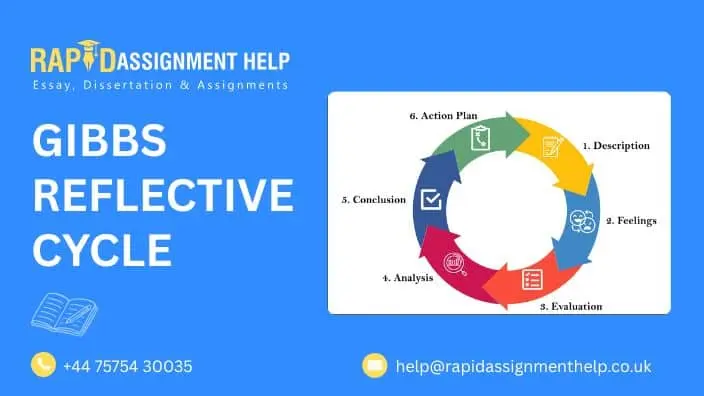
Gibbs reflective cycle is widely used because it provides a structured framework for reflection and decision-making. The model consists of six stages: description, feelings, evaluation, analysis, conclusion, and action plan. These stages guide users through a step-by-step reflective process that improves learning and future practice.
Description - What Happened?
The reflection cycle begins with the raw facts without interpretation or judgment. It has the goal of describing the cause.
Example
Feelings - What Were You Thinking and Feeling?
At the next stage, the reflector focuses on exploring the emotional response to the situation. While using the Gibbs model, emotional judgment is required.
Example
Evaluation - What Was Good and Bad about the Experience?
As defined by the name, here you assess what went well and what did not. This way, you do not think only of the negative or positive side of the incident.
Example
Analysis - Why Did it Happen?
Whatever the incident, you go a level deep to analyse why things happened as they did. This is when you link theory, practice, and professional standards.
Example
Conclusion - What Could Have Been Done Differently?
After the thoughtful reflection, the conclusion is the stage where you summarise key learning points. It includes the key insights gained from evaluating the incident.
Example
Action Plan - What Will You Do Next Time?
This is the stage when you truly make things happen based on whatever you assumed. By improving with the reflection, you make a step-by-step plan for future situations.
Example
By understanding these stages and their examples, you can also drive better outcomes. However, one thing to understand is that they are not just a textbook thing, but actually applied in real-life scenarios. Let’s see in the next section.
At first, the model was quite strange to understand. As people started seeing its impact on real-life scenarios, their perspective changed. Now it is widely used in most fields in this way.
Description: After spending a lot of time in my studies, I received a lower-than-expected grade, which made my mood go sour.
Feelings: I was so tense at first as I thought my results should be significantly better, according to my efforts.
Evaluation: When I received the feedback, it was highlighting the strong subject knowledge but criticised weak critical analysis and poor structure.
Analysis: After that, I realised that I focused more on describing theories rather than critically evaluating them.
Conclusion: I understood that understanding marking criteria and applying critical thinking are important for academic success.
Action Plan: For future assignments, I will review the marking rubrics carefully and seek assignment help for feedback.
Description: When I got into the hospital, a patient appeared distressed while I was explaining the routine procedure.
Feelings: Seeing that situation, I started feeling anxious and unsure about how to reassure the patient effectively.
Evaluation: Although the situation was managed safely, the patient remained visibly uncomfortable.
Analysis: Even though the procedure was followed correctly, I realised that my explanation lacked clarity.
Conclusion: Along with the procedure, effective communication and empathy are also critical components of patient-centred care.
Action Plan: For the future situations, I will practise therapeutic communication techniques and observe experienced nurses to improve patient interactions.
Description: In a recent meeting, a misunderstanding happened, which has delayed the task completion.
Feelings: That incident made me so tense about how the delay might affect the team’s performance.
Evaluation: Although the manager has resolved the issue, miscommunication has reduced the efficiency.
Analysis: After that, it was clear that the delay was caused by the fact that the expectations were not clearly communicated. Also, the assumptions were made without confirmation.
Conclusion: For better teamwork and effective outcomes, clear, structured communication is essential.
Action Plan: Next time, I will summarise the key points, ask for clarification, and confirm shared understanding among team members.
These are just a few examples, but the Gibbs reflective cycle has the same impact in multiple fields. Even if you are a student, you can use it for clarifying doubts and bring better results by evaluating past happenings. Now let’s have a look at how this model is different from others.
When it comes to Gibbs reflective cycle, many models appear similar, but they are not. One is Kolb's reflective cycle. In the chart mentioned below, let’s see how it is different or whether it is better than the Gibbs model:
| Aspects | Gibbs Reflective Cycle | Kolb’s Reflective Cycle |
|---|---|---|
| Primary Focus | Structured reflection on experiences | Learning through experience |
| Number of Stages | 6 stages | 4 stages |
| Emotional Reflection | Strong focus on feelings and emotions | Limited focus on emotions |
| Depth of Analysis | High, step-by-step evaluation | Moderate, concept-driven |
| Common Usage | Nursing, NHS practice, education, reflective writing | Training, management, skill development |
| Academic Suitability | Highly suitable for the UK assignments | Better for learning theories and training |
| Outcome | Action-focused improvement | Learning and experimentation |
After getting the big differences between the two, the question is which one is better? Well, neither model is universally better. Both have their own unique advantages that proven to be beneficial in different scenarios. Now, it's time to see the best and the downside of the Gibbs mode in the next part.
Till this point, the model seems to be very valuable, but at the same time, it also has its drawbacks. By understanding both the bright and the downside, you can use it properly without getting misunderstood. Here are its pros and cons:
| Pros | Cons |
|---|---|
| Offers a clear six-stage framework that anyone could follow | It has a fixed structure that can feel rigid for those who prefer open or creative reflection |
| Encourages emotional awareness by including a dedicated feelings stage and ethical reflection | Focusing on emotion feels uncomfortable or unnecessary for professionals |
| Reflection moves beyond description into evaluation, analysis, and learning. | Users may repeat similar points across stages if not applied correctly |
| Widely utilised in UK universities' assignments and revalidation | Less suitable for fast-paced or real-time decision-making situations. |
| Every scenario ends with an action plan, ensuring learning is applied to future practice | An action plan can be generic if not linked clearly to the analysis. |
| Highly valued model for reflective cycle, just like Argyle’s communication models and others. | If overused in assignments, it can feel formulaic, especially when originality is lacking |
This comparison is not to show that the model is not effective, but what you should keep in mind when using it. With a balanced approach, you can make the best use of it. Now it's time to end this blog with some useful key takeaways.
This page serves as the main pillar guide for understanding Gibbs Reflective Cycle, including its six stages, reflective writing structure, academic use, healthcare application, and practical examples. To provide more detailed learning resources, we have also created specialised pages related to nursing reflection, reflective essays, healthcare case studies, professional development, and public health assignments using Gibbs’ reflective framework.
This page is your go-to resource for understanding Gibbs Reflective Cycle. It covers the definition, six stages, how to structure reflective writing, examples, and how to use it academically. The links above take you to more focused guides on nursing reflection, critical incident analysis, and writing reflective assignments..
At the end of this blog, you might now be clear with the Gibbs reflective cycle and its effective use. This model has changed the thinking ability of people over time and supported them to avoid mistakes and come up with their best. However, it has some drawbacks, but you can surpass them by following these tips:
And if you are still feeling stuck using it or writing in your academic assignments, then we are here to support. At Rapid Assignment Help, you will find experienced experts who understand these models and guide you step-by-step. So, let the confusion go and make the model beneficial for you in real life.
Audrey Holsworth is an academic writer specializing in reflective practice, education, and professional learning. She produces student-friendly guides that explain reflective models and support academic writing across a variety of disciplines.
Writing a good Gibbs reflection can be simplified by following the right steps. It starts by emphasising all six stages in order and keeping a balance between analysis and description. For better use, begin by explaining the situation. After that, honestly describe your feelings with a critical evaluation supported by relevant theory. At the final step, summarise what you learned and finish with a realistic action plan.
Yes! Gibbs reflective cycle is suitable; in fact, it is widely used in clinical education to help nurses. Along with them, doctors and healthcare professionals also utilise the model for patient interactions, clinical decisions, and ethical situations. Its significance lies in its structured stages, which allow practitioners to analyse experiences, improve patient care, and enhance professional judgement.
Of course! The Gibbs cycle is effective in the workplace as it is required in meetings, projects, leadership decisions, and workplace challenges. These tasks focus on reviewing actions, evaluating outcomes, and creating an action plan. With the framework usage, employees and managers can improve communication along with performance. Also, it supports continuous professional development and practical learning for real experiences.
To make the conversation effective, you can start with these sentences:
These sentences help set a reflective tone and clearly signal critical thinking to examiners.
Get Extra 10% OFF on WhatsApp order!
use discountCopyright 2026 @ Rapid Assignment Help Services