SHN4023 Social influences on health and wellbeing Case Study
Explore behaviour change stages in diabetes management using Health Belief Model and Transtheoretical Model in Hasan’s case with cultural, social factors influencing wellbeing.
- Type Case Study
- Downloads3444
- Pages7
- Words1794
Introduction
The focus of this portfolio is to examine the use of the Health Belief Model (HBM) as a means to facilitate lifestyle behaviour change in Hasan, a 48-year-old man suffering from Type 2 diabetes, obesity and other health-related challenges. It will use the biopsychosocial approach to analyse their physical health, mental well-being, and the social situation of Hasan and its role in the present condition of his health and his chances for improving it with healthy behaviour. For students seeking help writing assignments, this case study provides practical application insights
It will review the model in detail, focusing on its major components and its strengths and weaknesses in forecasting and encouraging health behaviour change by using the model.
Subsequently, the application of the HBM to Hasan’s case will be explored, about his perceptions of health risks, barriers to change, and motivation levels about their ability to self-manage his diabetes, weight and smoking in the future.
Review of the Chosen Model
The Transtheoretical Model (TTM; Prochaska & DiClemente, 1983) is the most commonly used way of explaining how individuals come to change their behaviour. It argues that behaviour change is not happening in a flash but rather in stages (Del Rio Szupszynski & de Ávila, 2021). This model is particularly applicable to health-related behaviours such as smoking cessation, weight loss and diabetes management, which are key challenges that Hasan is dealing with.

 5 Years | PhD in Healthcare Management
The TTM comprises six stages through which people pass as they strive for sustained behaviour change. These stages include:
- Pre-contemplation (Not Ready)
- Contemplation (Getting Ready)
- Preparation (Ready)
- Action (Making a Change)
- Maintenance (Sustaining Change)
- Relapse (Setback)
Additionally, this model includes self-efficacy, decisional balance, and the processes of change and helps to explain why some people succeed and others struggle to keep healthy changes.
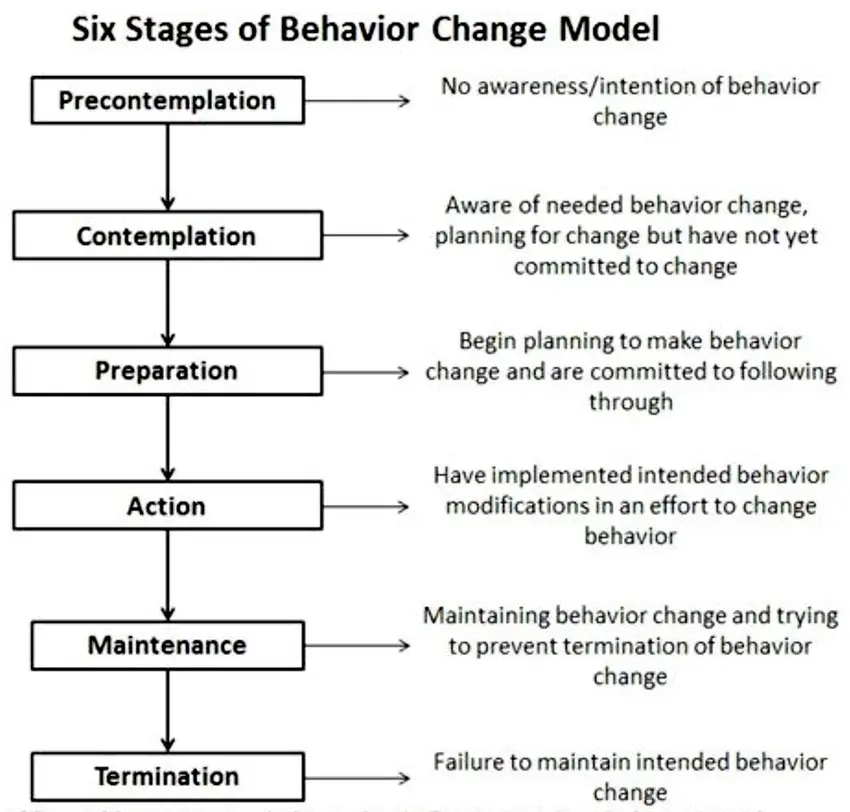
Figure 1: Stages of the model
Contemplation (Ready) – The individual has acknowledged a behaviour as unhealthy or detrimental and may believe that he or she needs to take action to repair the situation. Although Hasan knows his health risks, external stressors are too much for him to process, especially when it comes to making changes in his lifestyle.
Getting ready (Contemplation) – This stage is characterized by contemplating change but with ambivalence. Most think about the pros and cons and can be fearful – or sceptical – of their chances of success.
Ready to Act – The person is prepared to commit to making a change and the beginning of small steps heading towards healthier behaviours (Prochaska & DiClemente, 1983). It may cause them to begin searching for information, setting goals, or experimenting with small incremental changes. Although Hasan agrees to attend social prescribing sessions, and he now appears to be interested in learning about his diet, medication, and physical activity, he still needs structured support.
Making the Change (Action) – The person actively reforms his behaviour by adopting healthier food, exercising, and quitting smoking. This phase will have strong willpower, support systems and coping strategies.
Sustaining Change (Maintenance) – The individual works towards consolidating and maintaining their progress from the habit (reinforcing achievement) (Hawlader et al., 2022). Sustained new behaviours are at least 6 months, and strategies to maintain change are implemented. Support of Hasan would lead him to successfully control his diabetes, reduce smoking and adopt a healthier lifestyle.
Get assistance from our PROFESSIONAL ASSIGNMENT WRITERS to receive 100% assured AI-free and high-quality documents on time, ensuring an A+ grade in all subjects.
Setback and Reengagement – There are many individuals afflicted with relapse from the inability to unequivocally resist stress, external triggers, or a lack of support. Relapse is not, however, failure; it is part of the cycle of change whereby individuals can re-enter the process at an earlier stage.
Psychological Shifts Across Stages
Individuals undergo psychological shifts in any of these stages that contribute to their readiness for change (Liberati et al., 2021). People in the pre-contemplation and contemplation stages tend to be defensive, uncertain, or helpless in that they can change their behaviour. They become hopeful and determined to have control of their health in their direction toward preparation and action. Confidence is built up during the maintenance stage, but frustration, self-blame or demotivation may ensue when relapse occurs and is not managed (Semerari et al., 2021).
Processes of Change in TTM
These stages are driven by cognitive and behavioural progress, which results in a change. However, in the early stages, consciousness-raising is a crucial step, where the increased awareness of health risks and the benefits of change enable people to have new thoughts on their behaviour. Self-reevaluation motivates people to look at how they respond to the present and whether this response matches their convictions and goals to progress to setting and taking action.
Evaluation of Strengths and Weaknesses
Strengths of the Transtheoretical Model
The flexibility with which TTM can be applied to a broad spectrum of behaviours, such as smoking cessation, weight control, medication adherence and chronic disease management, is one of the primary strengths of TTM (Xu et al., 2024). Whereas rigid behavioural change models depict individuals as being impervious to failure, TTM recognizes that people gain progress on their own time and relapse intermittently before establishing sustainable success.
Another great advantage is that it can also personalize interventions by an individual's stage of change. By not using a one-size-fits-all approach, TTM offers healthcare providers strategies relevant to each individual’s readiness to change (Liu et al., 2024). TTM has been empirically shown to be effective in changing long-term behaviour, especially in smoking cessation, weight loss, and diabetes self-management.
Weaknesses of the Transtheoretical Model
Though TTM is strong, it has some limitations. However, one major criticism is that it assumes people go through the stages sequentially, which is fine if behaviour change is a simple linear process. Furthermore, people change their behaviour in a non-linear and unpredictable way (Iancu & Lanteigne, 2020). Stages are skipped, or people regress or cycle back from contemplation to action more than once before they stick with a new behaviour. For instance, Hasan may quit smoking temporarily when he opts to but relapses as a result of stress, signalling that real-world behaviour change is far from rigid.
Difficulties in Real-World Application
Behavior change does not happen in isolation so applying TTM in real-world settings can be complex. These significantly influence whether an individual can move through the stages successfully (Hawlader et al., 2022). In Hasan’s case, we see this: shift work, lack of financial stability, caregiving responsibilities, and lack of access to healthy food options are all kinds of obstacles that the model does not do much to address directly.
The cultural attitudes toward healthcare and lifestyle choices may also influence TTM’s effectiveness. For example, Hasan values family-based support more than external interventions, such that he may not be disposed to engage with professional services. If the model is applied where there is no such system in place, culturally relevant support systems, such as community health workers or religious-based wellness programs, could be added to the model to improve effectiveness.
Application to Hasan’s Case Study
Introduction to Hasan’s Lifestyle Behaviour
A 48-year-old taxi driver, Hasan, has diabetes, obesity, high blood pressure, and smokes. Because of his financial problems, shift work, and caregiving responsibilities, he cannot rank his health as a priority. He is aware of how sick he is but exhausted and unmotivated. However, he has attempted changes in his lifestyle but finds it difficult to be consistent. His resistance to seeking external support is also based on his cultural beliefs, but he gets spiritual and community support in his Mosque.
Justification for the Chosen Model
Hasan is a suitable person for the implementation of the Transtheoretical Model (TTM) because it takes behaviour change as a gradual process with possible relapse and setbacks. Unlike other models that consider that people make instantaneous decisions, TTM considers Hasan’s psychological readiness and applies the interventions to his stage of change (Liberati et al., 2021). The model also incorporates behavioural and cognitive strategies that are intended to be consistent with Hasan’s cultural and social context, such as community-based interventions at his Mosque for increasing motivation.
Application of the Model
Hasan realizes that he is at high risk for health, but he is not able to alter that. However, educational interventions might alleviate his confusion regarding diet, medication and smoking cessation. Motivational interviewing in contemplation can deal with his ambivalence by using family and religious values to bolster the benefits of change (Rosler et al., 2024). Before as part of pthe reparation, Hasan agrees to take part in social prescribing sessions and takes small lifestyle changes. This will make his transition easier with the help of a structured smoking reduction plan, peer support groups, etc. He started to do things in action that he could reduce smoking, his diet, and light exercise.
Conclusion
The Transtheoretical Model (TTM) provides a structured, adaptable framework to support Hasan in his health behaviour changes. Through TTM, individuals are recognized to be a non-linear, progressive behaviour change process, and personalized interventions are possible based on psychological readiness and cultural beliefs as well as lifestyle constraints.
Barriers to change include Hasan’s financial situation, caregiving responsibilities, and lack of motivation. On the other hand, as he goes through all the stages of TTM, he can practice small, sustainable modifications in smoking cessation, dietary habits and physical activity. Culturally sensitive community support, including (but not limited to) engagement with Mosque, led health initiatives and motivational interviewing as well as goal setting, can help to motivate him and reinforce long-term adherence.
References
- Del Rio Szupszynski, K. P., & de Ávila, A. C. (2021). The Transtheoretical Model of Behavior Change: Prochaska and DiClemente’s Model. Psychology of Substance Abuse, 3, 205–216. https://doi.org/10.1007/978-3-030-62106-3_14
- Hawlader, M. D. H., Mozid, N.-E., Sharmin, S., Monju, I. H., Ahmed, S. B., Sarker, W., Amin, M. A., Jhumur, S. S., & Dalal, K. (2022). The art of forming habits: applying habit theory in changing physical activity behaviour. Journal of Public Health, 31. https://doi.org/10.1007/s10389-022-01766-4
- Iancu, P., & Lanteigne, I. (2020). Advances in social work practice: Understanding uncertainty and unpredictability of complex non-linear situations. Journal of Social Work, 22(1), 146801732098057. https://doi.org/10.1177/1468017320980579
- Liberati, E., Richards, N., Willars, J., Scott, D., Boydell, N., Parker, J., Pinfold, V., Martin, G., Dixon-Woods, M., & Jones, P. B. (2021). A qualitative study of experiences of NHS mental healthcare workers during the Covid-19 pandemic. BMC Psychiatry, 21(1).
- Liu, J., Zhao, Q., Shen, Q., Meng, X., Zheng, Y., Lu, C., & Zheng, Y. (2024). Advances in theories and models of cardiac rehabilitation after acute myocardial infarction: A narrative review. Medicine, 103(51), e39755–e39755. https://doi.org/10.1097/md.0000000000039755
- Prochaska, J. O., & DiClemente, C. C. (1983). Stages and Processes of self-change of smoking: toward an Integrative Model of change. Journal of Consulting and Clinical Psychology, 51(3), 390–395.
- Rosler, N., Ori Wiener-Blotner, Orel Heskiau Micheles, & Sharvit, K. (2024). Understanding Reactions to Informative Process Model Interventions: Ambivalence as a Mechanism of Change. Behavioral Sciences, 14(12), 1152–1152. https://doi.org/10.3390/bs14121152
- Semerari, A., Pellecchia, G., & Carcione, A. (2021). The Therapeutic Relationship. Springer EBooks, 75–102. https://doi.org/10.1007/978-3-030-70455-1_6
- Xu, X., Zhang, G., Xia, Y., Xie, H., Ding, Z., Wang, H., Ma, Z., & Sun, T. (2024). Influencing Factors and Implementation Pathways of Adherence Behavior in Intelligent Personalized Exercise Prescription: Qualitative Study (Preprint). JMIR Mhealth and Uhealth, 12, e59610–e59610. https://doi.org/10.2196/59610
Recently Downloaded Case Studies by Customers
Bronchiolitis in Infants: A Nursing Care Analysis The investigation will focus on pharmacological administration, taking into...View and Download
Introduction Looking for top-notch assignment help? Our Assignment Help service provide expert support, ensuring high-quality,...View and Download
Introduction: Real-Life Case Study-Individual Report (CW1) Get free samples written by our Top-Notch subject experts for...View and Download
Introduction to Graze’s International Move into Switzerland Case Study Sample International marketing includes...View and Download
Introduction Human resource diversity [HRD] at the workplace is delineated as a crucial concept that is responsible for...View and Download
Chapter 1: Unilever's Path to Sustainability: Unilever's Sustainable Business Approach Sustainability plays a crucial role in...View and Download