
COIT11134 OOP Week 6 Lab sheet Assignment Sample
This assignment sample for COIT11134 OOP Week 6 Lab sheet from experts showcases the design and implementation of an Employee management system in Java, highlighting object-oriented principles like inheritance, abstraction, and polymorphism for effective real-world application modeling .

- Type Assignment
- Downloads2514
- Pages4
- Words1022
Introduction
The Java project “Employee Application” shows an example of utilising concepts in real-life situations in a more complex manner. This is a project that involves organizing the employee records by having a well-designed class. Therefore, it is intended to illustrate the possible approach to represent and control various types of employees due to their differentiation. This is a good project in the sense that it shows how programming concepts, which are used to create programs that simulate different aspects of employee handling, can be applied to define a structured approach to handling employee information. In summary, by following the realisation of this project, this paper has explained how Java programming language supports modelling of complicated large systems and dealing with pertinent data properly and efficiently and thus be a solution towards systematic management of the employees’ information.

 7 Years | MSc in Computer Science
Need urgent academic support? Rapid Assignment Help provides fast, reliable solutions for students across all subjects. Excellence is just a click away!
Task 1
The Employee class in Pratra’s COIT11134 OOP Week 6 Lab Sheet is designed as an abstract class representing general employee characteristics. It sets the foundation for subclassing various employee types with shared behaviours.
Employee Class
The Employee class is a first class created to be an abstract class through which all types of employees can be derived. Some of the key data that it incorporates are the first name of the employee, the last name of the employee, and the social security identifier number.

Get assistance from our PROFESSIONAL ASSIGNMENT WRITERS to receive 100% assured AI-free and high-quality documents on time, ensuring an A+ grade in all subjects.
Figure 1: Employee class
(Source: “Created by self in Eclipse”)
This class describes the general characteristics of the employees as well as behaviors that are characteristic of all of them. It contains the abstract method earnings() which needs to be implemented by any subclasses to determine their earnings depending on specified parameters. The benefits of the Employee class are that through the use of inheritance it imposes a definite structure and behavior yet maintains the ability to create more specific types of employees.
PieceWorker Class
That is why a new class, the PieceWorker, is derived from the Employee class and contains all the essential attributes connected with piecework, including the wage per piece and the production number of pieces.
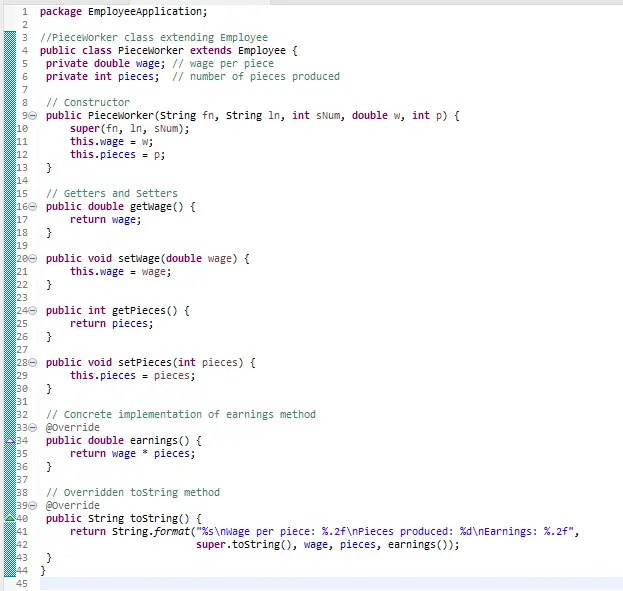
Figure 2: PieceWorker class
(Source: “Created by self in Eclipse”)
This subclass overrides the earnings() method from the Employee class in order to calculate total earnings from the above features. Using the PieceWorker class as an example they were able to showcase how different types of employees can have different ways of determining wages and how this concept can easily be expanded on the base Employee class structure.
Task 2
Pratra’s COIT11134 OOP Week 6 Lab Sheet features the PieceWorker subclass derived from Employee, implementing specific attributes like wage and production count, and overriding earnings() to calculate income based on piecework.
Employee Test class being a test driver, is specifically used to show the working of PieceWorker class in the overall employee management system. It creates different objects of PieceWorker that are different from each other and may have different name, social security number, wage, pieces worked etc.
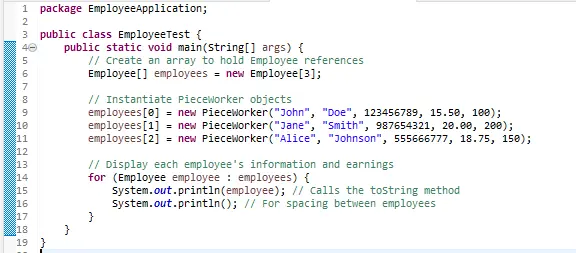
Figure 3: EmployeeTest class for testing
(Source: “Created by self in Eclipse”)
These are saved into an array which provide efficient way of handling or displaying employee details. The class then proceeds to go through the array, and call the toString() method that was implemented in the PieceWorker class to display full information about the worker, including the earnings which were calculated.

Figure 4: Output
(Source: “Created by self in Eclipse”)
This leads to the test driver of the employee management system and confirms its functionality through this specific test driver.
Conclusion
The “Employee Application in Java” project is excellent in that it directly shows how object-orientated principles can be used to design a usable system to control data on the employees. Thanks to the application of abstract classes and inheritance, the project clearly reflects a set of potential employee types and their remuneration. Common attributes and methods of the Employee and PieceWorker classes show that shared and specialised findings are applicable with different kinds of employees. This way, the project demonstrates the advantage of utilising Java for modelling real-life applications and making the development process efficient and the resultant application’s structure suitable for its further improvement.
Reference List
Journals
- Evans, B.J., Clark, J. and Flanagan, D., 2023. Java in a Nutshell. " O'Reilly Media, Inc.".
- Fatkharrofiqi, A., Kuswanto, H., Rahman, T., Handono, F.W. and Nurdin, H., 2020, November. Employee attendance application using location based service (lbs) method based on Android. In Journal of Physics: Conference Series (Vol. 1641, No. 1, p. 012044). IOP Publishing.
- Novelan, M.S. and Permana, A.I., 2022. Employee Presence Application System Using Android-Based Qr Code Reader. Jurnal Mantik, 6(2), pp.2280-2285.
- Zhang, X., Crabtree, J.D., Terwilliger, M.G. and Redman, T.T., 2020. Assessing students’ object-orientated programming skills with Java: The “Department-Employee” Project. Journal of Computer Information Systems.
Recently Downloaded Samples by Customers
Introduction - Ethics, Working Collaboratively And Values Assignment Sample Don't let complex assignments hold you back! Rapid...View and Download
Introduction to Impact of The Shortage of Healthcare Workers on Quality and Service Delivery in UK Background Health and social...View and Download
Task A: Understanding and Applying Learning Theories, Principles, and Models Students across the UK increasingly rely on expert...View and Download
1.0 Intoduction - Job Resources, Demand, and Their Impact on Anxiety and Burnout in Health Care Workers Assignment...View and Download
Introduction The purpose of this assignment is to evaluate the roles and responsibilities of healthcare workers, regulatory...View and Download
Introduction to Social Isolation And Stigmatization Assignment Analysis of current issues in health care There have been...View and Download