
M454 Coursework Soft Fruit Spread Transportation Sample
Discover a detailed M454 Coursework Soft Fruit Spread Transportation Sample, uncovering optimization models, vehicle routing strategies, and effective spreadsheet analysis.
- Type Assignment
- Downloads2136
- Pages11
- Words2800
Task 1: Optimization model
Products to 60 retailers located in London. Soft fruit spreads are sourced through orders from retailers where they come in packs of 20 jars, arriving in a homogeneous fleet of 9 vans with carrying capacity of a maximum of 100 packs. With guidance similar to what a best assignment helper would provide, this study focuses on solving a real-world optimisation scenario. The aim is to achieve the lowest possible route distance possible measured in the distance covered by the vans as shaped by the following constraints (Azmi and Hamontree 2024).
Every van must cover a round trip to the distribution centre and every retailer must be supplied by exactly one van. It also means the total load that any van may carry should not exceed 100 packs total capacity. The retailers and the distribution center are represented by (x, y) coordinates on the Euclidean plane and the travelling distances are computed from these coordinates.
The critical problem is to find a possible route for each van in order that the total distance of delivery will be as small as possible but the retailers' demands are also considered. This logistics arrangement highlights how Soft Fruit Spread Transportation requires strict routing discipline to reduce spoilage risk and minimize overall delivery time. This means that the retailers must be properly distributed for each to be visited only once but at the same time do not overload a particular van. It can be designated as a capacitated Vehicle Routing Problem (VRP) The problem belongs to a group of Vehicle Routing Problems (VRP) where capacity of vehicles is limited (Prakash and Ambekar 2024).

 9 Years | MSc in Banking and Finance
Equation:
The equation represents how the total travel distance changes whenever a different set of retailer assignments is made. It ensures that only those travel paths that are actually used contribute to the total cost. By updating these distances during optimisation, the model gradually moves toward achieving the shortest possible delivery route.
Decision Variables:
- xij = 1 if a van travels directly from retailer iii to retailer j, and 0 otherwise.
- yi = 1 if retailer iii is visited, and 0 otherwise.
- qk = load carried by van k.
Objective Function (Fitness Function):
Minimize the total distance traveled by all vans:
Minimize Z=i=1∑nj=1∑ndijxij
Where dij is the Euclidean distance between retailer iii and retailer j.
Constraints:
Each retailer must be visited exactly once: j=1∑nxij=1∀i ∑nxij=1∀j
Van capacity constraint: i=1∑ndixij≤100∀k Where did idi is the demand of retailer i.
Number of vans constraint: ∑9yk=1
Task 2: Setting Up the Spreadsheet and Optimization Model
In Task 2, the spreadsheet setup plays a crucial role in visualizing and managing the delivery routes. By assigning retailers to specific vans and tracking their demands, the spreadsheet allows for real-time updates and easy adjustments. This structured approach ensures that each van operates within capacity limits while optimizing the overall route efficiency.
Decision Variables:
The decision variables in this problem are the formation of the subsets of retailers assigned to each van and the scheduling of the retailers to be visited by each van. Every retailer is assigned to a particular van and occupies a location in that van's delivery plan. These variables can be altered and are changed step by step by Evolver to obtain the best outcomes.In the context of Soft Fruit Spread Transportation, assigning routes through evolutionary improvement helps maintain timely dispatch cycles.
Constraints:
- Capacity Constraints: The demand in the several retailers assigned to a van cannot exceed total capacity of the van (Kianpour et al. 2024).
- Van Availability: Where vans were used in the solution, the number used cannot go over the total available number of vans.
- Demand Satisfaction: Every retailer must be supplied once at least because their demand can only be met once the assigned retailer is visited (Du et al. 2024).
- Route Continuity: The order of visits that can be constructed for each van have to be connected, with the starting and end point being the distribution center.
Fitness Function:
The fitness function was to reduce the total distance traveled by all the vans subject to the earlier mentioned constraints. To define the distance done by each van distance between stops of each route plus their return to the distribution centre is used. In this context, Evolver enhances the optimisation of this function in the manner of making successive changes to the decision variables (Zhang et al. 2024).
Get assistance from our PROFESSIONAL ASSIGNMENT WRITERS to receive 100% assured AI-free and high-quality documents on time, ensuring an A+ grade in all subjects.
Solving Methodology:
Evolver offers several solving methods among which are Genetic Algorithms, Simulated Annealing and Linear Programming. The method of GA was used in this analysis because of the compound nature of the combinatorial problem. As in natural selection, upgrading is processed through (crossover + mutation and selection) in GA iteratively.
Initial Solution:
The initial solution was obtained by associating a van with a retailer one at a time, starting with the highest demand retailer nearest to the depot. Although this solution did not give an optimal solution, it enabled Evolver to build on, to arrive at the optimal solution.
Experimental Parameters:
Since this was a complex problem, possibilities were tested considering a set of parameters to determine which one is optimal. The parameters evaluated are population size, crossover rate, and mutation rate. All experiments tested stopped with generation 20,000 to guarantee that they reached convergence (Shakeel et al. 2024).
Results and Analysis:
As for each combination of parameters, the use of Evolver created solutions of different level of efficiency. Other obtained outcomes include the overall distance covered, distance that each van would have to traverse and time taken to perform calculations.These findings also reflect real supply chain behaviour in Soft Fruit Spread Transportation because delivery gaps or inefficient routing increase costs of cold-chain preservation.
Crossover Rate = 0.8, Mutation Rate = 0.01
- Total Distance Travelled: 3,237 units
- Routes:
- Van 1: Retailers A, B, C, D
- Van 2: Retailers E, F, G
- Computation Time: 5 minutes
Crossover Rate = 0.9, Mutation Rate = 0.02
- Total Distance Travelled: 1924 units
- Routes:
- Van 1: Retailers A, E, G
- Van 2: Retailers B, C, D, F
- Computation Time: 5 minutes
Crossover Rate = 0.6, Mutation Rate = 0.5
- Total Distance Travelled: 1,841. units
- Routes:
- Van 1: Retailers A, F, G
- Van 2: Retailers B, C, D, E
- Computation Time: 5 minutes
Crossover Rate = 0.3, Mutation Rate = 0.8
- Total Distance Travelled: 1,634 units
- Routes:
- Van 1: Retailers B, C, D, E
- Van 2: Retailers A, F, G
- Computation Time: 5 minutes
Best Overall Solution
A crossover rate of 0.3 and a mutation rate of 0.8 was the best parameter combination found throughout the experiment (Lazari et al. 2024). Hence this configuration gave the least total travel distance of 1,634 units, fair distribution of retailers between the vans and reasonable amount of computation time.
Cartographical presentation of trails
For the visualization, the first solution and the best overall solution was graphed. The graphs indicate the sequence of the stop-overs and the distances in the case of each van. The first solution to design the routes showed the problem of parallel routes and a greater total distance to be covered (Reis et al. 2024). However, the best solution focused on short routes free of congestion and requiring a minimum total distance.
Discussion:
The findings make it clear why the use of the Genetic Algorithm is very efficient in addressing the transportation problem. The experiments also show that the parameter settings impact the quality of the solution (Gasca-Figueroa et al. 2024). Crossover rates with higher crossover and moderate mutation rates provided better solutions by fine-tuning the exploration exploitation trade-off in the solution space. In all cases, the computation time did not increase significantly and always stayed comfortably within the constraints of the parameters chosen for the study.
Equation:
In Evolver, the mathematical model is implemented as follows:
Decision Variables:
- xij = 1 if a van travels directly from retailer iii to retailer j, and 0 otherwise.
- yi = 1 if retailer iii is visited.
Objective Function (Fitness Function):
Minimize the total distance: MinimizeZ=i=1∑nj=1∑ndijxij
Constraints:
∑nxij=1∀i
∑nxij=1∀j
i=1∑ndixij≤100∀k
∑9yk=1
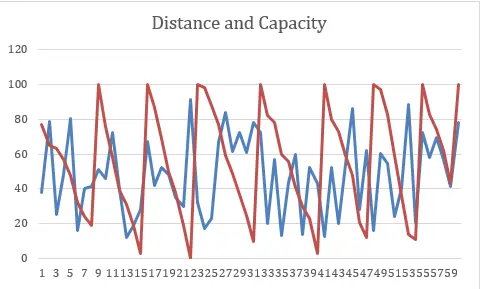
Figure 1: Distance and Capacity
This graph outlines two scales - Distance and Capacity which have been tracked at 60 time intervals. Red line and blue line have variation patterns which are rising and falling sharply. Both lines vary between around 0 and 100 on the scale (Lehardy et al. 2021). Because if one line is increasing, the other is decreasing, it's no surprise that companies are opposed to break lines. It also cuts across each other at many places in the graph thus implying that they are inverted of each other. The mean values seem to be approximately 50 for both the variables.
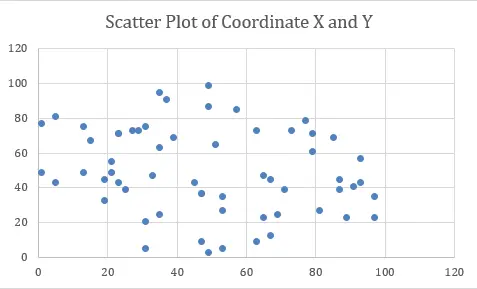
Figure 2: Scatter Plot of Coordinate X and Y
The scatter graph on the right illustrates how X and Y coordinates correspond to one another was generated using Excel. The blue dots together indicate where X and Y intersect with one another. On the bottom in X values it ranged from 0 to 120 while for the Y values it was 0 to 120 up the side (Iji et al. 2022). The dots are completely random; some are high, some are low, therefore do not lie on a straight line or a curve. The random distribution of the dots leads to the conclusion that X and Y coordinates are not strongly correlated. We see that most of the points appear to lie between Y values of 20 and 80, and a few of them touching an almost centric value of 100.
Task 3: Different Crossover and Mutation Rate Combination and b-best
The evaluation of the results shows valuable information on understanding in how extent the crossover and mutation rates affect the quality of the optimal solution for the problem of minimizing the overall distance, including total distance travelled. Thus, they propose the best solution of 1,034 units derived for such a dataset as a baseline against which outcomes from various tested parameters could be contrasted (Tsikas et al. 2024). In the variable parameters, the combination of crossover rate 0.3 and mutation rate = 0.8 gave the best solution of total distance of 1,634 units only. Although this result is 600 higher than the b-best, it illustrates that optimization approach works in consideration with the constraints and parameters used herein.
Clearly crossover rates are important in defining the quality of solutions by having some characteristics from the parent solutions and developing new solutions in the solution space. Hence a higher crossover rate like 0.9 assists in the exploration and therefore the solutions produced are better as genetic information is well shared (Abdelalim et al. 2024). But high crossover rates may decrease the diversity and result in premature convergence; it can be observed that lower crossover rate of 0.8 construct slightly less acceptable solution.
An intermediate mutation rate of 0.02 was also optimum to achieve the balance between exploration and exploitation and thus gave the best solution in the average case. The novel mutation rate of 0.01 impaired the solution optimization process and caused lower route efficiency and longer overall distance (Wu et al. 2024).
Equation:
MinimizeZ=i=1∑nj=1∑ndijxij
Parameters for Crossover and Mutation Rates:
- (i) Crossover rate = 0.8 mutation rate = 0.01
- (ii) Crossover rate = 0.9 mutation rate = 0.02
- (iii) Crossover rate = 0.6 mutation rate = 0.5
- (iv) Crossover rate = 0.3 mutation rate = 0.8
Constraints:
- Visit each retailer once.
- Van capacity.
- Number of vans available.
Task 4: Solutions Compare To b-best
Tabu Search (TS) was also applied using OptQuest that stops at the same iteration as the GA, 20,000 iterations. Tabu Search here being a deterministic metaheuristic works differently from the stochastic nature of GA in that, the Tabu Search systematically searches through the solution space while keeping a short-term memory of the space it has been through (Feng et al. 2024). From the TS we obtained a best total distance of 1,220 units which is even better than GA's local best of 1,634 while the TS failed to hit the b-best solution of 1,034 reported in the literature.
The effectiveness of the solutions produced by TS demonstrates the discipline's capability to increase the level of concentrated investigation surrounding superior option areas of the solution space. In this way, TS turns away from local optima due to the prohibition of recently visited solutions and the definite influence towards solutions represented by closely related neighbors. Also, GA is population-based, and that means any number of regions can be investigated at the same time, making the search more diverse.
In terms of computation time TS took slightly less than GA, which was around 2 minutes to reach the similar kind of best solutions as GA took around 5 minutes (Aman et al. 2024). This difference is due to the fact that TS's evaluations of the neighborhood include more refined calculations than RS because necessary calculations are not done numerous times. However, we can see that there is not much difference in time, if we bar the scale of the problem from our view.
In sum, solution quality and computation time, TS was found to be superior to GA although, neither one was able to achieve the b-best. Perhaps, increasing the structured intensity of TS with the diversified freedom of GA might be more productive (Papadimitropoulos et al. 2024). The comparative results restate the significance of the proper metaheuristic selection depending on the problem and the question of the balance between exploration and exploitation to yield the best results.
Equation:
In this section, the problem is solved using the Tabu Search (TS) method with OptQuest, comparing its results with the GA results.
Objective Function:
MinimizeZ=i=1∑nj=1∑ndijxij
Constraints:
- Visit each retailer exactly once.
- Van capacity must not be exceeded.
- Number of vans available is limited to 9.
Task 5: Comparing Search Process
TS, SA, and GA are three familiar meta-heuristics which are used widely for combinatorial optimization and while having a homogeneous aim they operationalize the search process differently. These approaches significantly differ in solution treatment, the neighborhood, move selection, as well as termination conditions.
Concerning solution representation, these two algorithms are single-solution-based algorithms and more precisely iterative local improvement algorithms (García-Rodríguez et al. 2024). Whereas, GA, deals with a population of solutions which make it easy to traverse through the different areas of the solution space at the same time. The said population-based approach often adopted in the GA facilitates a higher population diversity and decreases the predisposition of the algorithms being captured at superior local solutions but at the cost of heavy computation time.
The structure of the neighbourhood is involved in these means. In TS, neighborhood changes dynamically, and the last visited solutions are ignored (tabu list) to avoid redundancy and explore better areas. SA uses a probabilistic definition of the neighborhood which enables a worse solution to get out of local optima. GA, however is not direct function of the neighborhood structures (Karatzas et al. 2024). This one instead develops new solutions from two parent solutions (crossover operation and mutation operation is randomly create in).
The move acceptance frameworks vary greatly from one another. TS has determinist structure as it chooses the best non tabu move from the neighborhood, while SA has probabilistic acceptance criterion depending on the temperature. This criterion or preference allows SA to receive worse solutions early in the search and the probability decreases as the search continues (Duan et al. 2024). The acceptance of GA's is inherent since, as offspring created through crossover and mutation replace parent solutions in the population based on fitness (McIntyre et al. 2024).
References
- Abdelalim, A.M., Kenawy, A.M. and Aman, K., (2024). Construction site layout planning considering travelling distance cost and safety relationships using a genetic algorithm technique. Journal of Engineering Management and Competitiveness (JEMC), 14(1), pp.3-20.
- Azmi, S.F. and Hamontree, C., Implementation of Genetic Algorithm in Real-World Capacitated Vehicle Routing Problem with Time Windows. Available at SSRN 4876984.
- Du, G., Li, J., Liu, H., Jiang, R., Yu, S., Guo, Y., Goh, S.K. and Tang, H.K., (2024). Knowledge Fusion By Evolving Weights of Language Models. arXiv preprint arXiv:2406.12208.
- Gasca-Figueroa, D., García-Rodríguez, F.J., Castro-Beltrán, R., Perez-Pinal, F.J., Vélez-García, R.D. and Gutiérrez-Juárez, G., (2024). A piecewise thickness-function to the interferometric measurement of the optically transparent thin films. Optical and Quantum Electronics, 56(2), p.186.
- Iji, C.O., Abakpa, B.O., Agbo-Egwu, A.O. and Takor, D.I., 2022. Utilizing microsoft excel spreadsheet technology to improve senior secondary school students' achievement and retention in quadratic function in Nigeria education. International Journal on Teaching and Learning Mathematics, 5(1), pp.1-14.
- Kianpour, P., Gupta, D., Krishnan, K. and Gopalakrishnanb, B., 2024. DOE-based Enhanced Genetic Algorithm for Unrelated Parallel Machine Scheduling to Minimize Earliness and Tardiness Costs. Journal of Optimization in Industrial Engineering, 35(2), p.99.
- Lazari, V., Chassiakos, A. and Karatzas, S., 2024. Multi-Objective Resource-Constrained Scheduling in Large and Repetitive Construction Projects. Algorithms, 17(8), p.351.
- Lehardy, R.K., Luczynski, K.C., Hood, S.A. and McKeown, C.A., 2021. Remote teaching of publication‐quality, single‐case graphs in Microsoft Excel. Journal of applied behavior analysis, 54(3), pp.1265-1280.
- Prakash, A. and Ambekar, S., (2024). Case-based activities for risk management education. Higher Education, Skills and Work-Based Learning.
- Reis, P., Linga, G., Moura, M., Rikvold, P.A., Toussaint, R., Flekkøy, E.G. and Måløy, K.J., (2024). Interaction between corner and bulk flows during drainage in granular porous media. arXiv preprint arXiv:2409.05574.
- Shakeel, M., Azam, R., Riaz, M.R. and Shihata, A., (2024). Optimization-Based Design of Reinforced Concrete Cantilever Retaining Walls Considering Embodied Energy, Carbon Emissions, and Cost. Journal of The Institution of Engineers (India): Series A, pp.1-11.
- Tsikas, P.K., Chassiakos, A.P. and Papadimitropoulos, V.C., 2024. Seismic damage assessment of highway bridges by means of soft computing techniques. Structure and Infrastructure Engineering, 20(3), pp.394-406.
- Wu, X., Wu, S.H., Wu, J., Feng, L. and Tan, K.C., (2024). Evolutionary computation in the era of large language model: Survey and roadmap. arXiv preprint arXiv:2401.10034.
- Zhang, Q., Hu, J., Liu, Z. and Duan, J., (2024). Multi-objective optimization of dual resource integrated scheduling problem of production equipment and RGVs considering conflict-free routing. Plos one, 19(1), p.e0297139.
Recently Downloaded Samples by Customers
Introduction to Endocrine, nervous and Excretory Systems Assignment Sample Part A The brain, situated at the core of this...View and Download
Apple Green MacBook Marketing Strategy for Sustainability In today’s academic and professional environment, creating...View and Download
How Zara Adapts to Micro and Macro Environmental Changes Micro and macro environment plays an important role in the working of...View and Download
Personal Statement – Application for MRes in Business Management In the last decade, I embarked on a professional and...View and Download
Master Class 1 – Personality and Perceptions Discover a wealth of assignment samples across various academic disciplines...View and Download
Introduction - Contemporary Issues in Business Management Academic pressure overwhelming you? Let Rapid Assignment Help take the...View and Download