+44 75754 30035 help@rapidassignmenthelp.co.uk
offer
🎁Special Offer 🎁 Discounts - Up to 50% OFF!
🎁Special Offer 🎁 Discounts - Up to 50% OFF!

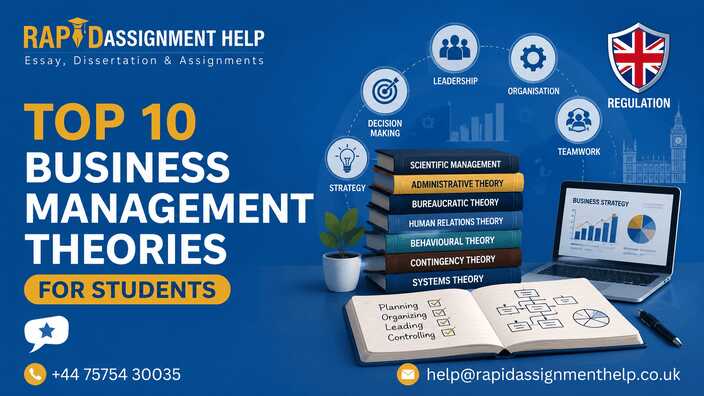
You might want to secure better positions at companies that will propel your career into leadership roles. However, it cannot be done without building that mindset and for that, knowing business management theories is crucial. The definition is more than with foundational frameworks of ideas, principles, and practices.
It is about the core of its significance and role in 2026, which we will discuss. So hold your attention for a while and dive into the learning of key management theories for a great career. Without wasting any moment, let’s get into it.
Management theories are not just a discipline, but it is more than that. It sets a strong foundation for students to develop their managerial skills. They are backed with analytical frameworks for problem-solving and understanding to navigate dynamic workplaces.
Well, you will surely deliver better assignment work and perform in the exam by learning these theories. In simple terms, you can demonstrate how human behaviour in workplaces works, make stronger decisions, and move easily towards application. That’s about the performance, but you are also preparing yourself for better future outcomes, which could be in interviews or managerial roles.
As of 2026, these skills are in demand and by improving knowledge in this field, students adapt to the flow. However, you know that business management has two major theories that set the foundation for making business learning effective. Let’s explore in the next section.
Management is a dynamic field where your every action relies on the situation and the required output. When you are making any business decision, make sure they are according to classical and modern theories. But before applying any, it is necessary to have their knowledge, which is mentioned below:
The theory takes a role as the foundational business philosophy that focuses on organisational efficiency, clear hierarchies, and standardised processes. It key facets are:
This theory came into place in the mid-to-late 20th-century. It focuses are integrating technology, statistical analysis, and human motivation. One of its core facets is:
Both theories have their different scope, adaptability, and core assumptions. When your goal is to achieve consistency, speed, and error reduction, use classical theories. On the other hand, modern theories take place when there is a need for innovation, problem-solving, and adaptability.
These were the two core management theories, but you know there are many. Let’s cover them in the next section.
Mastering business management assignments in academics can be complex, but you can still do your best. The solution is having an understanding of its different theories. For your knowledge, we have listed some of the major ones:
Principles of Administrative Management
This piece of management theory works on a universal blueprint that focuses on effective leadership. It is used by professionals to map out clear organisational charts, departmentalise teams, and allocate resources. With its impact, the framework is beneficial in maximising efficiency and minimising conflicts.
Systems Theory
It views organisations as interconnected systems where changes in one area influence the entire organisation. For troubleshooting the entire chain workflow, standardising global operations, and communication, this framework is utilised. Over the period, it helps to increase efficiency and supports better decision-making.
Learning Organisation Theory
The standard success of the company highlights learning, growth, and knowledge-sharing. It is used by companies to maintain the change, individual mastery, and to identify and refine assumptions. For adaptability, acceleration in problem-solving, better knowledge retention, and higher employee engagement, the model is beneficial.
Bureaucratic Management
This framework also works upon strict hierarchy, standardised rules, and merit-based advancement. Its core principles revolve around breaking work into small tasks, maintaining the workflow, and taking objective decisions based on facts. In large corporations like government agencies, military organisations, and health and education, the framework is prioritised.
Scientific Management
Frederick W. Taylor was the person who developed this framework. He has used science, mathematics, and engineering for an effective workflow. Now the framework is used in assembly line production, task analysis, and quality control. With its application, the model increases productivity, optimises resource allocation, and personalises management.
Contingency Management
One of the frameworks of business management that talks about the unique internal and external factors for optimal management. It is used for tailored organisational structures, matching the leader's style, and organic structures. Its major benefits are the flexibility and adaptability it provides in dynamic markets.
Quantitative Management
For the complex logistical problems, this theory is utilised, which is driven by mathematical models and statistical analysis. The model is useful for data-driven precision and resource efficiency, but it still has some limitations. It struggles to quantify behavioural factors and sometimes becomes imperfect with chaotic business environments.
Theories X and Y
Social psychologist Douglas McGregor developed this model of management theory for workforce motivation. While Theory X comes with an authoritarian approach used in strict standard operating procedures, Theory Y works differently. It applies in the creative fields and dynamic corporate environments.
Human Relations Theory
The origin of this framework dates back to the 1920s, when Elton Mayo used it to counter the scientific management. In many ways, such as group work encouragement, nurturing two-way communication, regular acknowledgement, and support leadership, this framework is beneficial.
Behavioural Management Theory
As the name suggests, this framework is based on the human dimension of work. In a company culture, this comes with the advantage of making the workflow smoother. It works on participative decision-making, offering rewards, and developing leadership. This is what leads to higher employee retention, productivity,
Till now, you might have gained knowledge of business management and its different theories. However, if you are still stuck completing its projects and looking for management assignment help, the final section is a must-read for you.
To wrap up, business management theories are what set a strong foundation for the subject. It is not just effective in studies but also helps students develop managerial competencies. As a student, whether it is completing academic tasks or building a strong career, these theories give you support.
In this blog, we hope you have gathered the knowledge you were looking for better academic work. However, projects on this subject can be tougher, and that’s when Rapid Assignment Help UK brings their professionals support. Improve your learning in the managerial field with confidence when there is a supportive hand available for you.
Andrew Fairfax is a business education writer who specializes in management, organizational behavior, and leadership studies. His articles break down complex theories into practical insights for students and aspiring professionals.
.
Get Extra 10% OFF on WhatsApp order!
use discountCopyright 2026 @ Rapid Assignment Help Services