Project Management Plan for Barclays Digital Banking in London : A Case Study
Project Management Plan for Barclays Digital Banking in London : A Case Study reviews project objectives, resource planning, risks and delivery stages.
- Introduction
- Company background and challenges
- Background of Barclays
- Challenge to Address
- Project aims, objectives and expected benefits
- Project Aims
- Project Objectives
- Expected Benefits
- Outline Business Case
- Option 1: Complete In-House Development
- Option 2: Hiring a Development Specialist
- Choice 3: Hybrid
- Investment Appraisal
- Project Approach
- Stakeholder Management Plan
- Internal Stakeholders
- External Stakeholders
- Engagement Strategy
- Power/Interest Mapping
- Team Organisation
- Project team structure
- RACI Matrix
- Schedule and critical path
- Schedule
- Critical Path Analysis
- Risk register
- Type Case Study
- Downloads543
- Pages14
- Words3389
Introduction
The project involves developing a detailed project plan for Barclays, one of the world's most successful multinational banks with its headquarters in London. An objective of the study is to research and implement project management principles in a situation at Barclays, such as the introduction of a new service or the implementation of a business change program. The overall goal is to create a clear and focused project plan, which will solve one of the many crucial challenges that the organization is currently experiencing, which can use digital banking better, or offering better customer service procedures. The plan will include project objectives, goals, and merits, as well as a strong business case. In addition, these appropriate project methodologies, stakeholder management strategies, organizational structures of the team, scheduling including critical path analysis, and a formal risk register will be incorporated into the study.
Struggling with tight deadlines? Assignment Help For Students from Rapid Assignment Help UK delivers well-researched, expertly written papers on time, every time.
Company background and challenges
Background of Barclays
Barclays is a universal bank based in London and it is a British multinational. It has its operations in more than 40 countries and has 83,000 employees all over the world. The structure of the bank takes the form of two major divisions; Barclays UK and Barclays International. Barclays UK deals in personal banking, business banking, and wealth management. Barclays International provides corporate banking and investment banking services as well as international cards and payments. Barclays has one of the oldest histories since the year 1690. It is known as an innovative banking organization, the first to introduce ATM and touchless payments in the UK. The bank has numerous clients across the globe and Europe, the Americas, Africa, and Asia and the bank maintains a great position in all these markets. The organization is intensively investing in technology and digital transformation aiming at customer experience improvement, operational efficiency and better cybersecurity(Barclays, 2025).
Challenge to Address
Barclays is increasingly under threat from digital-only banks and fintech companies. These rivals provide very customized, quick, and easy-to-use online banking services. With the changing customer expectations, conventional banks such as Barclays will be forced to change fast to maintain and expand the number of their customers. It is a challenge to modernise its digital banking platform to deliver smooth, safe, and innovative services. Although it has taken strides in being digital, there are still loopholes in customer experience, the velocity of digital transactions, and system convergence. Internal constraints also followed Barclays with legacy IT systems, pressure to comply with regulations, and the necessity to upgrade the level of skills of its staff to cope with sophisticated digital systems. All these factors are important in remaining competitive. The project is concerned with the idea of updating the mobile banking application provided by Barclays by adding more personal finance features powered by AI, quicker transaction times, and better usability features. This will make Barclays reach the top of digital banking and raise customer satisfaction and loyalty (Ainous & Nouichi, 2024).
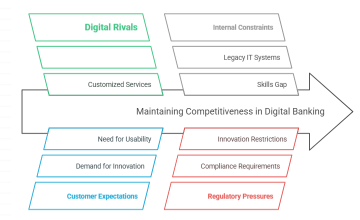
Figure 1: Challenges in Barclays Digital Transformation
Source: (Ainous & Nouichi, 2024)
Project aims, objectives and expected benefits
Project Aims
The main objective of this project is to design and build a complete overhaul of the mobile banking application of Barclays. Its emphasis is aimed at making the process of doing business more pleasant by implementing the most sophisticated AI-based financial solutions, making transactions faster, and offering an easy-to-use, ergonomic interface. The project is likely to serve as an effort to make Barclays one of the most renowned digital banks, which will be able to compete with fintech companies and digital banks effectively. The project is also supposed to merge the enhanced application with other Barclays online services, to make it a single platform. This will make sure that the customers enjoy accessibility to all banking facilities in one environment at any time (Dewasiri et al., 2023).
Project Objectives
- The first goal is to launch AI-powered personal finance features that provide customers with individual spend analysis, budgetary proposals, and forecasted financial intelligence. This will enable the user to make sound financial decisions.
- The second major goal will be to maximize the speed of transactions in the application. This is aimed at supporting instant payment and money transfer as well as making the process of loan application speedy, as it delays the satisfaction of the current customers.
- Another significant goal is to improve the user interface. The new interface will be geared toward user-friendliness, accessibility, and the content that is easily seen so as to make transactions in the bank using this new interface easier for everyone.
- Strong security controls are also necessary. The project will use biometric authentication, fraud detection, and encryption to secure customer records and transactions.
- The project also seeks to enhance back-end connectivity with core banking systems at Barclays to facilitate the seamless operations of the platform, irrespective of the usage rates (Dinçkol, 2021).
Expected Benefits
Customer satisfaction is likely to increase as a result of providing more customized and efficient services within the project. With this, the customers will gain improved financial management functionalities and their money will be accessible to them faster. Barclays will gain higher customer retention and acquisition, especially the tech-savvy (including younger) clients who value digital services more. Another major advantage is the issue of operations. Automation of some processes will decrease manual processes and save funds, resulting in correct service delivery. Improved security will help develop more confidence in the customers, decreasing the cases of fraud and breach of information. The integrated system will also give Barclays useful information, future ability of product creation, and customer-related marketing operations (Figura et al., 2025).
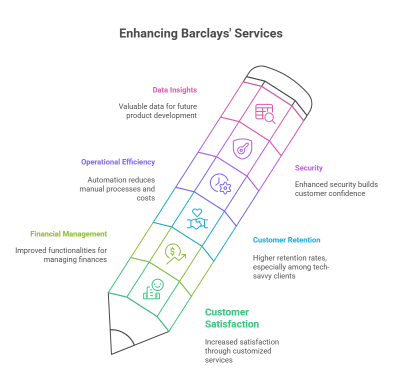
Figure 2: Expected Benefits
Source: (Figura et al., 2025)
Outline Business Case
Barclays strives to improve its mobile banking application to achieve customer satisfaction and digital competitiveness. This sort of project is a huge investment in terms of technology, developmental platforms, and security infrastructure. The justification of this quality of investment needs to involve a clear business case.
Option 1: Complete In-House Development
In this one, proceeding to develop the app upgrade fully with the use of the in-house IT staff and resources of Barclays is done. It is offering complete control in terms of design, security, and customization. Nevertheless, the latter alternative is very time-consuming, involves special competencies, and increases operational expenses. It can also cause project delays, particularly, in the case of complicated legacy systems (Gaviyau & Godi, 2025).
Option 2: Hiring a Development Specialist
In this strategy, the Bank would collaborate with a third-party fintech developer firm. It shortens the development cycle, provides access to senior knowledge, and has the potential to reduce initial expenses. It can however minimize the production over the result and one is sceptical of the data bucket and compliance (Karangara, 2023).
Choice 3: Hybrid
This is a combination of in-source project management and security framework, and outsourced app development. Barclays would keep important elements such as data protection on their side but focus on interface design and AI tools using external resources. This provides equal prices, quicker supply lines, and more flexibility (Kheterpal, 2024).
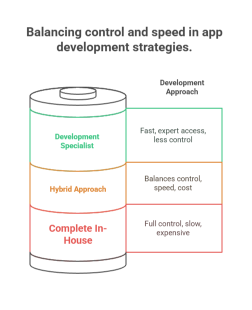
Figure 3: Outline Business Case
Source: (Kheterpal, 2024)
Investment Appraisal
Alternatively, depending on a cost-benefit analysis, a hybrid approach will come out as the most viable. Since the full in-house option is expensive and time-consuming, it offers a high level of control. Outsourcing can be cheaper and it is prone to data secrecy. The hybrid model is economically moderate, the delivery is faster and the security levels are okay. The expected ROI will be; additional use of its customers, lower costs in operation due to automation as well as the competitive nature of the market (Li, 2021).
Project Approach
The Agile methodology is selected as the approach to the chosen project of this initiative. Such a decision has been influenced by the challenge of flexibility, constant improvement, and speed of delivery in a highly dynamic digital banking environment. Agile is more concerned with production time in iterative cycles, sprints, making it possible to provide feedback, changes, and bring value to the project in more frequent instalments. It encourages teamwork among developers, designers, stakeholders, and end-users in cases where the project should be consistent with changing customer requirements and technological changes. Agile is also very appropriate in this software project since there is a lot of customer expectation, and iterative changes need to be made regularly. It enables Barclays to release small and viable chunks of the improved mobile app within brief durations. It allows releasing key features, like AI-driven finance tools and other improved security protocols, much faster than after the launch has occurred (Ogundipe & Odejide, 2024). Agile allows identification and mitigation of risk early as well. The problems may be identified in time through the constant testing and participation of the stakeholders and eliminated. This is especially useful to Barclays seeing that the regulatory framework involved is tough, and the requirements of cybersecurity are intense. An Agile Scrum framework will be used, which would involve distinct roles of Product Owner, Scrum Master, and Development Team employees. The priorities will be laid down by the Product Owner, and the Scrum Master will tend to the process to clear the way of the possible obstacles and facilitate the progress through the sprint. Reviews of sprints will comprise retrospectives and will be for two weeks. Through this process, it will be easy to track the progress and get regular input from the stakeholders to make sure that the solution is user-centric. Innovation is also advocated through this methodology. Programmers and designers, as well, will be able to test innovative solutions in limited spaces before mass implementation. Furthermore, Agile enables Barclays to respond to the changes and new customer demands occurring in the market, and it makes the project more flexible and adjustable to the changes (Roy & Basu, 2021).
Finally, Agile, especially the Scrum framework is responsive to the objectives of Barclays which are to be swift in delivery, customer-oriented architecture, and continuous improvement. It will provide quality results and flexibility, which will eventually provide support to the bank's bright ambition of being a leader in digital banking innovation.
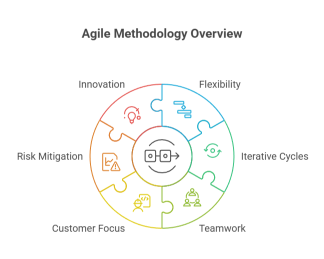
Figure 4: Agile Methodology Overview
Source: (Roy & Basu, 2021)
Stakeholder Management Plan
The management of stakeholders is an important component of the successful implementation of the Barclays mobile app upgrade project. The plan will recognise the main stakeholders, gauge their influence and interest, and develop engagement activities that secure the translation of their needs and expectations.
Internal Stakeholders
High power and interest are synonymous with the Senior Management. They do approvals of budgets, determine strategy, and ensure that there is alignment with corporate objectives. Key communications like regular progress reports, strategic updates, etc. will inform them. The Power and interest are high in the IT Department. They are not only involved in system integration but also technical development. An ongoing process of cooperation by means of daily stand-ups and technical reviews is relevant to staying on track. The power of the Compliance and Risk Team is moderate to high and is characterized by moderate interest. Regulatory compliance and data security are the major concerns of their major concern (Virk, 2025). They would need updates and participation at the stages of security testing. The Customer Support Team is a little concerned and a little strong. They will be dealing with customer problems after it is launched and must be trained and briefed regularly about the new features.
External Stakeholders
Interest among the customers is high and power is low. They are the business users of the app and this is why feedback from them is essential to designing the user-friendly features. Their feedback will be registered in surveys of the users, as well as beta tests, run throughout the project. The fintech development partners are highly interested and powerful, particularly under the hybrid development model. They need well-defined project scopes, schedules, and a frequency of communication to be able to deliver parts adequately. Regulatory Authorities have great power and little direct interest in the project. They control the observance of financial and data protection regulations. They will be audited regularly and compliance reports will be made (Wewege et al., 2020).
Engagement Strategy
The form of engagement will be selective depending on the categories of stakeholders. It will involve senior management and the IT unit in detail; senior management will be involved in making decisions. The customers will be involved in well-organized feedback programs. The formal reporting will be done to regulatory bodies and will be consulted. This strategic plan affirms equal participation, encourages open communication, and minimizes opposition during the project cycle.
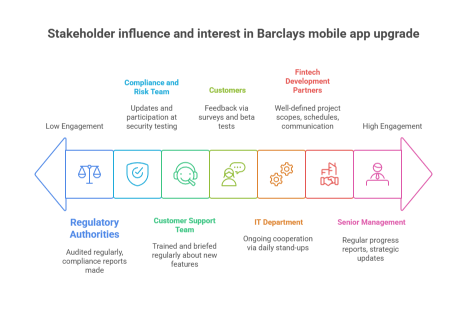
Figure 5: Stakeholder Influence and Interest in Barclays
Source: (Wewege et al., 2020)
Power/Interest Mapping
| Stakeholder | Power | Interest | Category |
| Senior Management | High | High | Key Players |
| IT Department | High | High | Key Players |
| Compliance & Risk Team | High | Moderate | Keep Satisfied |
| Customer Support Team | Low | Moderate | Keep Informed |
| Customers | Low | High | Keep Informed |
| Fintech Development Partners | High | High | Key Players |
| Regulatory Authorities | High | Low | Keep Satisfied |
Team Organisation
Project team structure
The project team of the mobile app upgrade at Barclays would be organized in such a way that there is no confusion in duties, responsibilities, and communication.
The Project Sponsor will be the same executive of Barclays where the strategic direction of the Project will be provided and the budget will be approved as well as matters of a high level will be resolved. A Project Manager will oversee day-to-day activities and will be in charge of keeping the project on scope, time, and budget, as well as orchestrating the collective effort of his team. The IT Development Team will be comprised of software developers, system architects, and cybersecurity experts from both Barclays as well as the fintech partner. Their work will be taking care of coding and testing and integration of the system. The Product Owner will work on the shaping of specifications, prioritization of work, and the voice of the customer in the project team. The Compliance and Risk Team will be in charge of its compliance with finance regulations and data protection laws and will coordinate with developers at important stages (Wysocka, 2025). The Customer Support Team will also take part in the subsequent stages as they should be ready to receive customer requests and give feedback about usability. A specialized technical expertise to provide will be in the form of AI tools, mobile app interfaces, constructed features, etc., or more advanced features, which will be provided by an external Fintech Development Partner within the framework of the deployment of the Project Manager.
This framework facilitates ownership, technical competency, and the ability to abide by regulations while working on a project at any given time.
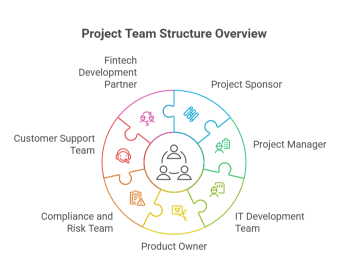
Figure 6: Project Team Structure
Source: (Wysocka, 2025)
RACI Matrix
| Stakeholder | Power | Interest | Category | ||||
| Senior Management | High | High | Key Players | ||||
| Task/Role | Project Sponsor | Project Manager | IT Development Team | Product Owner | Compliance & Risk Team | Customer Support | Fintech Partner |
| Project Approval | A | C | I | I | C | I | I |
| Requirement Definition | C | A | C | R | C | I | C |
| System Design & Development | I | C | R | C | I | I | R |
| Security & Compliance Review | I | C | C | I | R | I | C |
| Testing & Quality Assurance | I | A | R | C | C | I | R |
| User Training & Support Preparation | I | C | I | C | I | R | I |
| Project Monitoring & Reporting | C | R | C | I | I | I | I |
| IT Department | High | High | Key Players | ||||
| Compliance & Risk Team | High | Moderate | Keep Satisfied | ||||
| Customer Support Team | Low | Moderate | Keep Informed | ||||
| Customers | Low | High | Keep Informed | ||||
| Fintech Development Partners | High | High | Key Players | ||||
| Regulatory Authorities | High | Low | Keep Satisfied |
Legend:
R = Responsible
A = Accountable
C = Consulted
I = Informed
Schedule and critical path
Schedule
The project plan for upgrading the mobile app of Barclays is planned to follow a smooth flow and completion at the correct time. It has a duration of about 16 weeks, which is divided into phases with exact durations and dependencies.
The project begins with Project Initiation (1 week), and the following stage is Requirement Gathering (2 weeks) which is required to determine essential functionality and security requirements. System Design (2 weeks) is then concerned with interface and architectural planning.
After finishing the design, the Development Phase 1 (3 weeks) starts, with a view to core functionalities of AI-driven tools and backend integration. Upon the completion of this stage, Security & Compliance Review (2 weeks) is carried out to ensure compliance with the regulations and to have security measures in place.
Following successful security clearance, will come the Development Phase 2 (2 weeks) devoted to advanced features and improvements. This is then followed by Testing and Quality Assurance (2 weeks) where performance testing, usability, and security testing are carried out (Wysocka, 2025).
Then, there is User Training & Support Preparation (1 week) so that the customer support team is prepared to go live. The last phase of the project is the Final Review Launch (1 week) during which final approvals will be obtained and the app will be launched.
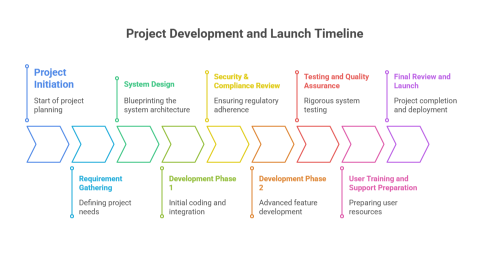
Figure 7: Critical path
Source:
Critical Path Analysis
Critical path is a sequence of tasks that determines the shortest period of the project. Critical path in this case comprises all the important activities that are involved in the project initiation to the final launch with no slack time:
Project Initiation-> Requirement Gathering-> System Design-> Development Phase 1->Security & Compliance Review- Development Phase 2 -Testing and Quality Assurance- User Training and Support Preparation-Final Review and Launch.
Any one of these tasks delayed would directly affect the overall project schedule. Proper risk management and observation along this route must be critical in order to realize the success of the project and deliver on time (Eze, 2025).
Risk register
|
Risk Description |
Impact |
Likelihood |
Mitigation Strategy |
Response Plan |
|
Technical Failures |
High |
Medium |
Conduct frequent testing; involve skilled developers |
Allocate extra testing time and backup systems |
|
Data Security Breaches |
High |
Low |
Implement advanced encryption and regular security audits |
Immediate incident response and strengthen controls |
|
Project Delays |
Medium |
Medium |
Monitor milestones through Agile sprints and daily stand-ups |
Adjust resources and revise project timeline |
|
Budget Overruns |
Medium |
Low |
Regular financial tracking and cost reviews |
Reassess project scope and negotiate with vendors |
|
Regulatory Non-compliance |
High |
Low |
Engage compliance teams throughout development |
Conduct legal review before launch |
Conclusion

 12 Years | MSc in Project Management
The work is a comprehensive project plan for the upgrade of the mobile banking application of Barclays with an intended benefit to improve customer satisfaction through the use of digital services. It describes definite goals, paying attention to AI-based technologies, the speed of transactions, and an ergonomic interface. A hybrid development strategy was chosen as a well-balanced cost cost-efficient and fast safe project. The agile approach provides flexibility and improvement to the project. The stakeholder plan, organization of the team, schedule, and risk strategies are aimed at contributing towards the smooth implementation. On the whole, the project will place Barclays in a better position to enhance its online presence, make its operations more efficient, and retain a competitive edge in the financial services industry that has rapidly been changing in the last several years.
References
- Ainous, R., & Nouichi, Y. (2024). Corporate Digital Responsibility and Artificial Intelligence in Banking Sector. Les Cahiers du Mecas
- Dewasiri, N.J., Karunarathne, K.S.S.N., & Menon, S. (2023). Fusion of Artificial Intelligence and Blockchain in the Banking Industry: Current Application, Adoption, and Future Challenges. Emerald Insight.
- Dinçkol, D. (2021). Industry Disruption in UK Banking: The Evolution of Regulation, Technology Adoption and Business Models. University of Warwick.
- Figura, M., Juracka, D., & Imppola, J. (2025). From Idea to Impact: The Role of Artificial Intelligence in the Transformation of Business Models. Management Dynamics in the Knowledge Economy.
- Gaviyau, W., & Godi, J. (2025). Banking Sector Transformation: Disruptions, Challenges and Opportunities. Preprints.org.
- Karangara, R. (2023). Impact of Fintech on the Banking Industry in UK & Europe. ResearchGate.
- Kheterpal, P. (2024). Future of Finance is Inclusive: Growing Need for Financial Organisations to Design and Develop for Diversity. Open Research Repository.
- Li, L. (2021). Contextual Behaviour-Driven Strategy: Digital Banking Beyond Internet and Mobile Applications. Journal of Digital Banking, 5(4).
- Ogundipe, D.O., & Odejide, O.A. (2024). Agile Methodologies in Digital Banking: Theoretical Underpinnings and Implications for Customer Satisfaction. Research Journal of Banking.
- Roy, D., & Basu, P.C. (2021). Digital Transformation of Banking Institutions. India Banking and Finance Report.
- Virk, A. (2025). Top Trends in Digital Transformation: Pain Points and Opportunities. Journal of Digital Banking, 10(1).
- Wewege, L., Lee, J., & Thomsett, M.C. (2020). Disruptions and Digital Banking Trends. Journal of Applied Finance and Banking.
- Wysocka, U. (2025). Ethics and Digital Mentoring: Awareness and Considerations in the AI-Driven Banking Industry. Digital Mentorship.
- Eze, T.C. (2025). The Impact of Technology on Customer Relationship Management in UK Banks. University of Wales Trinity Saint David.
- Dewasiri, N.J., Karunarathne, K.S.S.N., & Menon, S. (2023). Fusion of Artificial Intelligence and Blockchain in the Banking Industry. Emerald Insight.
Recently Downloaded Case Studies by Customers
1. Efficient Installation of Closed Cavity Facades Planning and Programming Effective supply chain management plays a crucial...View and Download
Introduction Looking for top-notch assignment help? Our Assignment Help service provide expert support, ensuring high-quality,...View and Download
Introduction Boost your academic performance with our premium-quality online assignment help, expertly crafted to align...View and Download
Introduction The term strategic agility is defined as capability of the business in order to determine potential threats,...View and Download
Tesco’s Big Data Strategy and Forecast of 2024 In the dynamic landscape of the retail industry, data analytics has become...View and Download
Introduction to Managing Strategic Change Assignment Organisational change refers to the actions in which the business or...View and Download