
7506BEQR Strategic Project Environment Assignment Sample on project planning, risk assessment, stakeholder engagement, resource management, sustainability practices, and project delivery evaluation.
Nowadays, metro systems are considered one of the most effective infrastructures that can be realized in cities to improve movements of goods to ensure the connectivity of people in an urbanized world. In fact, in the context of rapid urbanization, there is a general consensus on the positive impacts of effectively planned and properly managed metro systems on urban development and growth potential of the city (Furlan & AlMohannadi, 2016). Metro systems are directly linked to economic growth, social equity, and environmental protection. Within the scope of an urban development policy, investment in a metro system, or extension of an already existing system, could represent an optimal allocation of resources.
According to this fact, it is possible to appreciate how the fields connected to transportation and economic performance are strictly correlated, how an investment in the transport field may generate benefits and impacts in the economic field. From this point of view, it can be stated that the overarching theme of city planning aims at guaranteeing a correct degree of competitiveness by increasing the overall efficiency of the city. It is widely known that the metro system, which plays a fundamental role in this context, is directly linked to an optimal level of accessibility. Consequently, it is possible to assume the generality that the overall performances of a city or an urban area from an economic point of view that is strictly correlated to the micro aspects dealt with in this study.
Reference materials and sample papers are provided to clarify assignment structure and key learning outcomes. Through our help with assignment uk guidance is reflected while maintaining originality and ethical academic practice. The 7506BEQR Strategic Project Environment Assignment Sample highlights project planning, risk assessment, and strategic management practices in organisational contexts. These resources are intended solely for study and reference purposes.
To cope with this intricacy, I want to reference as a minimum 5 studies that explore diverse dimensions of the Doha Metro assignment, which serves as a crucial case look at in knowledge those relationships. Amerio (2020) provides insights into the instructions learned from the Doha Metro challenge, emphasizing the significance of know-how acquisition in such huge- scale initiatives. Similarly, Demmler et al. (2018) talk the implementation demanding situations confronted at some point of the task, highlighting essential problems that effect city transit improvement.
Kumar (2022) offers a detailed analysis within the context of project finance, illustrating how financial structuring and risk management principles apply to major infrastructure like the Doha Metro. Additionally, Ingletti, Scala, and Chiacchiari (2017) explored the application of Building Information Modeling (BIM) within the context of the Doha Metro's Al Jadeda Station, showcasing the role of technology in improving project outcomes.
Finally, Kalyvas and McCracken (2024) focus on the incorporation of innovative building automation and control systems within the Doha Metro, marking a significant development in the operational efficiency of urban transit systems. Together, these studies contribute to a theoretical model that can explain the evolving relationships among urban morphology, population flow, land use, and transportation systems. Economic methodologies employed in this research aim to enhance predictions related to these dynamics, supporting effective investment scheduling for the Department of Transportation (DOTr).
The study of shipping economics and urban improvement has gained prominence, mainly in light of the growing demand for urban technology and the expansion of towns. United Nations urbanization forecasts indicate that the city population is projected to reach 67% with the aid of the 12 months 2050, which underscores the want for superior predictive making plans for urban structures, substantially in transportation. However, the dynamics among urban systems and transportation frameworks represent a complex interplay that poses challenges for correct prediction.(Kamarudeen et al., 2018)
Yet, as a huge part of the world transitions into urban living, with cities responsible for 80% of global emissions, the common thinking is that the more public transport commuters, then the more environmentally friendly the city.
Presented in four standpoints, the Doha Metro Project is also scrutinized at a wider scope. Looking into its national economic interpretations, the macro perspective encompasses the prospective implications of the Doha Metro Project on the national economy, with thorough regard to major macroeconomic indicators, and into its spillovers on the regional economic spheres, focusing mainly on the perspectives with a vision to the distribution of wealth and income. At a deeper level, the cost-benefit analysis deals with the least prominent but yet the most comprehensive interpretations of the Doha Metro Project: the significance of efficient transportation infrastructure in supporting the Qatari economy’s diversification beyond oil and gas. To shed a wider scan of light on the project’s implications of a broader and far more diverse spectrum, the Doha Metro Project is extensively overviewed and outlined with reference to from a number of distinct standpoints.
The relationship between the Doha Metro Project and the economy can be understood through the effect on Gross Domestic Product (GDP). Investment in metro systems can stimulate economic growth. On the macroeconomic level, transport projects are assumed to improve national welfare by increasing productivity in the economy because transport networks are considered to be the backbone of the state. When fully operational, the Doha Metro is likely to lead to the following economic benefits: (a) improving productivity as a result of substantial time savings that create an environment for better commuting, and (b) creating jobs. Both Doha Metro Project Phase 1 construction period GDP impact starting 2009 and of the total Doha Metro net cumulative GDP impact between 2009 and 2018 are estimated. Over the same 2009- 2018 period, it is projected that the GDP contribution of the Doha Metro Project could exceed USD 40 billion. The economic growth contribution of the Doha Metro Project starts well before the first urban railway starts services; it will be generally rapid particularly as construction gets up to full speed. Good transport efficiencies have improved the GDP outcomes for Qatar, while enabling economic diversification. Continued infrastructural improvement provision as contained in the National Vision 2030 of Qatar, the metro will enhance interconnectivity in cities, lead to reduced travel times, and facilitate the movement of goods and services. The same will lead to more productivity and attract foreign investment in the country (Araburban.org, 2025). The revenue benefits of metro investments spread more widely across industry sectors than construction costs. The economic multiplier effect of transport infrastructure investment, particularly in relation to employment costs, is widely researched and well publicized. Consequential multiplier effects are likely to accrue for related industries as these benefits ripple through the economy. Furthermore, public transport improves accessibility more generally via improved public transport access, which further stimulates consumption and investment, inducing a further general boost to economic activity. However, it is particularly important that contributions to long-term economic objectives are measured since it is only during the construction phase of projects that the direct and indirect economic benefits tend to be visible and it is accepted that a new metro system may be operational for many years before it is considered that there is a positive economic return on the investment.
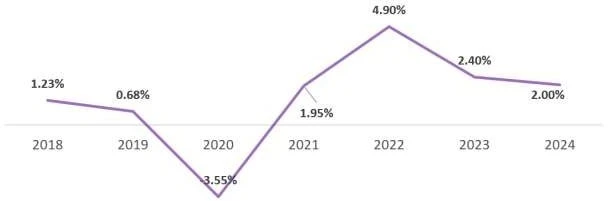
Figure 1: Qatar’s GDP Growth Rate (2014 -2024) in %
Qatar’s economy continues to demonstrate resilience, with an expected GDP growth of 2% for the fiscal year (FY) 2024, according to the International Monetary Fund (IMF). This follows a strong performance in 2022, when Qatar’s GDP growth reached a five-year high of 4.9%, driven largely by the successful hosting of the FIFA World Cup 2022 and the significant
economic activities it generated. Despite global economic volatility, inflationary pressures, and rising geopolitical tensions in the region, Qatar’s near-term economic outlook remains stable, supported by prudent economic policies and diversification efforts.(IMF,2024).
The Doha Metro is a major economic catalyst for the State of Qatar, functioning within the framework of the Qatar National Vision 2030. By augmenting urban connectivity and reducing travel times, the metro has now also reduced the efficiency of movement during goods and services, thereby channeling productivity. It has influenced direct foreign investment and provided support to local businesses, especially during major events like the FIFA World Cup 2022. Within the scope of sustainable urban development, the metro's interface with other transport systems has also helped in advancing the workability of a diversified economy for the nation. Moreover, alongside the creation of job opportunities, it energized tourism and retail activities thereby furthering its claim to the development of Qatar's economy (Araburban.org, 2025). In addition, they have many other wider impacts. Poorly designed or operated systems will create new problems, but properly planned and implemented metro projects can help to reduce many existing ills of city transport, such as congestion, time losses, air and noise pollution and accidents. The investments made in the metro typically go into the local economy and society in so many different ways. In the case of Doha, the Metro building itself is expected to have a large local component and will produce considerable construction work for a few years.
Infrastructure investment projects generally result in an increase in employment rates as direct and indirect job opportunities are generated (Furlan & AlMohannadi, 2016). Especially in the case of large-scale infrastructure investments such as railways, with direct job opportunities generated in manning trains and working on construction sites, a reduction in unemployment rates is achieved through the transformation of indirect job opportunities in industries such as steel, cement and other materials required for the completion of the project. The Doha Metro contributes toward Qatar's very low unemployment rate - 0.1% among the lowest in the world - as a result of the many jobs that the construction and operation phases of the metro have created (The Peninsula Newspaper, 2023). Such a project has taken up a wide pool of workers in its ranks-the engineers, the technicians, and the service staff- by opening up additional avenues of related industries, such as tourism and retail. In addition, the policy focus on public sector jobs and infrastructure development by Qatar further propels the country's low figures. Doha Metro contributes significantly to Egypt's achievements in this regard in terms of income and employment.
While considering numerous implications of the Doha Metro Project on the Qatari economic system, the speedy transit machine’s potential influences on low inflation want to be mentioned as properly. Although current unexpected economic phenomena show off that inflation dynamics are complex, stepped forward and expanded transportation centers within the us of a
theoretically may additionally act for efficient deliver chain and mitigate inflation charges (Furlan
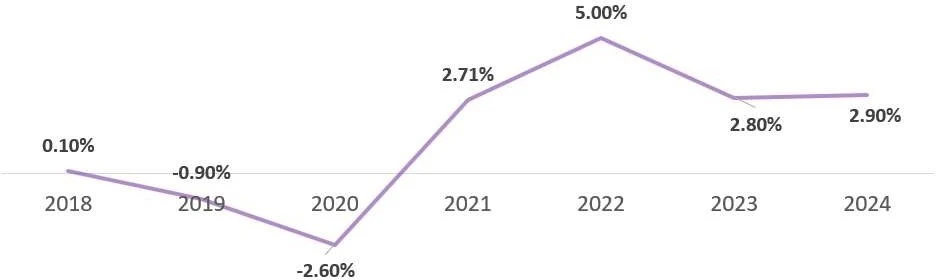
Figure 2: Inflation Rates (2014 – 2024) in %
Inflation in Qatar has been effectively managed, with the country maintaining a stable inflation rate of 2.9% in 2024, compared to 5% in 2022. This achievement is notable given the volatile global economy and the high-interest rate environment. (IMF,2024).
By providing a faster, cheaper, and more efficient mode of transport, the Doha Metro Project is expected to increase accessibility within Doha and Doha region. This increase in accessibility is expected to have a significant impact on economic development and trade, which can influence the export and import of goods, services, FDI, and labor. The cost of transportation and time spent on the road can be reduced through the metro, which would make the movement of people, goods, and services swift and safe. Yet, until now, there is limited understanding of the impact assessment of coming Doha Metro Project on the economic and regional development in the form of balance of payments (M N et al., 2006). To measure the impact on balance of payments within Doha as a result of the Doha metro project, (Furlan & AlMohannadi, 2016) has been used as a case study. A positive contribution of the Doha Metro Project to the balance of payments (BOP) can be found as a result of growth in earnings as people export more goods and services, as well as through foreign direct investment. A good transportation network can significantly reduce the transport burden for the traders, which would ultimately enhance the export intensity of goods and services.
By the end of 2021, the Doha Metro Project is due to be completed and operational. This project, which has been under construction since 2012, will likely alter the urban landscape and economic activities of the Qatari capital. A recent upsurge in the construction of numerous skyscrapers, by investors from both the public and private sector is reshaping Doha’s skyline. In maximum cases, this metro railway lines have the proportionality to the normal and lower income communities (Bardaka, 2016). There has externalities impacts such as travel time relaxation, market accessibility and the impact of connectivity. The rapid boom in construction activities may lead to a construction bubble, which will have implications on property prices. Property prices in close proximity to metro stations are expected to rise significantly.
The part on income equality distribution in the Doha Metro will provide an assurance that each party-such as government, private investors, and the general public-will benefit fairly from the economic benefits of the metro system. The Doha Metro falls under the National Vision 2030 of Qatar, which enhances urban livability, sustainability, and economic growth.
The metro system improves transportation efficiency, facilitating the movement of goods and services at high speed. It creates employment; most buildings and increasing economy will open up in that metro line; however, it also adds urban connectivity and walkability, resulting in socioeconomic benefits for the residential and visiting population.
The analysis encompasses a micro and a macro perspective. First, the micro perspective in the analysis delves into detailed economic implications at the level of individual households or businesses. This includes a consideration of the consumer and business-level impacts of the project. Enhanced metro services are expected to change the price of transportation goods and services while also improving the quality of these services. Which way will consumer behavior shift? For example, increased metro availability could imply increased demand for consumer goods but at the same time, the increased ‘congestion’ of retail outlets might exacerbate this effect. Enhanced metro services may cause demand for business location to increase in metro station areas while relative demand in non-station areas decreases. On the other hand, given the reduced walking times and possibly cheaper rents in metro stations, entrepreneurs in commercial services might locate here, causing an increase in relative demand. Intuitively, these effects are expected to depend not only on the price differential between metro and other transport means, but also on the willingness of the consumer and business population to pay for time and convenience (M N et al., 2006).
Transportation infrastructure is commonly analyzed with respect to supply and demand. Supply and demand are central concepts, not only in economics but also in transport theory. The relationship of supply with respect to demand and vice versa is a critical research issue. Market demand in the context of passenger transportation implies the entire specter of demand patterns for personal travels. However, in the context of the Doha Metro, it is necessary to focus on the consumer choice of the particular mode that satisfies the demand patterns, while at the same time considering indirect and induced effects on other modes of travel. Practically, a metro transportation line can decrease approximately 19.42 kt of CO2 emissions, 3.15 tonnes of PM 10 formation, 377.17 tonnes of 1,4-dichlorobenzene, 3.02 tonnes of nitrogen, 11.45 tonnes of sulfur dioxide, and 1.5 cubic meters of water (Al-Thawadi and Al-Ghamdi, 2019). This basic term of that reduction makes this portion more valuable in demand. The demand for transportation generally, and the expected introduction of the Doha Metro specifically, also comprise the egress patterns of passenger trips on their post-station segment. A passenger arriving at a station has multiple potential destinations along with various preferences. The stronger this system is with respect to the destination, the more probable a metro trip would appear. (Morgenroth, 2009).
Price elasticity is a key concept in transport demand analysis and will be addressed within the Doha Metro framework. Changes in the pricing of transport facilities are common policy instruments and as a consequence, prices are the main determinant of transport mode choices. For public transport operations in general and particularly in a city where there are multiple competing modes. Now, the sensitivity of the number of passengers or revenue to fare levels is a very critical decision. A higher price elasticity indicates greater sensitivity of users to changes in price and hence a higher number of passengers or revenue can be expected. Despite the fact that demand analysis for price setting and fare collection is a core activity of public transport companies and public authorities, there are multiple dimensions affecting the price elasticity of the potential users and hence the price and demand are not in such a simple linear relation. This metro line is for the users from rich users and the middle-class users in the Doha Metro transportation. In this case there are the basic transportation for public, can be used the multiple users in Qatar railways for the metro rail in low price as well as low fare.
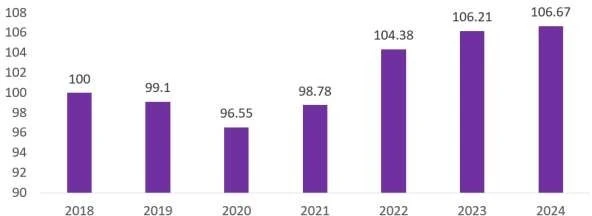
Figure 3: Consumer Price Index (2018-2024) (2018=100)
This figure 4 as the depicts the consumer price index from 2018-2024. So, this price index belongs to the 100 range as from 2018 to 2023. In this case, this IMF shows the impactful part in that Covid period as low and another period is is high for consuming prices. Due to this Qatar metro railway is commenced the price income from the customers according to the graph as fig 4.
The government plays a good sized function in the improvement and operation of the Doha Metro Project. Policies and coverage decisions at authorities stage shape the improvement of shipping infrastructure and have oblique impacts on the operation of the market. In terms of development, authorities coverage creates the preliminary impetus for rail investment through determining wide strategic improvement frameworks and the distribution of public investment. Over the longer time-scale the character of regulatory frameworks and contractual arrangements can influence the improvement of educate sectors, for example by using figuring
out the amount and nature of competition and the quantity of franchising of home markets. In terms of market operation, public coverage decided the regime of carrier regulation, safety, and technical and opposition that influences on the opportunities for specific railway activities. Furthermore, the roads, making plans and land use, and business guidelines pursued with the aid of governments will effect upon the dimensions and nature of demand for special forms of transport. The position played by means of transport in neighborhood and regional connectivity is equally affected by the general public policy selections. (A Hale, 2013).
This section looks into the market structure that is relevant to the Doha Metro Project. Firstly, the transport market characteristics are identified and analyzed based on what kind of market structure it corresponds to, and how the market structure affects economic competition. The introduction of the metro affects the new market, the existing transport services market, and the public transport market as a whole. Therefore, the barriers to entry into the industry are discussed, and lastly, the diversity of services based on the emergence of the metro is addressed.
Transport is understood as the movement of goods and people, whilst the market is a place where buyers and sellers meet and explore the buying and selling of goods and services (Furlan & AlMohannadi, 2016). Along with the Economic Development of Qatar, various types of demands for transport services have been continuously increased in terms of quantity and quality. Nonetheless, for several reasons, private cars have not met the requirements of the public, and other demand for traffic, such as buses and taxis, have not been preferred due to unsatisfactory demand or destination options.
This Doha Metro project, the corporate social responsibility is faced by Hamad group and RATP dev group by France. So, this corporation has the responsibility for socialization as to decrease accidents in the metro lines. In this case, there are the average speed metro lines such as 100 km/hr as 62 mph due to low accidents. Hence, this metro railroads are very much essential to make the time bounding in the journey of the customers. So, this CSR makes the corporation wealthy in punctuality and security. For this CSR, this corporation belongs to the ethnic way in the metro rail communication in Qatar capital and other regions. So, in this case, there are the CSR of that corporation, which makes the corporation socially responsible for the public transportation in the Qatar regions. Here, all the part of this transportation is for the economic gaining, so this transportation must be followed by CSR in the execution of metro rails.
To build infrastructure, resources need to be diverted from an alternative use, so the concept of opportunity cost must be considered. Hence, a central question is whether the allocation of resources for building a metro system in Doha is the best use of these resources, or whether they could be used more effectively to enhance the economic performance and social welfare of Doha and the surrounding region in other ways (Morgenroth, 2009). A consideration of this question implies that an ordered set of projects or investments is evaluated in terms of the various economic and social benefits they can generate, compared to a no-project scenario.
This critical analysis synthesizes thoughts and insights drawn both from the macro and micro perspectives of the Doha Metro Project. A critique is made on the wider implications of the study findings, of both strengths and points for consideration, in addition to gaps identified and potential further research outlined for the future. Therefore, the analysis consists of three interlinked set of thoughts, namely broader socio-economic outcomes; the concern on rigor in delivery and methods, with a view on policy recommendations, and finally, contingent factors regarding the project implementation.
Regarding the broader socio-economic outcomes of the Doha Metro Project, intended and unintended effects are considered next. The harm to the environment and main sectors within construction are discussed first, such as concerns for emissions and particular high-risk methodologies. This assessment of Qatar metro railroad is very much well dressed in the Qatar railroad analysis. In this case, this assessment has discussed the macro and micro part in the Doha Metro railway construction. This construction of that project belongs to the rail way making by the French Construction project make RATP dev and Keolis. The staggered mobilization of construction workers and materials, along with low-emission building paths, are also critiqued. Consequently, the repercussions on transit-oriented developments are unveiled through forward-looking property price reactions and issues of location. Hence, a need for close planning and monitoring on TOD development is dig into.
The delivery of the study, and the methods and data throughout, are questioned for their validity and for the reliance on data, results, and analyses from indirect and overly general sources. Indeed, tough assessments are methodologically difficult. It is worth reminding the economic and societal wide-ranging aspects to be considered beyond just monetary outcomes, but also of the need to reliably detect and isolate such effects. Moreover, the endeavor should be devoid of policy biases or normative desires irrespective of estimated results, or even of the wide body of undeniable environmental impacts of this project.
In this railway project, there are much sustainable as there is the good economy in making this project with positive thinking. This belongs to the costal lines and the historic lines in the Qatar region. Hence, this is the basic communication railroad, between the tourist places of Qatar with the public transportation. This project belongs the the Metro project, which is more essential than the railroad project. Hence, the construction of this depicted the highest sustainability in drilling capsules and railroad construction. In that project construction, there are highest sustainability in the railroad construction as this is underground. As the Qatar’s oil field and the underground water is existed, the metro communication does not collide that fields for the human and economical welfare for this country.
| Threat of New Entrants | Bargaining Power of Suppliers | Bargaining Power of Buyers | Threat of Substitutes | Industry Rivalry |
|---|---|---|---|---|
| There are high barriers to make the new investments and the regulatory body and the new investments. Novices have little chance with Doha Metro owing to the huge investment money required to establish such a project. Making a metro system requires advanced technology and specialized expertise plus an enormous amount of infrastructure and have strict regulatory approvals. Government support, as well as funding, has helped make it difficult for private players to enter this space, ensuring that this particular metro system remains the preeminent. | Suppliers need to be specialized to produce the high voltage machineries for this Doha Metro railway. Without this that will nor be possible to construct the metro rail. | Here the passengers has less bargaining power, the Metro rail operators should have to determine the unique fare chart with respect to the metro rail stations. | This is a mild threat concerning some alternatives like buses, taxis, ride-sharing services, and private cars. But, the metro has brought great conveniences, such as quick travel duration, less congestion, and the environmental friendliness of operation, reducing attraction towards adulteration. | The competition level in the Doha Metro industry is quite low since it is the only metro rail operator in the state of Qatar. However, since it was built as per the national urban planning strategy of the State of Qatar, there can be no other competing metro systems that would allow such operation without competition across its segment. |
There are high barriers to make the new investments and the regulatory body and the new investments. Novices have little chance with Doha Metro owing to the huge investment money required to establish such a project. Making a metro system requires advanced technology and specialized expertise plus an enormous amount of infrastructure and have strict regulatory approvals.
Government support, as well as funding, has helped make it difficult for private players to enter this space, ensuring that this particular metro system remains the preeminent.
Suppliers need to be specialized to produce the high voltage machineries for this Doha Metro railway. Without this that will nor be possible to construct the metro rail.
Here the passengers has less bargaining power, the Metro rail operators should have to determine the unique fare chart with respect to the metro rail stations.
This is a mild threat concerning some alternatives like buses, taxis, ride-sharing services, and private cars.
But, the metro has brought great conveniences, such as quick travel duration, less congestion, and the environmental friendliness of operation, reducing attraction towards adulteration.
The competition level in the Doha Metro industry is quite low since it is the only metro rail operator in the state of Qatar.
However, since it was built as per the national urban planning strategy of the State of Qatar, there can be no other competing metro systems that would allow such operation without competition across its segment.
| Political | Environmental | Social | Technological | Legal | Economical |
|---|---|---|---|---|---|
| This Doha metro Project is the main project of Qatar to develop the metro railways. So, this is the main political key to make logistics well and get connected. In a certain geopolitical situation, thie metro railway can be connected to the Qatar costal lines and main area. | This Doha metro project is a key environment friendly metro project. This may harm the soil only in the digging and pipe making as metro capsule. After making capsule, there will be no harm of nature as there are no emissions in running the metro. Yes, that’s true that in the desert area, the underground part does not get effect in the metro Railway building. | In the social impact, there are the basic implementation of public connection in greater Doha region. Now for the social region, this metro will play a crucial role constructing communication between Greater Doha and other regions of Qatar. So, In the Qatar, that can be the social morale in connecting the Historic places, museum and costal lines. Hence, in this case, public will be active socially by getting connection of historic places and tourist places via this metro lines. | For the technological overview, this metro rail lines are overhead somewhere and in somewhere underground. Now, for the technology, there are red, green and yellow lines in the Qatar, Doha metro project. There are the three lines combination in the metro line construction. Now, for the construction of the Overheads as stations of 100 and the Metro capsules there are well technology enabled. | In the Qatar’s metro project, there are some security issues as in the injuries of the workers. So, they have followed all the safety features during drilling and making the capsule of metro lines. In this case, this Qatar metro lines are well in QA and R&D due tto low legal issues. | For the Economic part of Qatar Railways (Metro) this metro project belongs the $40 billion in making all the infrastructure in railways. So, this is in high quality metro projects in the world. In Qatar, there has no issue of technology and economy so this Metro lines can be well sustainable and modernized. Moreover, this metro has four lines, which is also connected to the historic places of Qatar, so from there, this can be an economic earning for Qatar. |
Conclusion and Recommendations
 8 Years | DBA
This study provides a comprehensive overview and analytical assessment of the economic and regional impacts of the Doha Metro Project. Discussion of the Qatar Rail network plan is integrated with comparative considerations of the experiences of metro systems in other GCC countries and an in-depth analysis of metro transit-oriented developments underway around Doha. Key impacts of the Doha Metro Project are scoped and characterized in terms of economic diversification, job creation, technological and knowledge transfer, local industrial development, increased foreign direct investment, regional development, social high value property development and stakeholder benefits. The rapid increase in transport infrastructure in the GCC countries, planning a more sustainable urban form, the implications of the experiences of Metro systems in Dubai and Abu Dhabi, and Qatar’s economic and development plans are highlighted. Economic diversification through the construction of the metro network is recognized as having a large footprint on the economy, as it has the potential to boost industrial growth and to provide economic opportunities for a wide variety of sectors. In this sense, economic schemes might go beyond the building of lines and the procurement of rolling stock and focus on a broader view of the economy, possibly supporting market structures from which a broader range of commercial sectors might grow. R&D activities and innovation hubs, as well as a further stimulus for economic investment and FDIs, should be encouraged through the preparation of a long-term platform strategy.
The findings of the analysis and review underpin the urgent necessity of comprehensive planning for transit-oriented developments. Concrete policy and planning recommendations for the maximization of the positive impacts of the Doha Metro Project are formulated. Ongoing and adaptative assessment is crucial given the complex systemic interactions of planning, implementation and operation of the metro and land use developments. Such evaluation must be cognizant not only of the social and economic makeup of the region but also of local history, culture and geography and should span phenomenon related to rent, investment, gentrification and the real estate market. Likewise, while TODs, and transport infrastructure investments more generally, might offer an effective tool for the requalification of deprived urban areas, they also bring the risk of exacerbating social inequalities and fostering market dominance by a specific group of stakeholders. In light of the developmental path followed by Doha, specific attention should be given to evictions and displacement that might result from the policy of enhancing the land value surrounding metro stations. These aspects, if not taken into careful consideration, can undermine the social cohesion and the community spirit of the neighborhoods of the New Doha Korridor (NDK). From the planning decisions and experiences of Doha, no standard model can lead the sustainable development of a metro system and related TODs. For policies that aim at fostering a transport-land use symbiosis and at achieving positive outcomes for the urban system and the livelihood of the whole population, a more systemic approach is required. Only an integrated modeling system that takes into account the complex interrelation among transport, land use, economy, population and the environment can guide the formulation of sustainable strategies. This was not the case in Doha and Qatar. Better knowledge, data and understanding about the complex dynamics of transport- oriented urban development, are necessary from early stages of the planning. Thus, this analysis of the process of building a metro system and related developments since the initial planning, through construction and operation, arises in the hope that it may provide a roadmap for a more sustainable and equitable development of a metro system and related TODs.
Our assignment sample demonstrates how sources should be cited, and you can refer to a detailed Harvard Referencing Guide Example to ensure your work meets academic standards and maintains consistency throughout.
References:
Introduction Get Free Online Assignment Samples from UK's Best Assignment Help Experts to boost your academic...View and Download
Task 1 Business Report Introduction Financial management implies to the process of planning, acquiring, managing and controlling...View and Download
Introduction to Global Strategic Management Assignment 39251 Globalisation can be defined as the speedup exchange and movement...View and Download
Introduction to Business Economics Assignment Business economics is explained as a field of applied economics which studies the...View and Download
Introduction to Orientation For Success In Higher Education Assignment Part 1: Essay This essay shall outline the important...View and Download
Introduction Get free samples written by our Top-Notch subject experts for taking online Assignment Help services. A...View and Download
Copyright 2026 @ Rapid Assignment Help Services