
Hand Hygiene and Microbial Transfer Handwashing Practical Assignment Sample
Examine Hand Hygiene and Microbial Transfer Handwashing Practical including handwashing techniques, glove use, sanitization, microbial transfer, and antiseptic effectiveness.
- Type Assignment
- Downloads2481
- Pages8
- Words1965
Introduction: Hand Hygiene and Microbial Transfer Principles
Hand washing is among the essential activities that help people lower the infection risk because it removes pathogens on the skin's surface. The significance of hand washing was discovered by Ignaz Philipp Semmelweis in 1847 when he found that students carrying material from corpses to maternity patients were a major cause of puerperal fever. He came up with hand washing using chlorinated lime which helped in reducing infection rates significantly. Currently, hand washing is the best-known method of reducing the transmission of healthcare-acquired infections such as methicillin-resistant Staphylococcus aureus, and this foundational concept is often discussed by an assignment helper in UK when explaining infection prevention in clinical education. Proper washing of hands eliminates those bacteria that are on the skin for a short duration thereby reducing the general bacterial count on hands. In addition to washing hands, gloves, sanitizers, and surgical scrubs are some of the significant ways used in the medical field to avoid the transfer of pathogens and enhance the safety of patients and healthcare practitioners.

 5 Years | PhD in Physics
Aim: Objective of the Handwashing Practical
The rationale of this practical experiment is to ensure that students appreciate the role of washing hands as well as hand sanitization to prevent the spread of microorganisms. It will assist the students in explaining how bacteria are passed from one person to the other by touch and how they can be prevented by washing with soap and using hand sanitizers. Besides, the experiment will involve the use of UV-reactive lotion to illustrate microbial transmission and record the inhibition techniques of antiseptics on Staphylococcus epidermidis through inhibition zones. All in all, this experiment affirms the need for hygiene in the prevention of infections.
Reference materials and sample papers are provided to help students understand assignment structure and improve academic skills. We, as an assignment helper in UK offer guidance while maintaining original work. The Hand Hygiene and Microbial Transfer Handwashing Practical sample highlights report structure, observations, and discussion of findings. These resources are intended solely for study and reference purposes.
Method: Experimental Procedures for Hand Hygiene Study
A series of experiments were conducted in the Hand Hygiene and Microbial Transfer Handwashing Practical to observe the effect of handwashing, glove use, and sanitizers on microbial transfer. Nutrient and Mueller-Hinton agar plates were used to culture Staphylococcus epidermidis from hands under different conditions. Gloves, handwashing, or sanitizers were applied before contacting the agar to compare bacterial growth. UV-reactive lotion was also used to simulate microbial transfer during handshakes, allowing visualization of contamination spread.
Procedure 1
The nutrient agar plate should be divided into four sections namely; before the first glove, Temporary or the transfer zone, and sanitizing zone. It needs to be properly labeled with the date of the experiment and its name. Person 1 flicks his bare finger on the ‘before’ button. Person 1 wears gloves and with the help of the gloved finger taps on the marked label on the scale and denotes it as “Glove 1”. Their gloves are immersed and wiped in the suspending medium of Staphylococcus epidermidis (Ezezika et al. 2023). Person 2, who had protective gloves on, invited person one and began the next trick, performing a handshake and pressing the finger on ‘‘transient’. When their glove is disinfected and rinsed, Person 2 places their finger on “sanitize.” Then it needs to be incubated at the temperature of 37C for 1-2 days.
Get assistance from our PROFESSIONAL ASSIGNMENT WRITERS to receive 100% assured AI-free and high-quality documents on time, ensuring an A+ grade in all subjects.
Procedure 2
For spread plate 1, butter, margarine, and oil that is spread on it should be portioned into three equal parts. Unwashed hands are swabbed on 1 section. Hand washing and or swab on section 2. Occasionally, clean the section with sanitizer swab it, and then inoculate section 3. It is incubated at the temperature of 37C for 2 days. Mueller Hinton plate with Staphylococcus epidermidis should be used for spread plate 2. Twelve sterile discs should be placed on the plate with varying equal distances between each one and filled with three various antiseptics. Then it needs to be incubated at the temperature of 37C for 2 days.
Procedure 3
Here in this experiment, 4 students have participated. Applying the UV-reactive lotion to the hand gloves of Infected 1. The initial contact is demonstrated through a handshake between Infected 1 and Infected 2, and then through shaking hands with Infected 3 and then with Infected 4. Using UV goggles and light, score the transfer of “infection” from+++ (Infected 1) downwards by the acquires at the relative time intervals To record the relative time intervals for transferring infection from patient-infected 1 to all the others dubbed as; acquires refer to the given points.
Results: Observations and Bacterial Growth Analysis
After incubation the yeast sample was divided into four quadrants and all of them were evident. The ‘’before’’ quadrant exhibited a high density of bacteria colonies implying that the skin flora is highly existent. The quadrant of “glove 1” yielded small amounts of microorganisms, which confirmed the barrier action of the gloves. Again, the ‘transient’ zone showed profuse growth of Staphylococcus epidermidis thereby suggesting successful transfer of transient bacteria through contact. Substantial diminution in the number of colonies in the “sanitise” quadrant which proves how antiseptic wipes eliminate transient bacteria.
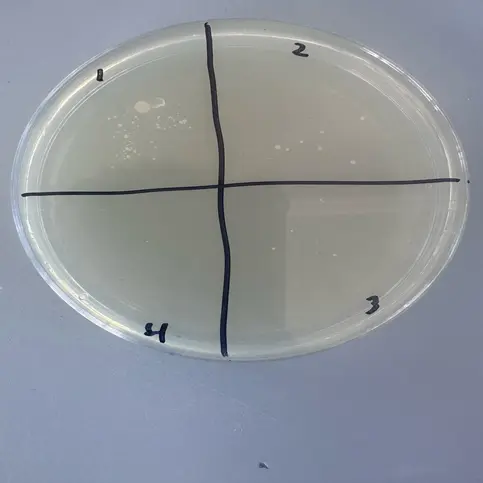
Figure 1: Procedure 1
When comparing the bacterial growth on spread plate 1, Section 1, which represented unwashed hand, there were more colonies while Section 2 which represented hand washed with soap had fewer colonies (Berendes et al. 2022). The last section which was 3 (after hand sanitizer) showed the lowest count, thus proving that the hand sanitizer had killed all the bacteria. On spread plate 2, there are well-defined zones of inhibition around the antiseptic discs that were different in size. Thus, the greatest zone of inhibition was detected for antiseptic 1, meaning that it possesses the highest antibacterial efficacy.
During the “before” quadrant, a dense amount of microbial colonies can be observed due to the presence of normal skin flora and contamination by transient microbes. There are very few microbial colonies present in the “glove 1” sector, which shows that gloves help prevent direct contact contamination. In the “transient” quadrant, there are many bacterial colonies, which verify the transfer of Staphylococcus epidermidis from Person 1 to Person 2 due to the hand contact transient bacteria are spread easily.
The microbes present in the ‘sanitize’ quadrant are significantly lower than in the other parts illuminating that disinfectant is capable of eradicating most skin flora from gloves or skin surface.
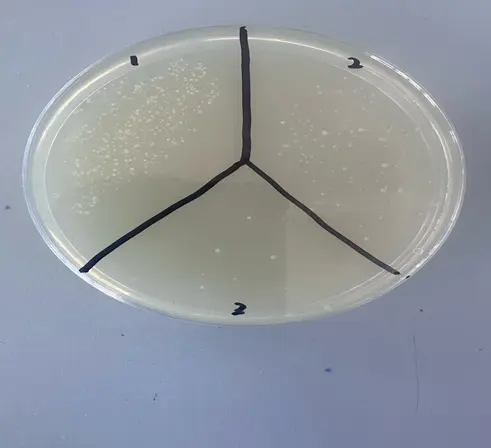
Figure 2: Procedure 2
Among these plates, some display the bacterial load prior to hand washing and after using antiseptics (Ross et al. 2023). Section 1 (unwashed hands) also shows densely populated bacterial count. Section 2 which was washed with soap presents very low count as compared to other section of the agar plates. It can be seen that after sanitising the bacterial volume in section 3 is low thus giving credence to the effectiveness of sanitiser as being the most effective cleaner. There is a definition of a clear zone of inhibition around the antiseptic discs, though with different sizes (Syed, and A. Al-Rawi, 2024). The biggest zone of inhibition shows that the antiseptic being tested is highly effective against Staphylococcus epidermidis.
Such observation of the wound reveals differences in antiseptic effects between the two groups of animals (Caruso et al. 2025). The size of clear zones reflects the effectiveness of biocides and helps to determine the use of disinfectants in clinical work.
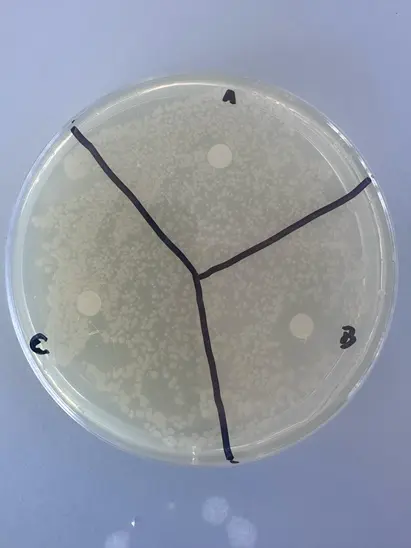
Figure 3: Procedure 3
These can be demonstrated with contamination transfer using UV reactive lotion. There is strong fluorescence (++++) meaning that the sample is fully contaminated. Infected 2 shows a slightly lesser amount of fluorescence (+++), while Infected 3 shows still less amount of fluorescence (++) which indicates a less contaminated level with reference to indirect contact (Enkhbat et al. 2022).
It remains to note that, within each level of contact, the level of contamination is considerably low, but it is still possible to detect residues of bacteria if there is no proper wash with water and soap. When exposed to UV light, Infected 1 was seen to fluoresce most (++++) which implies maximum contamination. In Infected 2 and 3, the brightness was somewhat lower: they had two plus-three and two plus-two respectively and Infected 4 had only one plus. The results depicted in figure 2 illustrated that Infected 1 had a very strong fluorescence (++++) when exposed to UV light, suggesting that the sample had been exposed to the simulated pathogen to the fullest extent (Thorseth et al. 2024). Infected 2 was shown to be slightly weaker (+++) indicating that there was only a partial transfer. Thus, the results of Infected 3 conformed well to those of the control, characterized by moderate contamination (++). Infected 4 also showed very close to zero contamination (+), which makes it clear that it is the least likely to transfer after several contacts.
Conclusion
After incubation the yeast sample was divided into four quadrants and all of them were evident. The ‘’before’’ quadrant exhibited a high density of bacteria colonies implying that the skin flora is highly existent. The quadrant of “glove 1” yielded small amounts of microorganisms, which confirmed the barrier action of the gloves. Again, the ‘transient’ zone showed profuse growth of Staphylococcus epidermidis thereby suggesting successful transfer of transient bacteria through contact. Substantial diminution in the number of colonies in the “sanitize” quadrant proves how antiseptic wipes eliminate transient bacteria. Procedure 3 proved that it only requires physical contact in some form and there is the transfer of contaminant, especially touching on how condemnatory necessary contact ought to be done to avoid the spread of the disease-causing microorganisms.
The results from the Hand Hygiene and Microbial Transfer Handwashing Practical clearly demonstrate that proper handwashing, sanitizer use, and glove application significantly reduce microbial transfer. Sources of error could be; the application of pressure in the inoculation process, adequate drying after the sanitation process, or the application of the antiseptic discs. Further enhancements can include quantitative CFU determinations and varying the contact time with the antiseptics. In conclusion, this specific experiment further supports the idea that the basics such as washing hands and sanitizing decrease the emergence of temporary bacteria, saving patients’ and HCWs’, time by preventing HCAIs (MacLeod et al. 2023). Therefore, it is recommended that healthcare practitioners use WHO Five Moments of Hand Hygiene in the infection prevention approaches.
References
- Berendes, D., Martinsen, A., Lozier, M., Rajasingham, A., Medley, A., Osborne, T., Trinies, V., Schweitzer, R., Prentice-Mott, G., Pratt, C. and Murphy, J., 2022. Improving water, sanitation, and hygiene (WASH), with a focus on hand hygiene, globally for community mitigation of COVID-19. PLoS Water, 1(6), p.e0000027.
- Caruso, B.A., Snyder, J.S., OBrien, L.A., LaFon, E., Files, K., Shoaib, D.M., Prasad, S.K., Rogers, H., Cumming, O., Esteves Mills, J. and Gordon, B., 2025. Behavioural factors influencing hand hygiene practices across domestic, institutional, and public community settings: A systematic review. medRxiv, pp.2025-03.
- Chen, J., Yang, L., Mak, Y.W., O’Donoghue, M., Shi, C., Tsang, H., Lu, S., Zou, J., Qin, J., Xie, Y.J. and Lai, T., 2024. Hand hygiene education components among first-year nursing students: a cluster randomized clinical trial. JAMA network open, 7(6), pp.e2413835-e2413835.
- Enkhbat, M., Togoobaatar, G., Erdenee, O. and Katsumata, A.T., 2022. Handwashing practice among elementary schoolchildren in urban setting, mongolia: a school‐based cross‐sectional survey. Journal of Environmental and Public Health, 2022(1), p.3103241.
- Ezezika, O., Heng, J., Fatima, K., Mohamed, A. and Barrett, K., 2023. What are the barriers and facilitators to community handwashing with water and soap? A systematic review. PLOS Global Public Health, 3(4), p.e0001720.
- MacLeod, C., Braun, L., Caruso, B.A., Chase, C., Chidziwisano, K., Chipungu, J., Dreibelbis, R., Ejemot-Nwadiaro, R., Gordon, B., Mills, J.E. and Cumming, O., 2023. Recommendations for hand hygiene in community settings: a scoping review of current international guidelines. BMJ open, 13(6), p.e068887.
- Ross, I., Bick, S., Ayieko, P., Dreibelbis, R., Wolf, J., Freeman, M.C., Allen, E., Brauer, M. and Cumming, O., 2023. Effectiveness of handwashing with soap for preventing acute respiratory infections in low-income and middle-income countries: a systematic review and meta-analysis. The Lancet, 401(10389), pp.1681-1690.
- Syed, W. and A. Al-Rawi, M.B., 2024. Assessment of Hand‐Washing Knowledge and Practice among Nursing Undergraduates in Saudi Arabia. Canadian Journal of Infectious Diseases and Medical Microbiology, 2024(1), p.7479845.
- Thorseth, A.H., Lamb, J., Mavodza, C.V., Tembo, M., Mushangari, A.P., Zinyandu, E., Heath, T. and White, S., 2024. Using Wash’Em to Design Handwashing Programmes for crisis-affected populations in Zimbabwe: a process evaluation. International Journal of Environmental Research and Public Health, 21(3), p.260.
Recently Downloaded Samples by Customers
Introduction: The Strategic Transformation of 7-Eleven Get free samples written by our Top-Notch subject experts for taking...View and Download
Overview of business idea Entrepreneurship may be defined as procedure of finding out the opportunities, managing resources,...View and Download
Introduction to Operations and Quality Management at Morrisons Assignment Sample The following report shall be based on the...View and Download
Task 1 New and emerging trends in digital communication technology are transforming how individuals and organisations connect,...View and Download
Introduction: Entrepreneur Report Assignment Get free samples written by our Top-Notch subject experts for taking...View and Download
Adult Mental Health and Patient Care in London In the current era, mental ill-health is considered a critical health issue that...View and Download