+44 75754 30035 help@rapidassignmenthelp.co.uk
offer
🎁Special Offer 🎁 Discounts - Up to 50% OFF!
🎁Special Offer 🎁 Discounts - Up to 50% OFF!

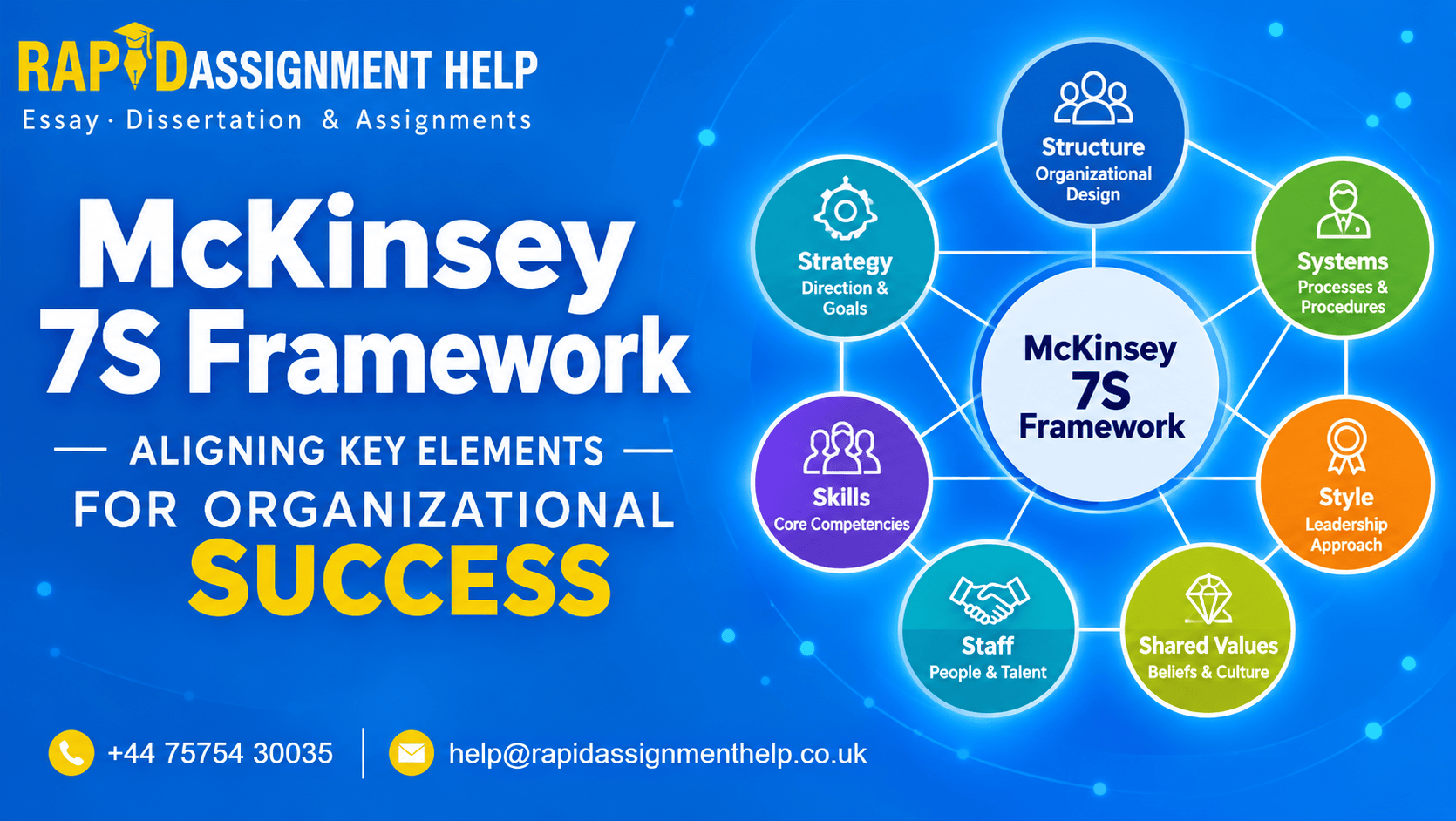
What is something that helps a business to grow? You may answer sales, employees, or, most commonly, a strategy. Surprisingly, you’re right, but it’s only half the truth. Growth cannot be defined with just one factor, and it's always a collective contribution of different parts of an organisation. That’s the missing piece that the McKinsey 7S Framework describes. It is one of the established methods that highlights the internal and practical values that companies are still operating with.
Now, if you’re a student or a working professional, learning about this framework helps you develop critical thinking. At the end of this blog, you won’t rely on motivational factors but can address the key components of a company. So let’s get into the point towards this mind-blowing strategic management style.
McKinsey is a method that keeps you logical about making organisational decisions. That’s why you must have the details of why it was established, its purpose, and whether it's good for you or not. Back in the late 1970s, three management consultants and organisational thinkers, Robert H. Waterman Jr., Thomas J. Peters, and Julien R. Phillips, developed the framework and were associated with McKinsey & Company.
This was just the beginning. In 1980, all three explored the problem in their article, Structure Is Not Organisation, published in Business Horizons.
You might ask: What this framework do and why there is even a need for it where business are emerging over time. Well, this development's major purpose was to highlight an issue with organisations. Before the publication of this article, companies were relying on organisational charts, but it was not enough. According to them, growth is the sum of people, management practices, capabilities, processes, and shared beliefs. This is what the McKinsey 7S Framework is all about: making strategic management better.
The framework received global highlight when Peters and Watman’s 1982 book, In Search of Excellence published this. If you look at the core facets of this framework, it will amaze you, but you know what? It couldn’t be done without the contribution of Anthony G. Athos (Harvard Business School Professor) and Richard Pascale. These two minds helped shape the model’s memorable seven-element structure.
However, if you’re thinking that the framework is liked by so many because of its exceptional insights, you might be wrong. What made this so effective is the real-world results of each S. Let’s explore them next.
Despite the ease of use, the McKinsey Framework gives practical viewpoints to identify the underlying growth killers. Whether it's internal relationships, misalignment, or evaluating existing capabilities, the model becomes helpful. Here are the 7S of the model and how they work:
There is no future for a company that walks on a black slate, but it's not just about making plans according to the model. It’s about achieving long-term objectives and establishing a competitive position in the market. A company can do this by targeting customers, allocating resources, setting business priorities and creating value.
Following this function, technology, workforce capabilities, and operational processes hold a strong place.
When the duties are fixed, no confusion happens. That’s what this point determines and evaluates: whether the structure is right or not. It oversees how departments coordinate activities, how decisions are made and who is accountable for different business functions.
This is one of the biggest drawbacks experts articulate: a company without clear focus in departments lacks growth. A structure is what helps organisations to stay accountable, move in a focused direction without leaving errors on the table. The important consideration is whether the organisational structure supports the company’s strategic direction.
If you ever handled your work systematically, you know how worthwhile and crucial it is. People often make mistakes when they have to make in-the-moment decisions. On the other hand, a systematic approach combines procedures, processes, and technological arrangements, making it effortless.
By using them, organisations can influence how information flows, how employees complete tasks, and how business performance is monitored. The same thing you can see is that when systems become inefficient, it results in mental fatigue.
This is an invincible growth factor that matters the most in most successful companies. More than any technical superiority, fundamental beliefs, principles, and organisational priorities help in strong decision-making. They form the cultural foundation of the organisation and occupy the central position in the traditional 7S diagram.
This one thing cannot be done with words of the month, like the company claims the value. It strongly depends on whether the employees experience quality in their everyday environment. While a company may promote innovation, it should not discourage employees from experimenting or questioning established practices.
Even after the 50 years of this framework development, skills still remained a most expensive currency. However, some companies overlook individual capabilities and competencies that cost them growth. That’s what this factor of the framework describes. It helps determine whether the workforce possesses the expertise required to achieve the business objectives.
It could be related to anything like technical knowledge, communication, leadership, problem-solving, data analysis, and specialised industry expertise.
More than what you’re doing, the way you’re doing make more impact and the nuance highlighted by the framework. It relates to how leaders communicate, make decisions, and include employees. In everyday news, you may have seen how a bad management style caused the company to neglect growth.
On the other hand, if the management encourages innovation, it results in a collaborative approach. This is what decides the long-term success of a company.
Staff is the foundation of a company that makes up an organisation. This point talks about how the workforce is recruited, developed, motivated, and retained. It comes down to workforce planning, talent management, employee development, and the distribution of human resources.
If the staff is in line with needs and their plantation is good, better output comes automatically. However, bad recruiting leaves a loophole in the company's growth direction that costs long-term decline.
These factors are categorised into two categories that define their importance even more. Let’s break them down in the next section and see why they matter.
After exploring the 7S of the McKinsey Framework, you might think: which applies where? To clarify the distinction, they are divided into two categories: Hard S’s and Soft S’s, differentiated for formal management arrangements and the human factors. Let’s see how both serve:
The quality of these 3S’s is that they are easy to identify and easier to document or change. But at the same time, they are tangible too. They’re rigid, and that’s why they are important for managing functions on a large scale.
These 4 S's aim to maintain an organisational culture, more towards enhancing the employee capabilities and management behaviour. You cannot measure them easily, but they still have a strong impact on functions.
You see how the categorical difference between Hard S and Soft S gives massive clarity. But one thing is not to misunderstand that one is better or more important than the other. Both aim to bridge the organisational objectives.
While they look great in theory, do they have any practical uses? Damn yes, and you will explore how companies are implementing the framework.
You might be amazed to see that companies like Microsoft, General Electric, Nokia, and even Apple use this framework. And there is no doubt about the exponential growth these companies have achieved. Well. McKinsey is not the only factor, but it is definitely one. This is how it can be implemented:
Step 1: Define the Objective
You need to have a clear idea of what you want to achieve with the framework. It comes down to clarifying objectives, whether it is improving operational efficiency, expanding into new markets, digital transformation, etc.
With a clear objective, you might struggle to determine whether the seven elements are aligned.
Step 2: Assess the Current State
Management assumptions often lead to wrong implementation and just overloading things. Instead, examine how the organisation currently operates. The best way is by reviewing its strategy, structure, operational systems, shared values, workforce capabilities, leadership practices, and staffing arrangements.
With actual employee feedback, management interviews, and organisational documents, you can make better decisions.
Step 3: Identify Gaps and Organisational Misalignment
By following Step 2, you can see the exact gaps and misalignments. Based on that, compare conditions with what the organisation needs to achieve its objectives. For example, a business pursuing rapid expansion may have an appropriate growth strategy but lack experienced managers, scalable operational systems and employees with the necessary market knowledge.
This is how it becomes easy to point out the exact areas for improvement.
Step 4: Develop an Organisational Alignment
This is the point when you point out the exact requirements for organisational alignment and solve the issue. This might involve redesigning reporting relationships, introducing new technologies, developing employee capabilities, or changing leadership practices.
Step 5: Implement Changes and Monitor Progress
At this point, you finally introduce the necessary improvements while tracking your changes. For this, you can use relevant performance indicators, employee feedback, and operational results.
Even with alignment, reassess it rather than treating implementation as a one-time exercise. This will prevent you from managing the situation if the framework doesn’t go the way it should for your objective.
This framework is not reserved for big organisations, but small agency managers and decision-makers can implement it. However, if you still doubt how effective the model could be in practice, the next section is a must-read.
The effectiveness of the McKinsey 7S Framework can be applied in different areas and has already been demonstrated so far. By gathering examples from popular industries, you can see how it can be beneficial for your company or specific study type:
Imagine a situation where a hospital wants to reduce patient waiting times and improve the quality of care. Here’s how it will be executed with the framework:
Learning: The hospital recognised that simply bringing a new appointment system will not solve the problem. Major needs are sufficient staff and effective communication between departments. All seven elements need to support the same objective.
For a retail store, the situation is the expansion from a physical store into online shopping. This requires:
Learning: Launching can be ineffective because it only provides digital expansion. A trained employee base, reliable delivery systems, and coordinated management are needed to grow an online business.
In the education sector, a university wants to introduce digital learning to make education more accessible. Here’s what they need to focus on:
Learning: Digital learning software will be only a start, but real changes begin with implementation. It involves teachers knowing how to use it, students needing support, and university policies encouraging digital learning.
Large production often causes delays, which disconnect a company from meeting demand. For this, a manufacturing company wants to reduce production delays and minimise product defects. Here’s how the framework will work:
Learning: Better production is not the byproduct of better machinery. At the same time, employees need the right skills, maintenance systems must function, and managers must address operational problems quickly.
There is a situation when a traditional bank wants to encourage customers to use mobile banking instead of visiting branches for routine transactions. The challenge here is improving the customer base. Here’s how the model will function:
Learning: Mobile banking can boost speed but cannot earn the trust of customers. Alongside, the bank needs to maintain reliability, security, and easy navigation.
This is about how the framework will be applied practically by acknowledging real industry situations. But what if you have to demonstrate this task in academic projects? You can do it by exploring the next section.
Students often look for strategic management assignment help because they feel confused when handling this framework. The reason is obvious due to the need for critical thinking and establishing the demonstration. However, scholars can overcome this issue by using these stages of application:
Establish the research objective
Be clear about the one thing you’re going to prove with your research. Decide whether it is employee performance, organisation effectiveness, digital transformation, or strategic implementation.
Develop research questions
Based on your main objective, formulate questions around the seven elements. For example, does the organisation’s leadership style support its strategic objectives? Do employees possess the skills required to implement organisational changes? These questions will support you to utilise the framework more effortlessly.
Operationalise the seven elements
This is when you need to connect each dimension into observable indicators. You can do this, for example, by examining strategy could be examined through organisation objectives, while staff development could be investigated through training opportunities and workforce planning.
Collect relevant data
According to your interconnected translation of ideas, use questionnaires, semi-structured interviews, observations, organisational reports, and secondary research. Combining quantitative and qualitative information can provide a more comprehensive understanding.
Analyse organisational alignment
Now it’s time to look at how well an organization's seven internal elements support one another and drive its goals. For this, examine the findings across all seven dimensions and identify relationships, inconsistencies, and potential weaknesses.
Interpret the findings
The final thing is the explanation that showcases how accurate and meaningful your analysis and research are with the model. You need to show the identified organisational conditions' influence on the research problem. Also, you might have to develop recommendations supported by the collected evidence.
For example, researchers studying digital transformation in a manufacturing company could examine whether its technology investments (Systems), employee capabilities (Skills), leadership behaviour (Style) and organisational priorities (Shared Values) support its digital strategy.
It's not very complex if you keep a few things in mind. Your application of the seven McKinsey elements should be translated into clearly defined indicators. Now it’s time to look at where the model is exceptional and where it still lacks.
Even proven as a best-in-class management strategy, the McKinsey 7S Framework still misses at some points. Let’s look at both sides with a clear differentiation:
| Exceptional Points | Limitations |
|---|---|
| Examines seven interconnected elements rather than focusing on strategy or structure. | Focuses primarily on internal factors and does not independently assess competition, market conditions, or economic influences. |
| Helps managers recognise gaps between business objectives, employees' capabilities, and operational processes. | Elements such as shared values, leadership style, and organisational culture can be difficult to evaluate objectively. |
| Encourages organisations to consider how changes in one area may affect other departments and functions. | Assessing and coordinating all seven elements can be challenging in large organisations. |
| Emphasises the contribution of leadership, shared values, and employee capabilities to organisational success. | Does not offer a universal step-by-step process for resolving organisational problems. |
| Can be applied across different settings, including businesses, healthcare institutions, and public-sector organisations. | Helps identify misalignment but does not automatically prescribe the best solution. |
Limitations don’t mean the model is not good. It's actually more amazing than it’s demonstrated in theory. You just need to understand how to align it perfectly to fulfil the objectives. One thing to keep in mind is that it is an internal model, and you might need tools such as SWOT or PESTLE to assess external business conditions. Now it’s time to end this blog with some useful learnings.
After reading this blog, the McKinsey 7S Framework and its effectiveness might be clear to you. As you know, a company's growth relies on several factors, and this model showcases how to improve those aspects and go beyond what’s normal. Apart from big companies, even small startups and businesses are using this in their workplace structure to level up their results. Whether it is for implementing digital transformation, improving internal processes, or preparing for organisational change, it is helpful.
As a student or workplace professional, you can understand these strategies and improve your assignment or company dynamics. And if you’re interested in exploring more about these types of strategic management insights, keep exploring Rapid Assignment Help UK blogs and guides.
Cyrus is one of the professionals who bring strong expertise in the management field. What makes him specialised is his MSc qualification in strategic management and his ability to drive practical solutions. For more than a decade, he spent time in organisations exploring the dynamics and made McKinsey's 7S explanation so effective in guides. That’s the reason readers find his words so relatable and useful in professional environments.
The McKinsey 7S framework is an internal organisation analysis, and it serves to evaluate seven interconnected elements. They are Strategy, Structure, Systems, Shared Values, Skills, Style, and Staff. Its major benefits for organisation is it helps it identify internal strengths, weaknesses, and misalignments. These are the factors that play a crucial role in organisational growth.
The McKinsey 7S Framework was developed by management consultants Robert H. Waterman Jr., Tom Peters, and Julien R. Phillips. They were associated with McKinsey & Company and introduced it in their 1980 article. It was titled Structure Is Not Organisation, published in Business Horizons. The core purpose behind this framework is to improve organisations. In a 1982 book, In Search of Excellence, the framework gained popularity; it was published by Tom Peters and Robert H. Waterman Jr.
This is also known as the Pareto Principle, which says approximately 80% of outcomes often result from 20% of inputs or efforts. In simple terms, it talks about how focused and important tasks can drive impressive growth. Organisations use it to identify the activities, customers, products, or resources that contribute significantly. However, the 80/20 rule is not a component of the McKinsey 7S Framework.
Absolutely! Just like any other management framework, the McKinsey 7S Framework has its limitations too. They are:
Every great framework has its drawbacks, but the McKinsey 7S Framework remains a useful tool. It helps organisations to understand effectiveness and supporting strategic change.
Get Extra 10% OFF on WhatsApp order!
use discountCopyright 2026 @ Rapid Assignment Help Services
 Order on WhatsAppEXTRA FLAT 10% OFF
offer price