
BUS5015 Data Analytics and Management Assignment Sample
BUS5015 Data Analytics and Management Assignment Sample on data-driven decision making, data collection and preprocessing, exploratory data analysis, statistical testing, data visualization, and business insight generation.

- Part 1: Identifying the Problem
- Data Analytics and the Role of Business Functions
- SWOT Analysis of VinoMax
- Key Strategic Implications
- Identifying the Problem
- Problem-Solving Phases
- Formulating the Research Question
- Part 2: Critically Evaluate Data Collection Methods
- Part 3: Data Analysis Process
- Data Visualization
- 4Wine Points by Variety (Box Plot)
- Correlation Analysis
- Statistical Analysis
- Type Assignment
- Downloads4002
- Pages14
- Words3380
Introduction: Data Analytics and Management
The importance of data analytics and management is gaining prominence with business organizations today. It aids in improving decision making, efficiency, and profits through various insights. A lot of businesses today, especially in critical areas, make use of data to fuel decision making with their reliance on data. This cannot be emphasized enough for example, understanding consumer behavior, setting up pricing models, and even optimizing procedures illustrates how important data is. I would explore the significance of data analytics by applying it with a case study of a wine production and distribution company known as VinoMax. VinoMax is situated in Germany which has a diverse and qualitative wine industry. The company has integrated data analytics to optimize its operations including pricing, selection of products to offer, and range, through the use of the data collected.
Like many other companies, VinoMax gathers customer preferences, ratings, and pricing information. The firm leverages this information to analyze trends and improve its performance in the highly competitive wine industry BUS5015 Data Analytics and Management. VinoMax seeks to analyze consumer sales data to capture deeper insights regarding the sales dynamics. It is very important for them to know how various wines do in different regions, and how quality (points) versus price and variety demand correlate. The report looks into the role of data analysis towards identifying challenges within the dataset and providing solutions such as optimal pricing, improving wine quality scores, and forecasting trends. The research will assist the company in configuring its business approaches and becoming proactively responsive to market changes by better employing data management methods to improve business intelligence.
Reference materials and samples are provided to explain assignment structure and key learning outcomes. Through our assignment help writing, guidance is reflected while ensuring all work remains original. The BUS5015 Data Analytics and Management Assignment Sample highlights data interpretation, analytical approaches, and management decision support within academic tasks. These resources are intended solely for study and reference purposes.
Part 1: Identifying the Problem
Today, data analytics is one of the primary techniques used in any business to identify problems and come up with sustainable solutions. Identifying a problem and creating a set of research questions is instrumental to answering them with data, to improve business processes. A fictional company focusing on wine production and distribution is named VinoMax. In the previous sections, we discussed how VinoMax can utilize data analytics to resolve business function related problems. In this section, we will conduct a data driven analysis to identify the problem VinoMax faces and construct data driven business decision aiding queries important for VinoMax.
Data Analytics and the Role of Business Functions
VinoMax, a company located in Germany, deals with a wide variety of wine products.
It works in a sector which has a well-deserved reputation for being multifaceted and having a wide market spectrum. To remain competitive in the wine industry, VinoMax uses data analytics tools to understand customers’ preferences, pricing, and sales data—data which is critical which is critical in making informed business decisions BUS5015 Data Analytics and Management. This allows VinoMax to optimize production processes for different wine varieties and anticipate future demands. In this way, VinoMax hopes to bolster its decision-making capabilities, mitigate customer disappointment, and reap additional revenues. VinoMax still faces issues such as achieving wine industry standards. VinoMax is encountering most problems regarding the dynamic nature of wine pricing. Considerable shifts in prices take place, influenced by factors including the wine’s grade, winery’s standing, and their clientele’s views (Alrfai et al., 2024). A VinoMax cornerstone is relying on spotting trends and connections between pricing, quality, and sales—and analytics is key in achieving this.
SWOT Analysis of VinoMax
| Strengths | Weaknesses |
|---|---|
| Diverse wine portfolio catering to various customer segments | Unpredictable sales due to high variability in wine pricing |
| Data analytics capabilities for understanding customer preferences | Underperforming wine varieties in certain regions |
| Strong reputation for quality in the German market | Incomplete data on wine characteristics affecting analysis accuracy |
| Efficient inventory management systems | Inconsistent quality across different wine varieties |
| Opportunities | Threats |
|---|---|
| Expansion into growing international markets (Attah et al., 2024) | Intense competition from local and international producers |
| Enhanced customer engagement through personalized marketing | Market fluctuations affecting pricing and sales |
| Leveraging advanced analytics for improved forecasting | Shifting consumer preferences toward organic or low-cost wines (Gadde., 2024) |
Key Strategic Implications
VinoMax’s core challenge is addressing the intricacies of the price-quality relation for their wines. Even though these factors interface in the wine industry, the relationship can be complex. VinoMax can create improved models of inventory control, pricing, and product design if these models are based on more sophisticated data on quality and price. Existing data analytics capabilities can fill analytic voids and enhance decision-making to fortify the company’s competitive edge in changing markets. Concentrating on maintaining quality in all types of wines while further penetrating appealing emerging markets can enhance VinoMax's market footing, commanding attention in the sector.

 8 Years | MSc in Construction Project Management
Identifying the Problem
One of the primary problems that VinoMax faces is the difficulty in predicting which wines will perform well in terms of sales based on their price and quality ratings. This issue arises because the company has a wide variety of wines, and their prices can vary significantly depending on the wine’s quality, variety, and production region. Additionally, certain wines may perform better in certain regions, while others may not sell as well.
Problem-Solving Phases
VinoMax faces a set wine's pricing and rating problem. In the given case, action planning and taking action involves substantiating the unstructured data, which is dynamically pricing based on data ranked pricing and rating dimensions considering various factors such as seasonalities, cross correlations, their synergies, and relevant guiding mechanisms across both historical and live data streams. In this particular issue, we focus on VinoMax who wishes to address unpredictability in wine sales based on price and quality ratings, or salesforce mediated and customer perceived value based rating against price strategic heuristics. As a start, VinoMax needs to analyze existing data, also referred to as telemetry view data, alongside various trends graphed from panoramic historical snapshots. This problem is preceded by a multitude of sub problems, including formulating reasonable guess working hypotheses on the nature of pricing heuristics, formulating time frames for multi-year spanning, and discrepancies across various regional subdivisions with regards to sale volumes.
Sub problems are multilayered and multidimensional fusion multi stratified cross-influence across region, season, competitors, and customer perception. The VinoMax case studies exemplify two crucial perspectives that explore the numerous variables towards achieving pseudo quantitative revealable measurable showable true salad. The learner want to highlight that VinoMax separates incorporating key variables to prepare scoped region such as sculpted area region wax overriding volumetric parameters for dominant features like price, quality and variety of the wine. Analyzing Outcomes and Decision Making: One of the steps includes understanding the insights from the analysis and making decisions that are informed by such data. As an illustration, VinoMax could ascertain that some wine types have better sales at certain prices and change their pricing policies. Executing the Proposed Solution: This means that VinoMax needs to execute the solution by adjusting its pricing strategy after the analysis to particular regions for some wines while ensuring that the wines being offered are those that customers expect in terms of quality.
Formulating the Research Question
Based on the problem identified, a clear research question needs to be formulated. The research question will help VinoMax focus its efforts on solving the identified problem.
Research Question: What is the relationship between wine price, quality ratings, and sales performance for VinoMax, and how can this understanding be used to optimize pricing and product strategies?
Part 2: Critically Evaluate Data Collection Methods
The dataset used for this analysis was preselected and provided as an Excel file and Python was used to extract, process and analyze the data BUS5015 Data Analytics and Management, the data represents information on wines, including columns like country, description, designation, points, price, province, region_1, region_2, variety and winery; it contains 2452 entries, however some columns are not fully complete for example, designation has 2299 non-null entries and price has 2347 non-null entries, while region_1 and region_2 are completely missing, which poses some challenges in data interpretation but does not entirely undermine the value of the dataset Its a fixed dataset that relies solely on existing records, no surveys, no interviews were used, and that means the data collection method was completely non-interactive and dependent on what was already available in the provided Excel file In addition Python libraries such as Pandas was used to load the file, clean the data and perform statistical analysis, this approach ensures that all the insights are drawn from historical records and already available data, however it also means that any errors in the original file are carried forward into the analysis, making robust data cleaning a crucial step The strength of this method is that the dataset is well structured and consistent in many aspects, even though there are some missing data points, the overall record is detailed and offers a wide range of variables, enabling a comprehensive statistical overview of wine quality and pricing patterns in the German wine market; despite its limitations in scope, the dataset provides a reliable basis for further analysis and decision making (Hossain et al., 2024)
Get assistance from our PROFESSIONAL ASSIGNMENT WRITERS to receive 100% assured AI-free and high-quality documents on time, ensuring an A+ grade in all subjects.
The evaluation of the data collection method in this research shows that using a preexisting Excel file, while efficient and cost effective, has inherent limitations and advantages, it is not subjected to external biases that may occur in primary data collection, however, it also lacks the dynamic nature of real-time data collection and may not capture emerging trends due to its static nature The primary benefit is the ease of access and the consistency of the data as it was already formatted for analysis by the research team, making it simpler to load into Pandas, yet this convenience comes at the expense of potential missing variables and formatting issues which need to be corrected manually The Excel file offers a snapshot of the wine industry in a structured manner; however, due to its predetermined content, it does not include qualitative insights that might have been obtained through methods like interviews, and this restricts the depth of contextual understanding of consumer behavior (Hussain et al., 2024) Moreover, the reliance on a single data source means that any limitations or errors within the file, such as missing entries, inconsistent data in numerical columns or incomplete text in the description column, directly affect the quality of the analysis (Khan et al., 2024) This method, although non-interactive and static, serves as a robust foundation for data analytics provided that careful data cleaning, standardization and error handling is applied during the preprocessing stage, further studies may benefit from integrating additional datasets to supplement these historical records and overcome the inherent limitations of a solely archival approach.
Part 3: Data Analysis Process
Data Visualization
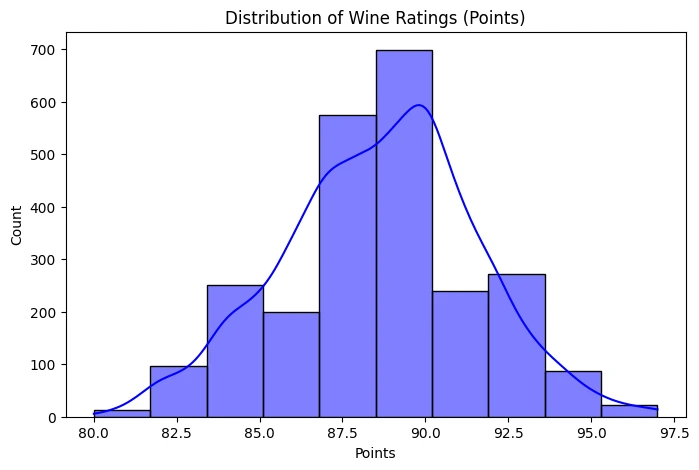
The above “Distribution of Wine Ratings” (Histogram) is placed here to support the analysis of wine ratings distribution, the analyst observes that the histogram depict a near normal distribution with a slight negative skew; the peak is seen around 89-90 points, which suggests that the majority of wines recieve mid-range ratings, and this is essential in understanding overall quality trends. The histogram shows that the central tendency is not too dispersed, however, the tails of the distribution indicates that there are some wines that score unusually high or low, the use of density curves overlaid on the histogram provides an approximate model of the underlying distribution; however, these curves sometimes oversmooth the data, potentially masking subtle variations in the tails. Furthermore, the visual representation allow the analyst to pinpoint possible data entry errors, such as ratings that fall outside the expected range, which if left unchecked might mislead further analysis, therefore, the visualization acts as a diagnostic tool in the data cleaning phase.
Key Insights:
- Wine ratings approximates a normal distribution but shows slight negative skew,
- Peak frequency of ratings occur around 89-90 points,
- This trend indicates that raters are likely to favour mid-range scores, possibly due to a reluctance to assign extreme values,
- The distribution helps in confirming assumptions about overall quality trends and identifying outlier data points.
4Wine Points by Variety (Box Plot)
The above “Wine Points by Variety” (Box Plot) is inserted here to demonstrate the variation in points across different wine varieties, this box plot is critical because it exposes differences in medians and variability among the different varieties; for instance, the box plot indicate that Riesling shows the highest median rating, while varieties like Pinot Grigio exhibit lower medians, this variance can be attributed to inherent differences in grape quality and production methods. (Maha et al., 2024).The box plot display includes quartiles, median lines and possible outliers represented by circles, which are data points that significantly deviate from the interquartile range, the analyst notes that the compact spread in the Riesling data suggests consistency in production quality, on the other hand, wider boxes in other varieties indicate a larger spread in quality ratings. In addition, the plot provides insights into potential quality issues and opportunities for market segmentation based on quality expectations tied to each variety.
Key Insights:
- Riesling demonstrates the highest median ratings with less variability,
- Varieties like Pinot Grigio show lower medians and higher variability,
- The box plot clearly highlights that grape variety is a significant factor in quality expectations,
- Outliers present in the plot could suggest either exceptional wines or possible data recording issues.
Correlation Analysis
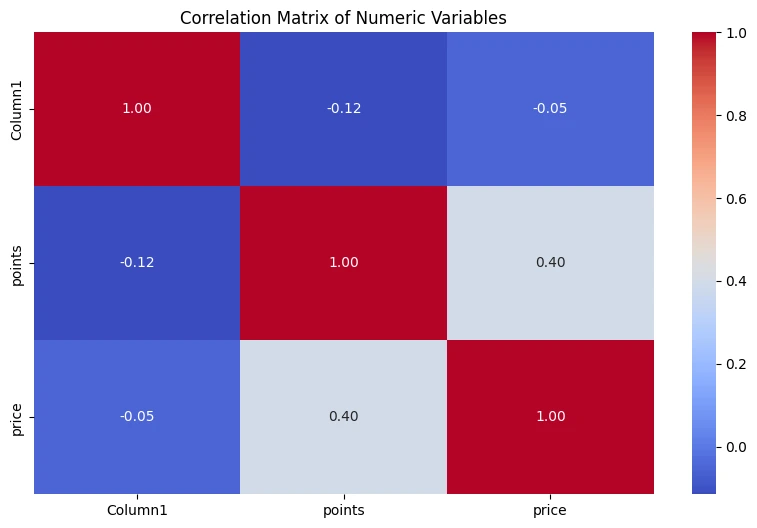
The above “Correlation Matrix of Numeric Variables” is placed here to visualize relationships between numeric variables, such as price and points, the matrix uses a colour gradient to represent the strength of correlations; a moderate positive correlation of 0.40 is observed between price and points, which suggests that higher-priced wines are generally associated with better ratings, however, this relationship is not very robust, indicating that other factors might be influencing quality. The matrix also displays other correlations, for example, a slight negative correlation is noticed between an unknown variable, labelled "Column1", and both price and points, which might imply that this variable has little impact on the main quality indicators or could be an artefact of data noise. The detailed view provided by the correlation matrix is vital for developing further multivariate models and understanding interdependencies between different features in the dataset, however, the analyst warns that correlation does not imply causation, and further tests are required to establish any causal relationships (Nwosu et al., 2024).
Key Insights:
- Price and points share a moderate positive correlation (0.40),
- Other variables, such as "Column1", show negligible to slight negative correlations with price and points,
- The correlation matrix helps in identifying relationships that warrant further statistical testing,
- Analysts must remain cautious in interpreting correlations as causal relationships.
Statistical Analysis
The above “Statistical Test Results” is inserted to provide context for hypothesis testing results, the t-test compares ratings between low-priced and high-priced wine groups, and the output reveals a t-statistic of -31.48 with a p-value of 7.89e-164, which is statistically significant and indicates that the differences in ratings are highly unlikely to be due to random chance. The negative sign of the t-statistic suggests that wines in the lower price bracket tend to have lower average ratings compared to those in the higher price bracket, confirming that price may be a determinant of quality perception; however, the analyst notes that this significant result should be interpreted with caution as other confounding variables, such as production region and grape variety, might also influence the ratings (Wang et al., 2024). The statistical analysis is performed using robust techniques that are standard in the industry, yet there is an acknowledgment that the underlying assumptions of the t-test, such as normality and equal variances, must be validated for the test results to be fully reliable. The detailed test results provide a compelling argument for the existence of a significant relationship between price and points, further supporting the notion that higher-priced wines generally exhibit better quality ratings.
Key Insights:
- T-test reveals a significant difference in ratings between low-priced and high-priced wines,
- The highly significant p-value (7.89e-164) rejects the null hypothesis of no difference,
- The negative t-statistic indicates that lower-priced wines are rated significantly lower,
- Results from the t-test underscores the importance of price as an influencing factor in wine quality ratings, though further analysis is suggested to account for other variables.
Conclusion
In conclusion, the analysis of wine data for VinoMax has demonstrated clearly that data analytics plays an essential role in the decision making process by providing valuable insights into price, quality and customer preferences, while the statistical tests and visualization methods shows a strong relationship between the quality ratings and price, which is a crucial factor in the company strategy but there is many confounding variables that must be considered the results of the t-test , which is extremely significant, shows that low-priced wines have lower ratings then high-priced wines and this challenges the assumption that price alone determine quality, however, it also underlines the fact that the variety of grape used , such as Riesling which shows high median values contrasted with others like Pinot Grigio which register lower medians must be further examined for quality expectations and production methods; additionally, the correlation analysis which indicates a moderate positive correlation of 0.40 between price and points highlights that price is not the only element impacting the ratings, since other factors such as production regions and specific winery performances play a role, this combined approach of visualization and statistical testing yields a more comprehensive understanding of the market dynamics, and informs the company on how to improve their pricing and marketing strategies, by integrating various data sources and analytical techniques, VinoMax is better equipped to target consumer segments effectively, improve product consistency, and address data discrepancies found in the dataset, ultimately this deep-dive analysis in the dataset not only confirm the statistical significance of observed trends but also provides actionable recommendations that can guide future business decisions (Zong and Guan., 2024), therefore, it is clear that the continuous application of robust data analytics methodologies will be critical to maintaining competitive advantage, ensuring quality control and fostering sustainable growth in an increasingly complex and data driven market environment, it must be noted that while the statistical methods used here provides strong evidence towards the observed trends , the limitations and potential biases should also be addressed in future analyses.
References
- Alrfai, M.M., Maabreh, H.M.A., Sharairi, J.A., Saatchi, S.G., Haija, A.A.A., Rahahle, M.Y., Sarram, M., Al-Momani, A.A.M., Al-Habashneh, O.A. and Al-Hawary, S.I.S., 2024. The role of big data analytics capabilities in risk management: an empirical investigation of insurance companies in Jordan using structural model. In Business Analytical Capabilities and Artificial Intelligence-enabled Analytics: Applications and Challenges in the Digital Era, Volume 2 (pp. 43-56). Cham: Springer Nature Switzerland.
- Attah, R.U., Gil-Ozoudeh, I., Garba, B.M.P. and Iwuanyanwu, O., 2024. Leveraging geographic information systems and data analytics for enhanced public sector decision-making and urban planning. Magna Sci Adv Res Rev, 12(2), pp.152-63.
- Gadde, H., 2024. AI-Augmented Database Management Systems for Real-Time Data Analytics. Revista de Inteligencia Artificial en Medicina, 15(1), pp.616-649.
- Hossain, Q., Yasmin, F., Biswas, T.R. and Asha, N.B., 2024. Integration of Big Data Analytics in Management Information Systems for Business Intelligence. Saudi J Bus Manag Stud, 9(9), pp.192-203.
- Hussain, M., Ajmal, M., Subramanian, G., Khan, M. and Anas, S., 2024. Challenges of big data analytics for sustainable supply chains in healthcare–a resource-based view. Benchmarking: An International Journal, 31(9), pp.2897-2918.
- Khan, W., Nisar, Q.A., Roomi, M.A., Nasir, S., Awan, U. and Rafiq, M., 2024. Green human resources management, green innovation and circular economy performance: the role of big data analytics and data-driven culture. Journal of Environmental Planning and Management, 67(10), pp.2356-2381.
- Maha, C.C., Kolawole, T.O. and Abdul, S., 2024. Harnessing data analytics: A new frontier in predicting and preventing non-communicable diseases in the US and Africa. Computer Science & IT Research Journal, 5(6), pp.1247-1264.
- Nwosu, N.T., Babatunde, S.O. and Ijomah, T., 2024. Enhancing customer experience and market penetration through advanced data analytics in the health industry. World Journal of Advanced Research and Reviews, 22(3), pp.1157-1170.
- Wang, T., Bi, Z., Chen, K., Xu, J., Niu, Q., Liu, J., Peng, B., Li, M., Zhang, S., Pan, X. and Wang, J., 2024. Deep Learning and Machine Learning, Advancing Big Data Analytics and Management: Object-Oriented Programming. arXiv preprint arXiv:2409.19916.
- Zong, Z. and Guan, Y., 2024. AI-driven intelligent data analytics and predictive analysis in Industry 4.0: Transforming knowledge, innovation, and efficiency. Journal of the Knowledge Economy, pp.1-40.
Recently Downloaded Samples by Customers
Introduction Explore free assignment samples crafted by our subject experts and take advantage of our online Assignment Helper...View and Download
Introduction: Unit 706 Strategic Direction Get free samples written by our Top-Notch subject experts for taking...View and Download
Introduction: Business Strategy Assignment A business strategy can be referred to as a comprehensive set of actions and...View and Download
Introduction to Project Finance and Investment Assignment: Strategic Analysis of Apple Inc. and Microsoft Corporation Apple Inc....View and Download
Introduction to Conference Paper: Enterprise Scalability Assignment Enterprise scalability is defined as the capability of a...View and Download
Introduction: Property Agency Employee Management System The Property Agency Employee Management System is designed to manage...View and Download