Understanding Health Conditions in Mental Health Nursing Assignment Sample
This assignment examines mental health conditions in nursing practice, from recognising symptoms to planning care and supporting patient wellbeing needs.
- Introduction
- Discuss the Pathophysiology, Aetiology, and Presentation of the Condition
- Pathophysiology of depression and anxiety
- Aetiology
- Presentation of depression and anxiety
- Reflect on individuals’ and their careers’ lived experience of the condition
- Examine the interplay between bio-psychosocial (physical, psychological and social) aspects of the health condition
- Impact on the person and their careers
- Type Assignment
- Downloads549
- Pages10
- Words2524
Introduction
Understanding health conditions is essential in mental health nursing practices as it allows nurses to provide appropriate care to patients to improve their outcomes and promote well-being. This assessment mainly produces a case study in the form of a concept map relating to Mr. Jones who suffered from depression and anxiety. Depression and anxiety are two prevalent mental health conditions that hurt individuals' emotional well-being and daily functioning. This case study also explores the lived experiences of the individual, highlighting the complex interplay between biological, psychological, and social factors influencing their mental health and overall quality of life. Additionally, by effectively understanding these dynamics, it is easy to find out some significant diagnoses that can help and support the patient to recover quickly. These dynamic analyses are also crucial for effective nursing practice and providing holistic care to the patient.
Juggling lectures, part-time work, and deadlines? Let our Assignment Help For Students take the pressure off with professionally written, thoroughly researched assignments at affordable prices.
Discuss the Pathophysiology, Aetiology, and Presentation of the Condition
The terms "pathophysiology," "aetiology," and "presentation" are essential for comprehending any disease. Pathophysiology represents the functional differences that appear in the body due to a disease or a specific injury. Aetiology refers to the reason or source of the disease. Presentation contains the visible signs and symptoms a patient experiences and the way the condition manifests itself.
Pathophysiology of depression and anxiety
Depression and anxiety are increased through a complicated interplay among neurobiological, genetic, and environmental factors. However, depression and anxiety are also created due to different types of mental pressures, such as financial pressure, relationship pressure, study or career pressure, etc, which are mainly visible in individuals. Neurotransmitter dysregulation is an essential aspect, prominently affecting the monoamines serotonin, norepinephrine, and dopamine, which play important roles in mood regulation. In addition, most of the studies and researchers indicate that low levels of serotonin are significantly connected with depressive symptoms, affecting mood, sleep, and appetite (Kayabaşı et al., 2021). Norepinephrine, related to arousal and alertness, is also implicated, with deficiencies potentially contributing to depressive states characterised by fatigue and diminished motivation (Ross and Van, 2021).
The neuroanatomical research supports the concept that depression and anxiety is significantly connected with modifications in brain structure and function. The brain imaging studies also demonstrate that alterations in areas such as the prefrontal cortex are effectively involved in decision-making and emotional regulation, which processes emotions (de Almeida Brites, 2024). Additionally, the hippocampus is significantly essential for memory and learning because it helps and supports effectively reducing volume in individuals who suffer from depression and anxiety. Different individuals mainly suffered from anxiety and depression due to neurotoxic effects of chronic stress and the resultant dysregulation of the hypothalamic-pituitary-adrenal (HPA) axis (Milligan et al., 2021).
Aetiology
The aetiology of depression and anxiety is multifactorial, containing genetic, environmental, psychological, and biological components. Genetic predisposition most essential cause of depression and anxiety, because if any individual has a painful family history, it can be a significant risk factor. Environmental factors, such as trauma, loss, and chronic stress, can be considered as precipitants and exacerbate symptoms. The psychological factors, mainly including mental distortions and maladaptive coping mechanisms, also further contribute to the development of these disorders, causing individuals to feel depressed. Thus, it is crucial to identify and understand the underlying factors quickly to reduce possible deterioration in the mental health symptoms.
Presentation of depression and anxiety
Depression and anxiety can increase through a variety of forms, as, in recent years, most individuals feel pressure socially and domestically. Most importantly, according to the Diagnostic and Statistical Manual of Mental Disorders (DSM-5), if an individual has a symptom of depressive mood, loss of interest in any work and communication, sleep disturbances, and feelings of worthlessness or excessive guilt for minimum two weeks then he require depression diagnosis (Ma, 2022).. Moreover, by effectively implementing these diagnoses, it was easy to ensure a patient’s quick recovery who suffered from depression and anxiety (Banerjee et al., 2024). On the other hand, manifests as excessive worry, restlessness, irritability, and physical symptoms such as palpitations or muscle tension also considered significant causes of increasing depression and anxiety. Co-occurring symptoms require complicated diagnosis and treatment; however, making a complete assessment is necessary for effective intervention (Otasowie, 2021).
Reflect on individuals’ and their careers’ lived experience of the condition
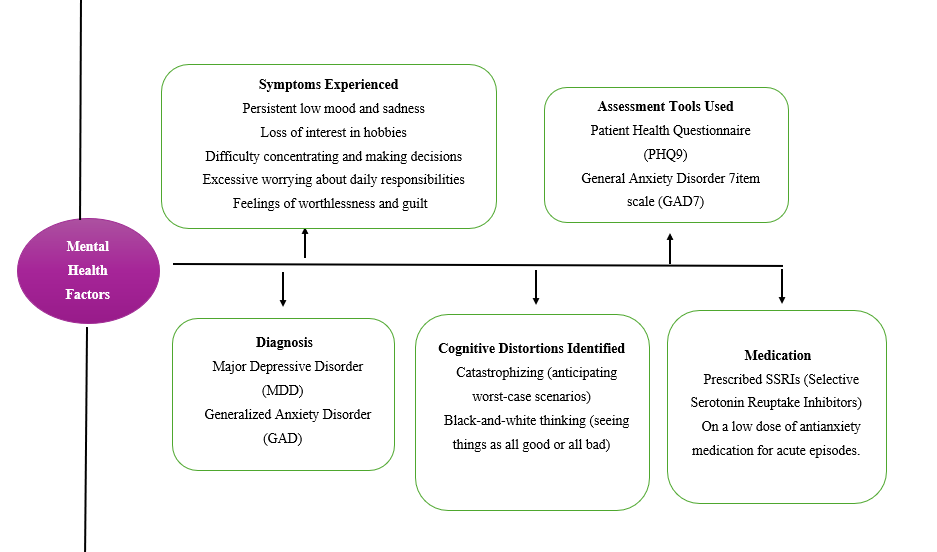
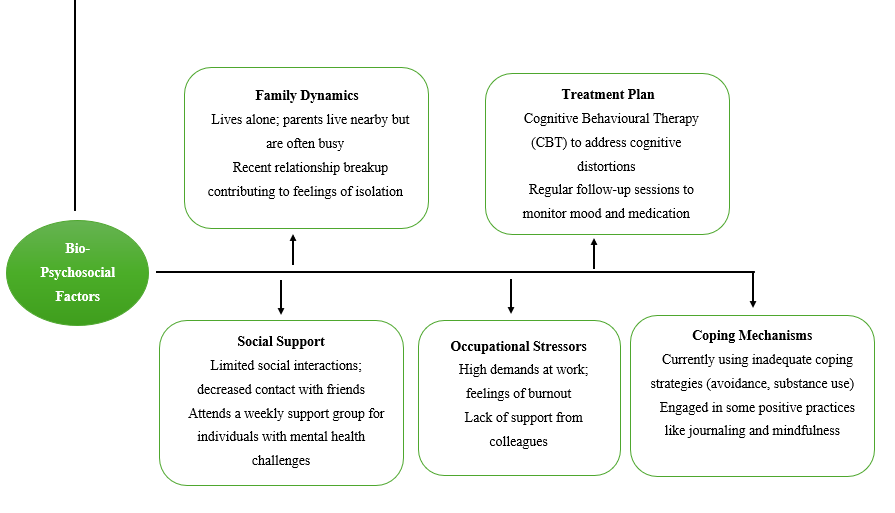
Figure 1: Case Study Concept Map
(Source: Self-Created)
The individual in focus, a 34-year-old male Mr. Jones, experienced a significant decrease in mental health following the loss of a close family member. The initial symptoms of his mental depression and anxiety were overwhelming sadness, a lack of motivation, and difficulties concentrating at work. He has no significant previous medical history but bears a family history of anxiety and depression. As time progressed, he started experiencing heightened anxiety, which is significantly characterised by constant worry about job security and feelings of inadequacy. Most importantly, due to these potential reasons, he also faces some mental pressure regarding financial instability and loneliness. Therefore, due to these specific things, he also started heavy smoking and drinking, which has a negative impact on his physical health as well. In addition, the lived experience of this person reflects that depression, and anxiety can be characterised by many things, such as domestic, social, financial, and career-related pressures. Moreover, when individuals feel this kind of pressure, they start self-isolation, which generates a negative impact on their personal and professional lives. Social relations also declined as he stopped communicating with friends and family, and it strengthened his feelings of loneliness. The stigma connected with mental health issues exacerbated his condition, as he feared judgment and sought to maintain a facade of normalcy at work. Due to high depression and anxiety levels, individuals experience low confidence in work, and this creates different types of conflicts with family, friends, and colleagues. For mental health diagnosis, Major Depressive Disorder (MDD) and Generalized Anxiety Disorder (GAD) has been used (pmc.ncbi.nlm.nih.gov, 2021). Thus, he prescribed with SSRIs (Selective Serotonin Reuptake Inhibitors) on a low dose for acute incidents.
Most importantly, depression and anxiety can lead to reduced focus, attention, and encouragement of an individual; it also makes some potential difficult to meet work demands. In addition, this kind of situation not only creates symptoms of depression, but it also increases the suicidal tendency. However, the significant interplay between an individual's mental and physical health became clear as they developed sleeplessness and increased fatigue, leading to decreased productivity and performance at work. Moreover, most of the individuals also noticed some potential changes in their demeanour, expressing concern but feeling uncertain about how to approach the topic. This lack of supportive dialogue further increases their silence and struggle. In addition, when individuals feel this kind of situation, they require potential support from their families and friends. By giving them proper mental support, they can feel comfortable and which helps and supports them to overcome depression and anxiety. Therefore, as per various researchers, it was easy to understand the signs of depreciation and anxiety, not only visible in mature individuals in recent years most college students who are aged between 18 to 40 experience these potential problems. Additionally, these kinds of problems not only hurt their mental well-being being it also generate a negative impact on their career and academic growth. However, to reduce these problems, individuals can join a meditation club because it can create a comfortable environment, which also generates a positive impact on their personal and professional lives. Furthermore, when individuals effectively identify the reason behind the increasing depression and anxiety, individuals can effectively improve their physical and mental well-being, and it also enhances their career prospects.
Examine the interplay between bio-psychosocial (physical, psychological and social) aspects of the health condition
|
Physical |
Biologically, genetic predisposition and neurotransmitter imbalances are key factors in the development of depression and anxiety. In addition, according to Homberg and Jagiellowicz, (2022), certain alleles may increase an individual’s susceptibility to depression. Variations in genes related to serotonin transport, such as the serotonin transporter gene (5-HTTLPR), have been implicated in the modulation of emotional responses and stress reactivity. Additionally, abnormalities in neurotransmitter systems, particularly those involving serotonin, norepinephrine, and dopamine, are commonly associated with depressive symptoms. These biological underpinnings suggest that depression has a physiological basis, which necessitates a more extensive evaluation beyond environmental factors. Most importantly, neuroimaging studies have revealed that individuals with depression and anxiety often exhibit changes in brain structure and function. For example, alterations in the prefrontal cortex, hippocampus, and amygdala have been observed, indicating impairments in cognitive control, emotional regulation, and memory processes (Friedman and Robbins, 2022). |
|
Psychological |
Psychologically, cognitive processes and personality traits significantly influence the manifestation and trajectory of depression and anxiety. Beck et al. (2024) highlight how negative thinking patterns, such as hopelessness or cognitive distortions, can lead to and perpetuate depressive states. Individuals who exhibit traits associated with neuroticism may be more prone to experiencing heightened emotional distress and developing depression and anxiety, as their propensity to respond negatively to stressors can exacerbate symptoms. Patient Health Questionnaire (PHQ9) and General Anxiety Disorder 7item scale (GAD7) are used (self-report questionnaires) for screening and measuring depression and anxiety respectively (pmc.ncbi.nlm.nih.gov, 2021). The insights into the Cognitive-behavioural therapy (CBT) sustain the effective psychological intervention for individual having depression and anxiety. This concentrates on identifications and restructuring maladaptive patterns of thoughts (Roscoe and Taylor, 2023). This therapeutic approach aid a person to challenge negative perceptions while promoting skills to manage stress. |
|
Social |
Environmental and social stressors also impact the depression and anxiety management. For example, aspects such as family dynamics, socioeconomic status, cultural context, and social support are paramount in shaping experiences among individuals especially with depression and anxiety. As opined by Prizeman et al., (2024), depression further influence by social isolation and scarce of supportive relationships, mainly during treatments. In addition, societal stigma surrounding mental health issues often discourages individuals from seeking help, leading to feelings of shame and further entrenchment in depressive symptoms (Prizeman et al., 2024). Additionally, workplace factors play an important role in the biopsychosocial landscape of depression and anxiety. |
Table 1: Examine the Interplay Between Bio-Psychosocial Aspects

 10 Years | MSc in Nursing
Impact on the person and their careers
Depression and anxiety can significantly impact both personal well-being and career advancement. They can also lead to decreased productivity, creating difficulty focusing, increased truancy, and challenges in interpersonal connections at work. Therefore, it also effectively affects job satisfaction and career advancement because when different individuals experience depression, they start feeling lonely and worthless at work. However, due to these specific problems, most of the individuals also feel detached from family, friends, and the workplace. Most importantly, due to the feeling of depression and anxiety, most of the individuals experience a swinging mood, which can generate a negative impact on their work environment because it creates conflict with colleagues. However, a supportive and healthy work environment can be a protective factor for mental health, while poor working conditions can exacerbate these issues. The impact of depression and anxiety on individuals extends far beyond emotional distress; it can significantly affect their professional lives and overall careers.
Therefore, individuals also experience decreased productivity and increased absenteeism, which can lead to job insecurity and heightened stress levels (Sanchez et al., 2021). The cyclical nature of depression and work-related stress can create a challenging environment for recovery, where performance issues further exacerbate the severity of depressive symptoms. Career aspirations can also be adversely affected, with individuals reporting the desire to downsize their professional goals, fearing failure or an inability to cope with increased responsibilities (Chen and Siew, 2024). In some cases, individuals may feel compelled to leave their careers altogether, aiming for less demanding roles and even transitioning to part-time work. The long-term career consequences of depression can thus be profound, influencing not only financial stability but also personal identity and fulfilment. In addition, due to depression and anxiety, most of the individuals feel a lower satisfaction level regarding their work. It also effectively increases the suicidal tendency among them.
Conclusion
Based on the overall analysis, it was easy to conclude that depression and anxiety are the most significant issues which generate a negative impact on an individual’s mental and physical well-being. Therefore, as per the analysis, depression and anxiety are mainly caused by various things such as high work pressure, feeling lonely, and detachment from others. However, to mitigate these potential issues, individuals need to effectively join a medication club, communicate with family and friends regarding their feelings. According to the research, it was also identified that due to the mental conditions of depression and anxiety, many individuals can feel a suicidal tendency.
Reference
- Banerjee, P., Chau, K., Kotla, S., Davis, E.L., Turcios, E.B., Li, S., Pengzhi, Z., Wang, G., Kolluru, G.K., Jain, A. and Cooke, J.P., (2024). A potential role for MAGI-1 in the bi-directional relationship between Major Depressive Disorder and Cardiovascular Disease. Current atherosclerosis reports, 26(9), pp.463-483.
- Beck, A.T., Rush, A.J., Shaw, B.F., Emery, G., DeRubeis, R.J. and Hollon, S.D., (2024). Cognitive therapy of depression. Guilford Publications.
- Chen, C.P. and Siew, R., (2024). Improving career wellbeing of individuals with serious mental illness. British Journal of Guidance & Counselling, 52(3), pp.405-417.
- de Almeida Brites, J., (2024). Patterns of Brain Activity in Aggressors: A Meta-Analysis Study of Functional Magnetic Resonance Imaging on Decision-Making and Emotional Regulation: Mini Review. SOJ Neuro Neurosci, 4(1), pp.1-4.
- Friedman, N.P. and Robbins, T.W., (2022). The role of prefrontal cortex in cognitive control and executive function. Neuropsychopharmacology, 47(1), pp.72-89.
- Homberg, J.R. and Jagiellowicz, J., (2022). A neural model of vulnerability and resilience to stress-related disorders linked to differential susceptibility. Molecular Psychiatry, 27(1), pp.514-524.
- Kayabaşı, Y., Güneş, B. and Erbaş, O., (2021). Serotonin receptors and depression. Journal of Experimental and Basic Medical Sciences, 2(2), pp.240-246.
- Ma, F., (2022). Diagnostic and statistical manual of mental disorders-5 (DSM-5). In Encyclopedia of gerontology and population aging (pp. 1414-1425). Cham: Springer International Publishing.
- Milligan Armstrong, A., Porter, T., Quek, H., White, A., Haynes, J., Jackaman, C., Villemagne, V., Munyard, K., Laws, S.M., Verdile, G. and Groth, D., (2021). Chronic stress and A lzheimer's disease: the interplay between the hypothalamic–pituitary–adrenal axis, genetics and microglia. Biological Reviews, 96(5), pp.2209-2228.
- Otasowie, J., (2021). Co-occurring mental disorder and substance use disorder in young people: aetiology, assessment and treatment. BJPsych Advances, 27(4), pp.272-281.
- pmc.ncbi.nlm.nih.gov, (2021). Generalised Anxiety Disorder and Depression: Contemporary Treatment Approaches. Available at: https://pmc.ncbi.nlm.nih.gov/articles/PMC8437834/ (Accessed on 8.7.2025)
- pmc.ncbi.nlm.nih.gov, (2021). Patient Health Questionnaire 9 (PHQ-9) and General Anxiety Disorder 7 (GAD-7) data contributed by 13,829 respondents to a national survey about COVID-19 restrictions in Australia. Available at: https://pmc.ncbi.nlm.nih.gov/articles/PMC9754708/. (Accessed on 8.7.2025)
- Prizeman, K., McCabe, C. and Weinstein, N., (2024). Stigma and its impact on disclosure and mental health secrecy in young people with clinical depression symptoms: A qualitative analysis. Plos one, 19(1), p.e0296221.
- Prizeman, K., Weinstein, N. and McCabe, C., (2023). Effects of mental health stigma on loneliness, social isolation, and relationships in young people with depression symptoms. BMC psychiatry, 23(1), p.527.
- Roscoe, J. and Taylor, J., (2023). Maladaptive therapist schemas in CBT practice, training and supervision: A scoping review. Clinical Psychology & Psychotherapy, 30(3), pp.510-527.
- Ross, J.A. and Van Bockstaele, E.J., (2021). The locus coeruleus-norepinephrine system in stress and arousal: unraveling historical, current, and future perspectives. Frontiers in psychiatry, 11, p.601519.
- Sanchez-Gomez, M., Giorgi, G., Finstad, G.L., Alessio, F., Ariza-Montes, A., Arcangeli, G. and Mucci, N., (2021). Economic stress at work: its impact over absenteeism and innovation. International journal of environmental research and public health, 18(10), p.5265.
Recently Downloaded Samples by Customers
Introduction: Life Course Approaches to Health and Ageing Middle life is commonly referred to as the period between the ages of...View and Download
Introduction Get free samples written by our Top-Notch subject experts for taking online Assignment...View and Download
Introduction to Business Economics Assignment Business economics is explained as a field of applied economics which studies the...View and Download
Introduction to Auditing Assignment Sample Audit Senior 1 Company background Compass Group plc. is a British multinational...View and Download
1.0 Introduction Equity came into existence when there were felt to be injustices that were not catered for in the “common...View and Download
Introduction Health and social care is one of most responsible field and it highly contributes to the welfare of society. A...View and Download