+44 75754 30035 help@rapidassignmenthelp.co.uk
offer
🎁Special Offer 🎁 Discounts - Up to 50% OFF!
🎁Special Offer 🎁 Discounts - Up to 50% OFF!

As a UK student, you might have the dream of scoring higher marks, getting good grades, and better placement. What if you’re classified as a 2:2 degree? Are your career options over? Absolutely not, and that’s why you need to understand what it actually is so you stop blaming your potential. You might be thinking, as obvious as it is, but knowing ‘What is a 2:2 degree in the UK' might be helpful for you.
In this blog, you are going to explore this classification while breaking the key myths from top to bottom. At the end, you will be well informed about the degree and will have a changed perception. So let’s find out the best advice from the guide by starting now.
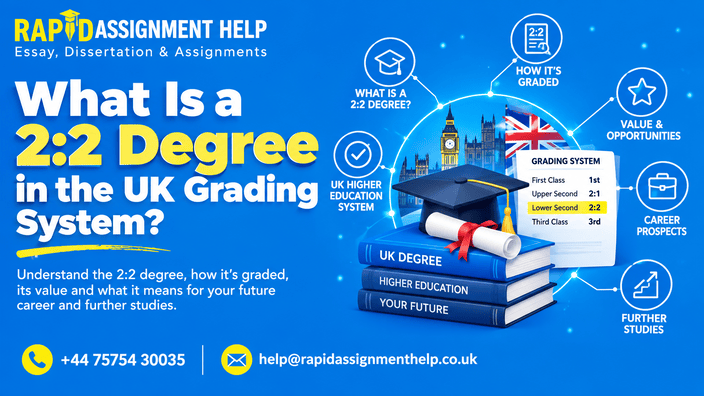
The definition of a 2:2 degree is quite simple. It is a classification that addresses the Lower Second-Class Honours degree at the undergraduate level. It sits below a 2:1 (Upper Second-Class Honours) and above a Third-Class Honours degree in the UK grading system.
In universities, there are academic requirements for an honours degree, and the name symbolises that. It is also called Desmond in British university slang because the name is similar to the name Desmond Totu.
The definition is clear now, so let’s look at the requirements to achieve that honour.
Now here is the main question: ‘What percentage is a 2:2 degree?’ Well, if your marks range between 50% and 59%, you are considered a 2:2 degree holder. These honours depend upon the UK classification, which follows:
| Degree Classification | Typical Percentage |
| First-Class Honours | 70% and above |
| Upper Second-Class Honours (2:1) | 60%-69% |
| Lower Second-Class Honours (2:2) | 50%-59% |
| Third-Class Honours | 40%-49% |
| Fail | Usually below 40% |
These numbers are standard, but sometimes they depend on the university and its specific rules. Some universities also use additional criteria to determine whether a student just below a classification boundary qualifies for the higher reward.
Suppose you have scored the required marks to be considered a 2:2 degree holder, but is it good? So the answer is yes but subjective too. Whether it is a good result depends on your career goals, subject, and the entry requirements of your intended job or postgraduate course.
The classification is sufficient for many jobs and also meets the entry requirements for certain postgraduate courses. However, sometimes it varies, so it's better to check these factors:
Career requirements: Check whether your preferred employers accept applicants with a 2:2.
Further study: Review the entry criteria for master's degrees and other postgraduate qualifications.
Relevant experience: Internships, placements and practical projects can help demonstrate your capabilities.
Career progression: Professional skills, further qualifications and work performance may become increasingly important as you gain experience.
Just like these, it comes with many advantages which you’re going to explore next.
You might be surprised, but you can still access many opportunities with a 2:2 degree classification. On the one hand, some point to the numbers as average; it brings so many benefits. Here are the key advantages:
There are many skill-based jobs in companies, and employers look for graduates for them. With enough experience and suitability for the role, a 2:2 degree adds a plus point for the position. It helps you access many opportunities for your career.
If you have a plan to continue your studies further, a 2:2 degree classification might be helpful. Many postgraduate programmes accept applicants with a 2:2 if you have relevant experience, a strong personal statement, and evidence of suitability. However, always confirm the specific entry requirements before applying.
Access to different training programmes, certifications or industry-specific qualifications is also easy for you. With such guidance and additional training, you can develop specialised knowledge and strengthen your CV.
Even though you haven’t achieved the classification you aimed for, it doesn’t diminish your learning and practical knowledge. Work placements, volunteering, personal projects, and relevant employment can help demonstrate problem-solving, communication, teamwork, and other skills.
While a 2:2 is just an academic way to classify ranks, it doesn’t automatically prevent you from progressing into more senior positions. With relevant experience, you can get better chances for greater emphasis on your achievements, expertise, and performance.
These benefits are vital and helpful for students who have the 2:2 classification. However, sometimes it's not enough for some programmes and roles, so can you improve it? Let’s explore it in the next section.
The answer to whether you can improve your degree classification explicitly depends on your university. If regulations allow you to do it, you can and here are the possible steps to understand your options:
Check your final weighted average
Look at your marking and confirm your current marks and how each year, module, and credit contributes to your final classification.
Review the borderline classification rules
If your marks are just below the required 2:1, ask your professors. Some universities consider students whose final marks fall just below a classification boundary. The criteria for an upgrade differ between institutions.
Check whether any assessments remain
The best chance to improve your degree classification when you haven’t completed your degree. Identify the remaining assessments that count towards your classification. Calculate what marks you would need to reach your target, using your course’s actual weighting rules.
Speak to your academic department
If you want to know whether an extension is allowed or not, ask your tutor or programme administrator. They will explain the applicable regulations, confirm your current position, and clarify whether a borderline review is available.
Focus on the work that still counts
Maybe there are some upcoming assessments; use the marking criteria, feedback, and academic support to improve your performance. This small step can help you change the final results.
You can ask your university whether any formal review or appeal route applies to your circumstances. Do not assume that a mark close to 60% will automatically be rounded up or upgraded. However, if you are considered to be 2:2, you should avoid these misconceptions explained next.
Since academic marks relate to the future, students start putting themselves into myths or overthinking that should be broken. The reason understanding facts can help you make better decisions about your next steps:
| Common Misconceptions | The Reality |
| A 2:2 means you cannot get a good job | Many employers consider applicants with a 2:2, particularly where no minimum classification is specified |
| All graduate schemes require a 2:1 | Some do, but others accept a 2:2. Always check individual scheme requirements |
| You cannot pursue a master’s degree with a 2:2 | Some postgraduate courses accept a 2:2, while others require higher marks or additional qualifications |
| Employers only care about your degree classification | Employers may also assess relevant experience, technical abilities, communication, and interview performance |
| A mark of 59% always means you will receive a 2:2 | Borderline rules may apply, but depending on the university’s regulations and your academic profile |
| Every UK university calculates degrees in the same way | Classification bands are widely used, but calculation methods, weightings, and borderline rules can differ |
One thing to remember as a student is that a 2:2 is neither a guarantee of success nor a barrier to every opportunity. Now it’s time to end this blog with some useful learning.
To wrap up, a vast majority of students in the UK earn a 2:2 degree classification but still do better in life. The reason it is just a profile, not proof of excellence and this mindset should be developed. Instead of overthinking, you should think about merging your experience and building a skill set for a bright future. And if you have time, focus on how you can improve it with the practices mentioned above.
This is how you can change your perspective and do better for your career. We hope this blog gave you the information to change the old-school mindset. For more such guidance, enrol in Rapid Assignment Help UK and excel in your academics with quality writing and result-driven knowledge.
I am your assignment expert for International Relations. I have done my MPhil in International Relations from the famous University of Oxford. You can reach out to me whenever you are stuck or short of time. I am not just limited to the main subjects of International Relations. You can seek my guidance in geography assignments as well. You will get a quality assignment in these subjects with an incisive analysis.
Get Extra 10% OFF on WhatsApp order!
use discountCopyright 2026 @ Rapid Assignment Help Services