Emphasising the Environment Assignment Sample
This environment assignment example examines major ecological concerns, human impact and practical approaches to environmental protection.

- Type Assignment
- Downloads531
- Pages6
- Words1411
Introduction
Corporate Social Responsibility (CSR) has become a central part of business strategy, rather than a peripheral idea, around the world. Formerly based in philanthropy and community engagement, CSR has now integrated sustainability, ethical governance, and stakeholder interactions into its decision-making process. The definition of sustainable development supplied in the Brundtland Report still stands out as the underlying policy driving current CSR efforts: it refers to sustainable development as development that addresses the needs of the current generation, and still does not deprive future generations of the ability to meet their own needs. Interconnectedness among the global economies, the climatic challenge, the financial crisis, and stakeholder awareness have quickened the significance of CSR (Rahman et al., 2025). Investors, regulators, and consumers have increasingly begun to pressure corporations to make their policies comply with environmental, social, and governance (ESG) considerations. The report is an evidence-based and longitudinal analysis of the development of CSR, taking note of some of the most important milestones and critically analysing the drivers towards global adoption. The discussion is supported by academic sources, data tables, and graphic illustrations.
Juggling lectures, part-time work, and deadlines? Let our Assignment Help For Students take the pressure off with professionally written, thoroughly researched assignments at affordable prices.
|
Date |
Location |
Impact |
Outcome |
|
1976 |
USA |
OECD Guidelines for Multinational Enterprises introduced |
Framework promoting ethical business behaviour internationally |
|
1987 |
Global |
Brundtland Report published |
Concept of “sustainable development” established; sustainability linked with corporate ethics |
|
1992 |
Rio de Janeiro |
UN Earth Summit |
Agenda 21 promoted sustainable corporate activities |
|
1999 |
Global |
UN Global Compact launched |
Voluntary initiative encouraging corporations to adopt sustainable and socially responsible policies |
|
2001 |
EU |
European Commission’s CSR Green Paper |
Formalized CSR in European policy, encouraging businesses to integrate CSR |
|
2011 |
Global |
UN Guiding Principles on Business and Human Rights |
Framework for companies to address human rights issues within their operations |
|
2015 |
Global |
UN Sustainable Development Goals (SDGs) |
17 global goals launched to address poverty, inequality, and climate change |
|
2020 |
Global |
COVID-19 Pandemic |
CSR strategies re-focused on health, labor rights, and community resilience |
|
2021 |
Global |
COP26 Climate Summit |
Major corporate climate pledges announced; Net Zero commitments accelerated |
|
2024 |
Global |
Rise of ESG investing |
ESG factors become standard in investment decision-making; regulatory reporting mandated |
Table: Key Events Shaping the Evolution of Corporate Social Responsibility Source: (Ketterling & Germany, 2025)

 3 Years | MSc in Management
Developmental Trends and Critical Evaluation
The CSR movement developed some steam in the 1970s when such frameworks as the OECD Guidelines promoted ethics in the conduct of multinational enterprises. But it was the Brundtland Report of 1987 that introduced the potent concept of sustainable development which mingled environmental care, social justice, and economic progress. This was achieved when the UN Earth Summit in Rio de Janeiro in 1992 heralded the introduction of sustainability in corporate practices (Agenda 21) that pre-conditioned the corporate commitment to the environment. In 1999, the UN Global Compact offered the world its first international voluntary effort toward corporate sustainability, in which companies were asked to implement their strategies in line with internationally accepted ideas of human rights, labour rights, environmental matters, and anti-corruption policies (Stewart, 2025). The European Union's 2001 Green Paper institutionalized CSR in its regional policy making and European companies have systematically adopted CSR in their operation and management. This policy-based practice made Europe the CSR leader and led to the creation of strong reporting systems and stakeholder engagement systems. CSR acquired a critical governance element in 2011 when the UN Guiding Principles on Business and Human Rights held companies accountable for the social risks that their supply chains entailed, and on the human rights impact thereof. CSR ceased being simply a voluntary activity to became the prescriptions of international law on corporations (Verma et al., 2025). The real breakthrough came in 2015 when the UN Sustainable Development Goals (SDGs) were endorsed. These 17 connected goals gave the world a blueprint to work on to solve the current urgent issues like poverty, inequality, and climate change. Businesses across the world have started incorporating SDG goals in their sustainability plans and CSR is now being related to long-term business strategies The COVID-19 pandemic, in the year 2020, became a kind of litmus test to the resilience of CSR. Most firms turned their attention to employee well-being, teleworking, and social well-being. Tech giants such as Unilever and Microsoft took philanthropic efforts to another level, and also secured employee safety in the workplace, which ultimately led to the intersection of CSR and crisis management (Del Sarto, 2025). In 2021, huge companies declared ambitious plans to tackle climate change at COP26. Companies like Amazon, Microsoft, Shell, and others are committed to net-zero emissions in the face of increased investor and regulatory interest in climate risk. This was an important turning point in the role of CSR as a voluntary process which became a mandatory practice in climate governance. It became a reality because ESG investing took the financial markets by storm by 2024, and governments, such as the EU and the US Securities and Exchange Commission, enforced the essential ESG disclosures. CSR has turned out to be a crucial business force as investors today prefer to patronize firms that can prove their social responsibility, diversity, and carbon-neutrality (MacGregor Pelikánová, 2025).
Get assistance from our PROFESSIONAL ASSIGNMENT WRITERS to receive 100% assured AI-free and high-quality documents on time, ensuring an A+ grade in all subjects.
The graph below shows how many companies publish formal CSR globally: the peak was observed after 2015.
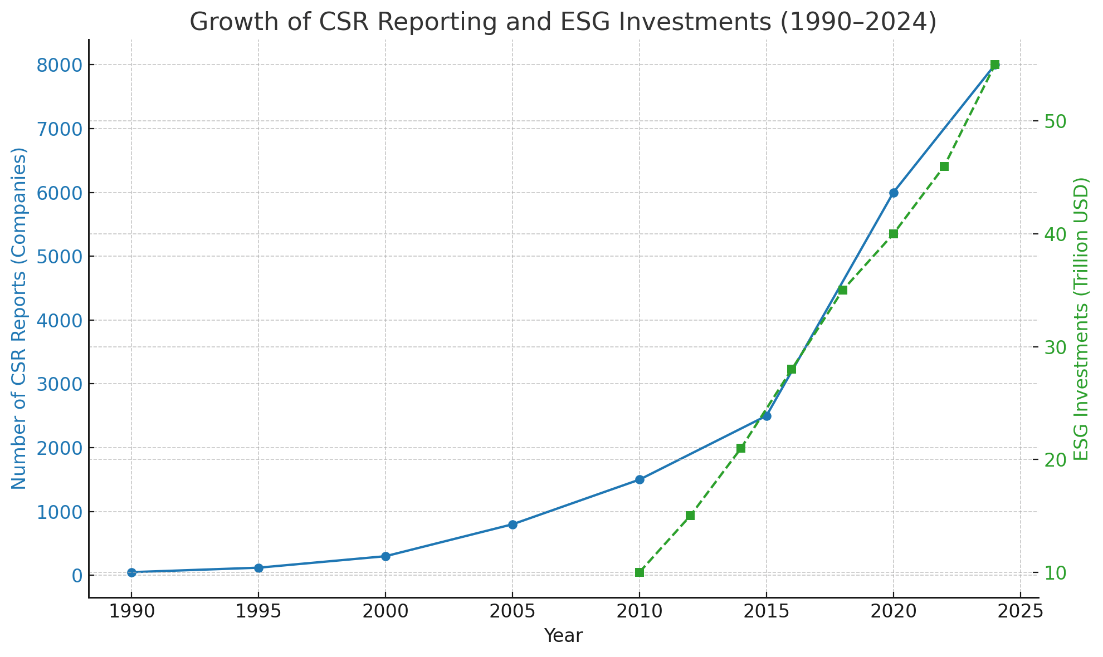
Figure 1: Growth of CSR and ESG Investment
Source: (MacGregor Pelikánová, 2025)
One more chart demonstrates the increase of ESG investing, which also presents assets under management (AUM) in trillions of USD between 2010 and 2024 (Hughes et al., 2025).
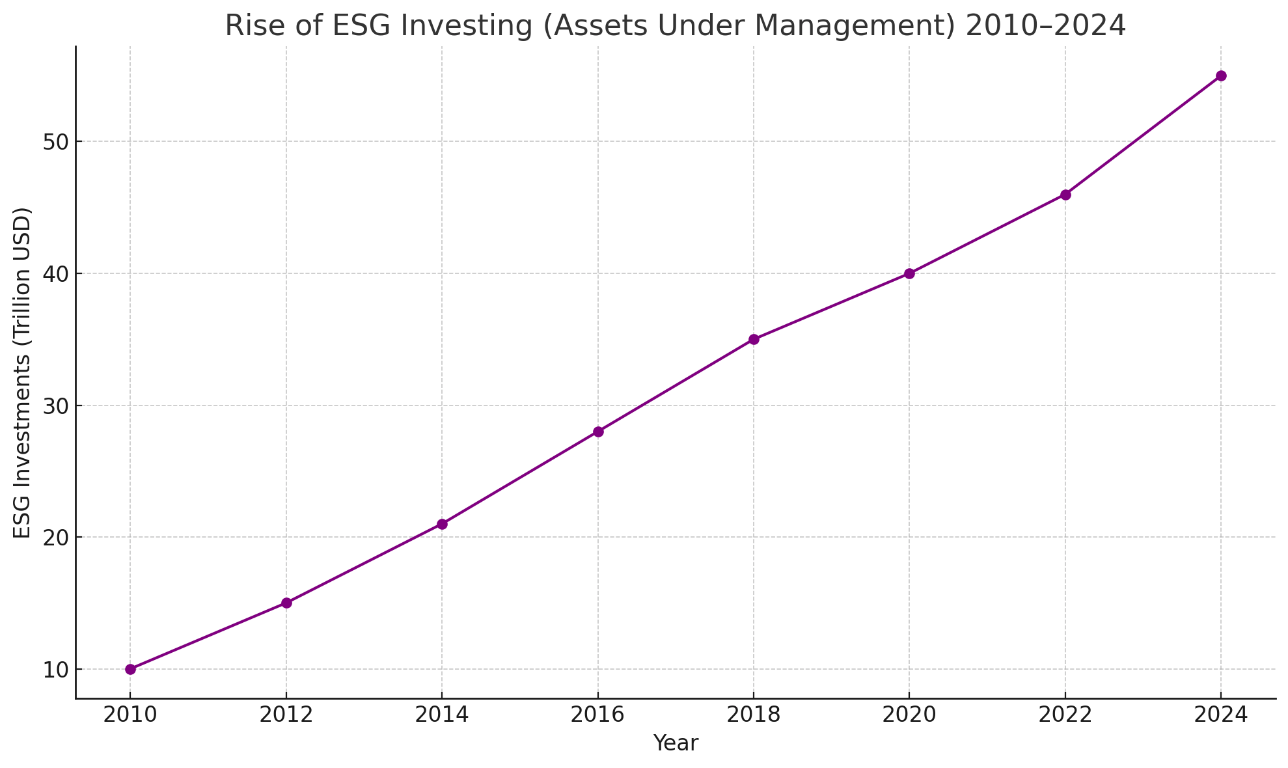
Figure 2: Rise of ESG Investing (Assets Under Management)
Source: (Hughes et al., 2025)
Theoretical Insights and Contemporary Relevance
A significant part of the contemporary development of CSR is based on the stakeholder theory that was originally theorized by Freeman (1984). It assumes that businesses should be able to serve the interests of many stakeholders other than shareholders to successfully achieve long-term success. This theory correlates with the CSR practices that combine the elements of sustainability, community involvement, and ethically responsible governance. The development of CSR is also revealed in the eyes of the institutional theory (Nevo, 2025). With a growing number of regulatory frameworks and international treaties, corporations became able to respond to institutional demands, which soon embraced the idea of CSR as a form of legitimacy and risk alternatives. Further, the pyramid of CSR suggested by Carroll (1991) is one of the classic models with a four-tier focus that includes the economic, legal, ethical, and philanthropic responsibilities (Hejlová, 2025). Over the past few years, businesses have paid more and more attention to ethical and charity aspects at least in terms of community investments and climate programs. The modern CSR focuses on the systemic cohesion of business strategy. The emergence of ESG norms strengthens the tendency of measurable, auditable CSR practices. The companies should also have positive social and environmental effects besides minimizing the harm (Migliavacca, 2025).
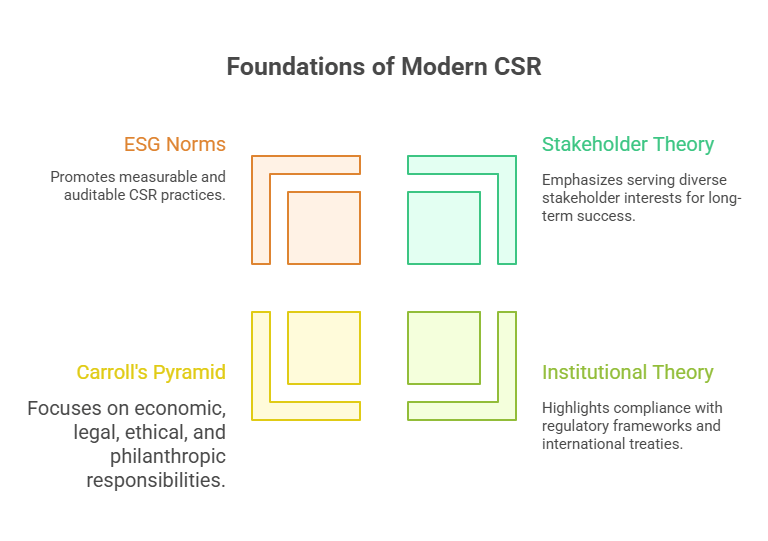
Figure 3: Foundation of Modern CSR
Source: (Migliavacca, 2025)
Conclusion
Corporate Social Responsibility is no longer a side issue, but a business strategy and even a business governance issue. Its development has been driven by major global events, sustainability landmarks, and regulatory changes over the decades. CSR is no longer discretionary but a necessity that ensures risk mitigation, creation of value, and sustainable growth of the present-day world. Modern CSR includes issues of the climate, human rights, adequate supply chain, as well as inclusive governance. The intersection between what investors want, what regulation demands, and what society needs, means that CSR will be taking new directions.
References
- Del Sarto, N. (2025) ‘The evolution of sustainability: From CSR to sustainable finance’, in Banks: Quantitative Insights into the ESG-Cost of Debt. Springer.
- Hejlová, D. (2025) ‘The evolution and controversy of ESG: Communicating responsibility or responsible communication?’, in Responsibility in Strategic Communication. Emerald Publishing.
- Hughes, M., Hu, Q., Simeonova, B., Ge, B. & Issah, W.B. (2025) ESG in family firms: A review of research, regulations and practice guidance. University of East Anglia Repository.
- Ketterling, C.I. & Germany, B. (2025) The global landscape of ESG guidelines and standards: Corporate social responsibility, responsible investment, and ESG compliance. Open Science Framework.
- MacGregor Pelikánová, R. (2025) ‘Enforcement of sustainability by investors: Environment social governance’, in Sustainability in Europe: Roots and Evolution. Springer.
- Migliavacca, A. (2025) Accounting for sustainable business: Integrating CSR and ESG principles. Routledge.
- Nevo, E. (2025) Reasonable sustainability strategy for a drug development company. Theseus Repository (Finland).
- Rahman, M.K., Haque, M. & Darda, M.A. (2025) ‘Breaking into the mainstream: The rise of ESG in business management’, Asian Business Research Journal.
- Stewart, R. (2025) ‘ESG and the changing language of corporate social responsibility’, California Management Review.
- Verma, M., Misra, A.K. & Tripathy, U. (2025) ‘ESG performance and corporate metrics: Mapping research trends and setting future research agenda’, Global Knowledge, Memory and Communication.
Recently Downloaded Samples by Customers
Introduction Get free samples written by our Top-Notch subject experts for taking assignment help services. As Global...View and Download
Introduction Growth planning is defined as continuous business planning procedure which aids businesses to be concentrated, grow...View and Download
Introduction to Project Management Assignment Sample The Smart City OS project in Hull is one way to bring about positive change...View and Download
Introduction Get Free Online Assignment Samples from UK's Best Assignment Help Experts to boost your academic...View and Download
1 Introduction to Business Plan Proposal 1.1 Problem Identification Agricultural activities in Birmingham such as industrial...View and Download
Chapter 1: Introduction For students diving into the complex world of psychiatric genetics, College Assignment Help offers...View and Download