Impact of Digital Transformation on UK Retail SMEs Assignment Sample
The impact of digital transformation initiatives on innovation and competitiveness among small and medium-sized enterprises (SMEs) in the UK Retail sector.

- CHAPTER 1: Introduction
- 1.1 Research background
- 1.2 Research rationale
- 1.3 Research Aim
- 1.4 Research objectives
- 1.5 Research Questions
- 1.6 Research gap
- 1.7 Research benefits
- 1.8 Chapter conclusion
- CHAPTER 2: Literature Review
- 2.1 Introduction
- 2.2 Main body
- 2.3 Literature gap
- 2.4 Conclusion
- CHAPTER 3: Researarch Methodology
- 3.1 Introduction
- 3.2 Gantt chart diagram
- 3.3 Research structure
- 3.4 Research strategy
- 3.5 Methods to use
- 3.6 Time scale
- 3.7 Data collection methods
- 3.8 Data analysis methods
- 3.9 Ethics
- 3.10 Conclusion
- Type Assignment
- Downloads537
- Pages15
- Words3823
CHAPTER 1: Introduction
1.1 Research background
Digital transformation (DT) refers to integrating digital technologies within traditional processes in order to meet evolving market requirement and fulfil customer expectations. It is imperative for all business type whether small, medium or large (Pergelova and Yordanova, 2025). It has positive influence over business operation as it helps in managing core business processes in a manner that delivers values to end users. Many SME’s are leveraging digital technologies within their existing business process in order to shape innovation at workplace and strengthen business’s competitiveness to remain profitable in market domain. Following research proposal is aiming to centralise the study based on digital transformation and its impact over small and medium-sized SME’s innovation and competitiveness. Additionally researcher is focusing on accomplishing the goal of research study to complete current proposal in timely manner as well as attaining dedicated objectives of study.
This proposal is going to cover different aspect of research to prepare aim and objectives of study in order to set direction for research. Key literature review is also going to be evaluate with relevant sources and followed by critics. Further, methodologies are going to be evaluate in order to support research data arrangement, major emphasis is going to be placed on data collection method to draw conclusion of study.
Struggling with tight deadlines? Assignment Help For Students from Rapid Assignment Help UK delivers well-researched, expertly written papers on time, every time.
1.2 Research rationale
The main reason behind leading study in this research context is to examine the degree to which digital transformation initiatives shapes innovation and competitiveness within SMEs in retail sector (Mkhize et al, 2025). Retail sector is evolving with emerging technologies to meet their customer expectation; this has created extreme need for businesses to integrate digital technologies in order to maintain their competitiveness in market. This subject of research is interested since it helps in developing new knowledge related to digital technologies that are found to be more crucial for retail businesses. Additionally, this proposal will be going to centralised information to SME’s so that they will be able to adapt to digital culture and undergo transformation for better business profitability.
1.3 Research Aim
The aim of the research is to assess the impact of digital transformation initiatives on innovation and competitiveness among small and medium-sized enterprises (SMEs) in the UK retail sector.
1.4 Research objectives
- To assess digital transformation initiative adopted by SMEs in the UK retail sector.
- To evaluate how these digital transformation initiative influence innovation practices within SMEs in the UK retail sector.
- To analyse the extent to which digital transformation initiatives contribute to the competitiveness of SMEs in the UK retail sector.
1.5 Research Questions
- What are the most common digital transformation initiatives being implemented by SMEs in the UK retail sector?
- How do digital transformation initiatives impact the types and frequency of innovation within SMEs in the UK Retail Sector?
- What ways do digital transformation initiatives contribute to or hinder the competitiveness of SMEs in the UK retail sector?
1.6 Research gap
Present research proposal is aiming to fulfil the gap identified in previous studies in terms of lack of industry specific information (Ghamgui et al, 2025). As many studies have conducted before centralised all information to particular organisation or sector, there is no such evidence found related to this topic dedicated to small and medium size business. Therefore, analyst is going to arrange this proposal’s information in a manner that will support many SME’s to undergo DT and achieve their business goals. Additionally, earlier studies has been conducted on significance of digital transformation for business, but no study has been conducted on impact of DT for business innovation and competitiveness. Therefore, analyst is aiming to fulfil this gap by analysing DT’s impact in context of SMEs.
1.7 Research benefits
Following research is beneficial in every aspect as it will help in conducting dissertation in organised manner since researcher is focusing on collecting and arranging data in structural way (Lu et al, 2025). Further, detailed information about digital transformation and its associated aspect will help many small and medium size companies to understand its impact on their business, this will further help them in integrating digital technologies within their existing system to streamline their business innovation initiatives (Rijal et al, 2025). Along with this, information present in this study will assist fellow researcher who are conducting study in similar context. It will also benefit researcher in order to enhance existing knowledge about this field and promote knowledge base by inculcating new information.
1.8 Chapter conclusion
It has been summarised from the introduction chapter that formulation of aim and objective of research helps in arranging further research stages in sequential manner. The above chapter has specified rationale behind study to understand the role of DT in shaping workplace innovation. Further, research questions have been enlisted to draw information accordingly and work towards reaching end outcome. Lastly this chapter has highlighted gap which need to be fulfilled at the end of project and also entailed benefits which this research is going to be offered in terms of coherent information.
CHAPTER 2: Literature Review
2.1 Introduction
A literature review dictates comprehensive arrangement of study followed by critical evaluation of the resources used. In this researcher focuses on analysing and evaluating existing literature about the research topic and offer context for present study (Billi and Bernardo, 2025). The current literature is based on understanding the impact of digital transformation in context of SME’s and it will highlight the information based on its role in shaping innovative and competitiveness initiatives for business. To ensure better readability of literature review, analyst will arrange it in thematic manner so that systematic information will be going to evaluate. Further, information will be going to cited throughout LR to ensure its credibility.
2.2 Main body
Theme 1: Assessing digital transformation initiative adopted by SMEs in the UK retail sector
As per the view of Nicoletti and Appolloni, (2025) digital transformation is all about incorporating computerised technologies within an organisation’s core operations, commodities and strategies. Companies undergo DT to better engage and offer their employees, end users and thus optimising their competency ability. Many SMEs in UK retail sector has been adopting and practicing digital technologies like cloud computing, software oriented supply chain process, helping them in dealing with devastating impact, innovate and adapt to urgent market needs and organise their business model accordingly. However, Malik et al, (2025) said that approach to DT is not easier for SME’s due to higher cost associated with digital technologies, many SME’s are failing to integrate these costlier systems due to their limited financial capacity, hence facing issues in terms of poor customer experience, delays in delivery etc.
Kim et al, (2025) detailed that businesses are confronted with ongoing market changes like streamlining value chains, strategies as demand has become more dynamic and oriented towards cost effectiveness and customized commodities. To deal with this challenge, organisations need to be more agile to promptly respond back to changing market needs. Thus, large corporations are leading in leveraging digital technologies in their business in order to remain stronger in market. However, SME’s appeared to be challenges due to their limited internal resources. Conversely Li and Wei, (2025) stated that maximum number of medium size businesses have already integrated DT in their business, while small businesses are also coming forward to undergo workplace digital transformation. For instance, many SME’s in UK retail sector have already embraced digital platform like Shopify in order to sell their goods and services online and outreaching their customer base. While others’ are also found to be using cloud based tools for effective payroll, key informed decision, customer retention etc.
Theme 2: Evaluating digital transformation initiative influencing innovation practices within SMEs
Nyqvist et al, (2025) entails that DT initiative like integrating technologies including cloud based software, block-chain and inventory management software for supply chain process has been strengthening abilities of SME’s to experience innovation in their business. UK retail sector is highly competitive due to presence of big giants like Tesco, M&S, Sainsbury, ASDA and other this makes market competency level more intense. Thus to separate customer base, many SME’s has been adopting to DT initiatives and shaping innovation in their place. For instance Brompton bicycle SME’s identifies as key role player in technology in streamlining its production process. Effective uses of 3D printing and robotics have enhanced company’s reach to audience (Efficiency AI, 2025). Just like them many other SMEs also found to be using e-platform effectively and cultivating agile workplace culture that is adaptable to new challenges and driving towards business innovation. On contradictory note Li and Zhu, ( 2025) not all transformation founds to be successful in case of SME’s as complexity in integrating digital technologies has been impacting company’s ability. Also increasing operating cost for SME’s since DT requires proper knowledge thus leading to increased cost for employee training and development.
Further, Chen and Ren, (2025) outlined that many DT has been designed for large corporations and may not be applicable to SME’s needs and challenges. Thus there is no clear guarantee to success, for instance many UK SME’s have experienced poor result from their approach to DT. It is found that lack of employee understanding on digital technologies have exposed SME’s to failure, leading to resource wastage and loss of opportunities. However, Malik et al, (2025) said that it is not the case for all SME’s, many are thriving in UK retail sector due to their quick innovation in services and products. For instance, Graze a UK SME’s have been experiencing innovation in business, as digital model has enabled them to offer better online services by offering healthy and customizable snack.
Theme 3: Analysing the extent to which DT initiatives contribute to the competitiveness of SMEs
Based on viewpoint of Bekele and Raj, (2025) DT have potentially promoted business competitiveness of SME’s in UK retail sector. Due to this transformation many SME firms in UK has been experiencing increased operational effectiveness, cultivating innovation, streamlined supply chain, improvised customer experience. Additionally, this has led companies to quickly adapt to changing customer needs and tailoring best strategies to provide better customer services and remain competent in market. Contrariwise, Zhen and Zhou, (2025) entailed that though DT provides numerous opportunities to SME’s in terms of increased competitiveness, however there are some factors that negatively affect their business competency including, security concerns, lack of expertise, resistance to change. These challenges affects their ability to efficiently utilise digital systems, significantly increasing the gap between them and other corporations, hence loosing opportunities.
From the view point of Youssef and ElSabry, (2025), it has been found that many SME’s in UK retail sector has been expanding their services to online medium as well in order to reach wider audience and enhance competitiveness in business. DT is making SMEs to make data driven decision by accessing large amount of data which gives insights about market and customer domain and adjust their strategies accordingly. This results into improvised product and service strategy leading to better customer experience and maximum business competitiveness. In oppose with Moussaoui et al, (2025) said that digitalisation is also prone to cyber risk including malicious attack, data breaches that costs businesses. Failing to meet cyber security measure has been exposing many SME’s in UK to malicious attack leading to financial loss, brand damage.
2.3 Literature gap
As digital transformation of workplace is evolving topic so there is a lack of current information founds in previous studies (Espina-Romero et al, 2025). Thus analyst have decided to utilise latest scholar’s information no older than 5 years for this literature part. Up to date information will help dedicated audience to utilise it in efficient manner. Another gap identified in literature is that many studies have been conducted on digital transformation in SME’s context lack specific aspect of the UK retail industry. This also means that understandings from other sector may not be directly relevant to the sole chances and issues faced by UK retail SMEs.
2.4 Conclusion
From the above LR it has been concluded that digital transformation have positive influence over business profitability as it helps SME’s to improvise their business core processes and provide maximum values to their customers. Having digital technologies in place strengthen business’s approach to shape innovation in their business and maintain competitiveness to remain stronger in market. Reliable information used in LR has supported in analysing the extent to which workplace digital transformation assists competitiveness.
CHAPTER 3: Researarch Methodology
3.1 Introduction
Methodology chapter explains dedicated research approach that are going to be followed in main dissertation. Therefore, analyst is going to evaluate proper research approach in context of impact digital transformation initiatives for SME’s innovation and competitiveness.
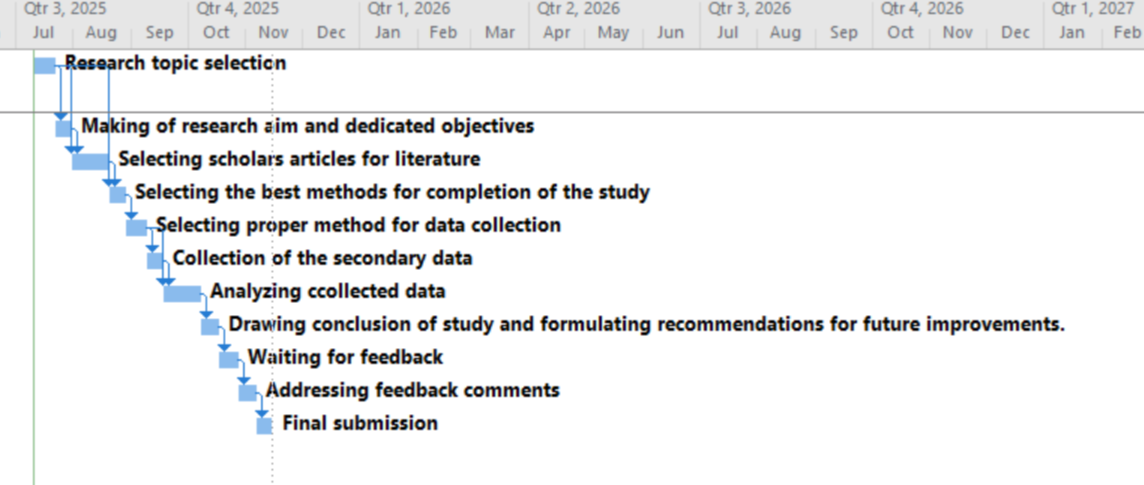
3.2 Gantt chart diagram
3.3 Research structure
Analyst will be going to follow sequential structure for the research (Fang, 2025). Through interpretivism philosophy and inductive approach analyst will be going to conduct study in an effective manner that helps in drawing relevant data for study.
3.4 Research strategy
A strategy in research is comprehensive plan which suggests the way in which study is organised to accomplish research objectives (Pessot et al, 2025). There are mainly two strategies which follows in research one is survey strategy and other is secondary strategy. Survey method is generally associated with primary research, focusing on collecting handful data through questionnaire and interview techniques. While secondary strategy concern with utilising existing data based on research topic. To avoid delay in time analyst will be going to employ secondary method since it is time and cost convenient. Existing information available on DT impact over SME’s innovation and competency will help in completing research in timely and cost efficiently manner.
3.5 Methods to use
There are different method of research applied in study based upon factors including researcher’s interest, timeliness, budget constraint etc. As qualitative and quantitative are two data method utilised in study, where qualitative concern with non-numeric information and quantitative concerns with statistical, figurative information (Edu et al, 2025). To optimise research’s readability, analyst will be going to utilise qualitative data and will ensure to collect data in non-numeric form about impact of DT over business competitiveness and innovation. The reason for not using quantitative method because of the time constraints as using statistical tool requires specific knowledge and practice which consumes time (Tajudeen et al, 2025). Thus, qualitative will help in understanding research topic in depth manner and thereby contributes in addressing the research questions.
Research philosophy:
Philosophy entails analyst’s broad assumption, knowledge that assists in designing and implementing study. It mainly categorise in two broad terms which is interpretivism and positivism. Interpretivism emphasise on developing understanding about topic in social context, while positivism focuses on scientific aspect of study (Gyamerah et al, 2025). However, for the main project analyst will not consider positivism approach since it bases its foundation on quantitative data and project will be going to evaluate qualitative data. Therefore, analyst will apply interpretivism approach for dissertation since it is found to be helpful in interpreting hidden information, thus it will help in understanding core digital transformation approach and its application to SME’s business in UK retail sector.
Research approach:
A general plan followed by researcher to set further stages of study. It is of mainly two type inductive and deductive. Inductive approach follows bottom up approach, it enables researcher to observe collected data and develop understanding in to lay base for new theories (Sheppard, 2025). On the other hand, deductive type uses top-down approach where it base its information based on hypothesis derived from existing theories, thus failure in hypothesis formation can lead to unreliable research result. Therefore, analyst will employ inductive approach in order to develop better understanding in formulated research question as it will help in gathering reliable data related to SME’s in UK and their approach to DT for their business innovation and competency.
3.6 Time scale
|
Task Name |
Duration |
Start |
Finish |
Predecessors |
|
Research topic selection |
7 days |
Fri 11-07-25 |
Mon 21-07-25 |
|
|
Making of research aim and dedicated objectives |
7 days |
Tue 22-07-25 |
Wed 30-07-25 |
1 |
|
Selecting scholars articles for literature |
14 days |
Thu 31-07-25 |
Tue 19-08-25 |
1,2 |
|
Selecting the best methods for completion of the study |
7 days |
Wed 20-08-25 |
Thu 28-08-25 |
1,3 |
|
Selecting proper method for data collection |
7 days |
Fri 29-08-25 |
Mon 08-09-25 |
4 |
|
Collection of the secondary data |
7 days |
Tue 09-09-25 |
Wed 17-09-25 |
5 |
|
Analysing collected data |
14 days |
Thu 18-09-25 |
Tue 07-10-25 |
5,6 |
|
Drawing conclusion of study and formulating recommendations for future improvements. |
7 days |
Wed 08-10-25 |
Thu 16-10-25 |
7 |
|
Waiting for feedback |
7 days |
Fri 17-10-25 |
Mon 27-10-25 |
8 |
|
Addressing feedback comments |
7 days |
Tue 28-10-25 |
Wed 05-11-25 |
9 |
|
Final submission |
7 days |
Thu 06-11-25 |
Fri 14-11-25 |
10 |
3.7 Data collection methods
A process of gathering relevant data aligning with research topic, it is mainly of two type which is primary method and secondary method (Gong, 2025). In primary technique data is being collected through survey, focus group observation, interviews etc. while in secondary method, already existing data is subjected to gathered, in this data is likely to collect from secondary mode like scholars articles, books and journals, websites etc. However, primary data technique requires more time and extra budget which is somehow not possible for this research. Thus in order to complete research in short time analyst will be going to utilise secondary technique and will focus on collecting data about digital transformation and its approach in innovation and competitiveness for SME’s. For reliability criteria analyst will ensure to utilise only those articles who comprise of cited, latest (not 5 year older) information.

 3 Years | MSc in Management
3.8 Data analysis methods
It concern with analysing collected data by applying various approaches to draw conclusion. Analysis can be done in two ways one is statistical and other is thematic. Statistical is associated with numeric quantitative data which is avoided for main study (Conlon and Corbet, 2025). Therefore, analyst will be going to apply thematic approach as it helps in elaborating information by arranging it in different themes. Therefore, analyst will arrange themes based on DT and its impact over SME’s performance in retail sector in order to complete research by meeting all objectives.
3.9 Ethics
Ethics in research involves maintaining data confidentiality, data anonymity, honesty, integrity, informed consent. All these ethics plays a vital role in completing research in fair manner (Amankona et al, 2025). Researcher will be going to follow all these ethics while conducting main research, as analyst will going to ensure data confidentiality by controlling access to data, further analyst will ensure to maintain data anonymity by masking personal information of author’s whose resources has been selected for main project. Consent will also going to be taken to maintain fairness in research, as analyst will inform and obtained consent of key scholars before using their resources.
3.10 Conclusion
This particular chapter has highlighted the key combination of research methods in order to complete main research. For dissertation analyst has made emphasise on using qualitative secondary approach to arrange study in structured manner. Further, research ethics has elaborated which need to be maintain throughout dissertation to enhance its readability and credibility.
REFERENCES
Books and Journals
- Amankona, D., Yi, K., Tackie, E.A., Tweneboa Kodua, L. and Odai, L.A., 2025. Responsible digital innovation and innovation performance in ghana’s high-tech industry: The mediating roles of digital organizational culture and strategy, and the moderating role of digital literacy.SAGE Open,15(2), p.21582440251341256.
- Bekele, H. and Raj, S., 2025. Digitalization and digital transformation in the tourism industry: a bibliometric review and research agenda.Tourism Review,80(4), pp.894-913.
- Billi, A. and Bernardo, A., 2025. The Effects of Digital Transformation, IT Innovation, and Sustainability Strategies on Firms’ Performances: An Empirical Study.Sustainability,17(3), p.823.
- Chen, Y. and Ren, J., 2025. How does digital transformation improve ESG performance? Empirical research from 396 enterprises.International Entrepreneurship and Management Journal,21(1), pp.1-24.
- Conlon, T. and Corbet, S., 2025. The Influence of COVID-19 upon Global Innovation.Available at SSRN 5233738.
- Edu, A.S., Ofosuhene, E., Agozie, D.Q., Gyamfi, B.A. and Asongu, S.A., 2025. Optimizing Sustainable Resource Efficiency: A Fuzzy‐Set Qualitative Comparative Analysis of Sustainable Practices in SMEs.Business Strategy and the Environment,34(3), pp.2799-2812.
- Espina-Romero, L., Chafloque-Céspedes, R., Izaguirre Olmedo, J., Albarran Taype, R. and Ochoa-Díaz, A., 2025. Driving Digital Transformation in Lima’s SMEs: Unveiling the Role of Digital Competencies and Organizational Culture in Business Success.Administrative Sciences,15(1), p.19.
- Fang, Z., 2025. Microservice-Driven Modular Low-Code Platform for Accelerating SME Digital Transformation.
- Ghamgui, N., Rezaei, M., Hentati, I., Louati, N. and Karim Kefi, M., 2025. The role of business planning for internationalisation: Navigating digital transformation in an emerging economy.The International Journal of Entrepreneurship and Innovation, p.14657503251328951.
- Gong, Z., 2025. The Factors Affecting the Strategic Transformation of Small and Medium-sized Sporting Goods Enterprises.Academic Journal of Humanities & Social Sciences,8(4), pp.69-76.
- Gyamerah, S., Afshari, L. and Asante, D., 2025. Digital transformation in the SME context: The nexus between leadership, digital capabilities and digital strategy.International Small Business Journal, p.02662426251314108.
- Kim, Y.J., Passerini, K., Yun, B.S. and Kim, A., 2025. Making the case for digital transformation: Digital entrepreneurship and on-demand service innovation.Journal of Small Business Management, pp.1-29.
- Li, J. and Wei, J., 2025. Digital Transformation and Innovation in Emerging Economies: An Introduction and Future Directions.International Journal of Technology Management,97, p.2.
- Li, X. and Zhu, S., 2025. How digital transformation can affect corporate technology innovation: The role of income gap.Finance Research Letters,75, p.106826.
- Lu, Q., Qin, W., Yan, R., Zhang, S. and Ma, L., 2025. The Effect of SMEs’ Digitalization on Supply Chain Financing Performance: Based on the Resource Orchestration Theory.Journal of Theoretical and Applied Electronic Commerce Research,20(1), p.20.
- Malik, M., Raziq, M.M., Sarwar, N. and Gohar, M., 2025. Navigating the change: a case study of the textile industry on digital leadership, digital transformation and innovative business models.Benchmarking: An International Journal,32(2), pp.550-577.
- Malik, M., Raziq, M.M., Sarwar, N. and Tariq, A., 2025. Digital leadership, business model innovation and organizational change: role of leader in steering digital transformation.Benchmarking: An International Journal,32(5), pp.1632-1662.
- Mkhize, A., Mokhothu, K.D., Tshikhotho, M. and Thango, B.A., 2025. Evaluating the Impact of Cloud Computing on SME Performance: A Systematic Review.Businesses,5(2), p.23.
- Moussaoui, A., Batali, I., Khedid, Z. and Esskalli, K., 2025. The Digital Shift in Moroccan SMEs: Navigating Between Digitization, Digitalization, and Digital Transformation.International Journal of Strategic Management and Economic Studies (IJSMES),4(1), pp.01-12.
- Nicoletti, B. and Appolloni, A., 2025. Digital transformation in ecosystems: integrated operations model and its application to fifth-party logistics operators.Journal of Global Operations and Strategic Sourcing,18(1), pp.91-122.
- Nyqvist, R., Peltokorpi, A., Lavikka, R. and Ainamo, A., 2025. Building the digital age: management of digital transformation in the construction industry.Construction Management and Economics,43(4), pp.262-283.
- Pergelova, A. and Yordanova, D., 2025. The human element in digital transformation: The role of talent management for SMEs.Journal of the International Council for Small Business,6(2), pp.269-283.
- Pessot, E., Zangiacomi, A. and Sacco, M., 2025. Exploring SMEs innovation paths with augmented and virtual reality technologies.European Journal of Innovation Management,28(3), pp.1181-1201.
- Rijal, S., Rahmatullah, R., Sriwahyuni, S., Arisah, N. and Tadampali, A.C.T., 2025. The Influence of Economic Literacy, Entrepreneurship Education and Entrepreneur Mindset in Improving The Competitiveness of Small and Medium Enterprises"(SMES) with Business Performance as A Moderator Variable.International Journal of Business, Law, and Education,6(1), pp.568-597.
- Sheppard, M., 2025. Pathway-specific effects of internationalization on the entrepreneurial orientation–innovation relationship in SMEs.International Marketing Review.
- Tajudeen, F.P., Moghavvemi, S., Thirumoorthi, T., Phoong, S.W. and Bahri, E.N.B.A., 2025. Impact of Digital Transformation on Business Functional Areas of SMEs. InDigital Transformation of Malaysian Small and Medium Enterprises(pp. 45-68). Emerald Publishing Limited.
- Youssef, A.A. and ElSabry, E.A., 2025. The Challenge of Innovation Measurement in Small and Medium Enterprises (SMEs): Approaches and Challenges in Assessing Innovative Capabilities.Interdisciplinary Studies on Digital Transformation and Innovation: Business, Education, and Medical Approaches, pp.99-126.
- Zhen, X. and Zhou, Y., 2025. Digital transformation and corporate creditworthiness.Finance Research Letters,74, p.106742.
Recently Downloaded Samples by Customers
1. Introduction The study area, located on the south coast of the United Kingdom at coordinates 50.622614°N,...View and Download
Introduction Get Free Online Assignment Samples from UK's Best Assignment Help Experts to boost your academic...View and Download
Introduction to BMM6492 Corporate Sustainability Assignment Corporate sustainability refers to the ability of...View and Download
Introduction: Entrepreneurship and Small Business Management Struggling with entrepreneurship assignments? Assignment Help...View and Download
Overview As an adult care worker for young adults with autism and learning difficulties, I provide tailored care to promote...View and Download
Criterion 3: Strategy Formulation Tesla’s mission to accelerate the world’s transition to sustainable energy has...View and Download