COMP11113 Information Systems Analysis and Design Assignment Sample
Modeling The Volbank System: A Uml-Based Analysis For Volunteer Matching

- Type Assignment
- Downloads543
- Pages14
- Words3434
1. Introduction
This report has the aim of modeling the VolBank system through Unified Modeling Language (UML) in order to obtain the functionalities and structure of the system. VolBank is a non-profit organization, which is located in Glasgow, and its task is to make people feel that they are a part of the community through promotion of voluntary activities. Volunteers present their talents to other people and the organization runs such exchanges through a registration and matching platform. The course assignments are aimed at modeling the system in which the volunteers can provide their services, demands, and interests, and the idea of matching the individuals who seek help and the individuals who can provide it will be established. That is why this report will show an overview of the important parts of the system by using UML diagrams, Use Case Diagram, Class Diagram, and Sequence Diagram. The importance of the individual diagram is discussed in order to show how the diagram aid in capturing picture of the system operation and its structure.
Struggling with tight deadlines? Assignment Help For Students from Rapid Assignment Help UK delivers well-researched, expertly written papers on time, every time.
2. System Overview
VolBank is a grassroots movement to bridge the gap between those with skills and those who need skills. The main feature of the system is that people are able to sign up their skills, i.e. painting or teaching a foreign language, and define what skills they need, i.e. the person willing to repaint their house, or a local Spanish teacher. The information is saved in the system and thereafter, enables the staff to match the volunteers according to the offered skills and needs. Volunteers are also enabled to re-edit or re-update their skills and needs (Tian et al.2023). The mission of VolBank is to simplify such interactions to instill an idea of community, sense of personal responsibility, and support. This system will work via a convenient site and the data will be entered by volunteers through their email addresses and passwords. When they have registered, the volunteers have the opportunity to post their personal information, skills available and the skills required. Members of the staff will be able to access profiles of the volunteers then pair the volunteers according to the needs of each and inform viewers of such successful pairings (Benbya et al.2021). Moreover, VolBank can enable the staff to publicize the community-based voluntary programs that can be attended by the orphanages, and this will promote the vision of the organization of local community work. The platform of VolBank will introduce an interactive and participatory atmosphere where people will be able to share and draw skills in the communities which they live. This not only fills the distance between the people needing assistance and the people providing it but also establishes an environment of reciprocity and supports the development of a greater community feeling (Xing et al., 2024). It has a user-friendly system which means that its system can be used by a wide demographic, even by people who are not technologically friendly.

 5 Years | PhD in Computer Science
VolBank has a low-technical registration and logging in through email, which will allow the volunteers to begin their work as soon as possible, with or without their technical knowledge. The next great capability of VolBank is the opportunity to find individuals who fit the specific needs and skills which is organized in a particular pairing so that both connections are meaningful and useful (Bloomfield et al., 2022). An intuitive interface will support the matching process to help the staff identify the volunteers that can effectively help the people in need. This will enable the volunteers to always update their needs and skills, so that the system is dynamic and flexible to such changing needs of the community (Oliveira et al., 2022). The profile editing/update option offered by a platform will ensure that it establishes the purpose of involving individuals in their continual involvement and interaction. Also, VolBank serves as a medium that facilitates the publicity of diverse local activities and projects, like local galleries or volunteer-based events, especially in the regions and sectors where resources might be limited, like orphanages. It not only makes the community strong but also spurs the mission of VolBank to develop a sense of responsibilities shared, empowerment and support of local causes. With these initiatives, VolBank is making the future where individuals can connect, share, and grow together by doing what is right collectively.
3. Use Case Diagram
The Use Case Diagram defines the process ability of the VolBank system including the main use cases and the interaction of the various actors with the use cases. There are three key actors in this diagram, and they are: the Volunteer, the VolBank Staff and the Local Communities. These actors take different interactions in the system. The Volunteer will have an opportunity to become a member of the system, log in, provide personal information, and state the skills he/she can provide and require. VolBank Staff is to match the people based on their needs and skills, perceive volunteer registration data, and make known the voluntary activities (Szymkowiak et al.2021). The system can also be used by local communities to post events, although such capabilities are mostly used by the regular employees.
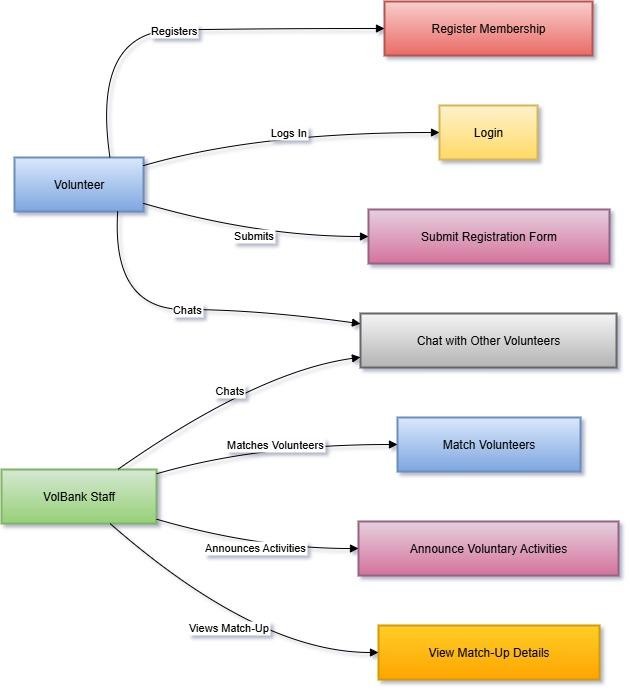
Figure 1: Use Case Diagram
(Source: Self-Created in Draw.io)
The Use Case Diagram of the VolBank reveals that the functionality of this system is presented through the important interactions between the actors and the core processes of the system. The major participants of this system are the Volunteer, VolBank Staff, and the Local Communities who have unique roles in the general running and the achievement of the system.
Volunteer: The VolBank system is dependent on the activities of volunteers. They are allowed to register as a member of the platform by submitting personal basic information including name, and contact information as well as any skill that they may have to offer or need. The volunteers are able to log in and update with their information and it is easy to reflect any change in the skill they offer or require. This autonomy gives volunteers a freedom to update their profiles and continue being available in the system until they are matched with the appropriate partners.
VolBank Staff: The members of VolBank staff are in charge of the fluency of the system functioning. Their major roles are to process data on the registration of volunteers, analyze the needs and the capacities of the volunteers as well as match them. The members of the staff also possess the right to address the volunteers, providing the information on the volunteer pairs and advertising the community projects. Moreover, the staff members make it their duty to promote and control the volunteer-based activities and events to make sure that these are offered to the appropriate parties.
Get assistance from our PROFESSIONAL ASSIGNMENT WRITERS to receive 100% assured AI-free and high-quality documents on time, ensuring an A+ grade in all subjects.
Local Communities: The system is utilized by local communities (usually organized in the form of a group or organization) to create events and post these events which volunteers can attend to. These activities (i.e. workshops, clean-up drives, charity programs, etc.) serve crucially towards enhancing the vision of the organization in terms of local engagement and community service (Halperin and McElroy, 2023). Although the posting of the events may be undertaken by the volunteers, it is usually the work of the staff of the VolBank who are seen to maintain the flow of the events in consistency with the overall objectives of the organization.
The exchange between these three players volunteers, staff, and local communities provides a synergetic and dynamic environment in which new skills are exchanged and new community projects encouraged (Fiegenbaum et al., 2025). The use case diagram is successful in the specification of the roles and responsibilities of each actor, which is important in the area of smooth system operation and maximization of the effects of VolBank community-driven mission.
4. Use Case Description: "Register Membership"
The use case of "Register Membership" reflects how a volunteer can enroll to the VolBank system. After clicking on the "Registration" button on the site, a registration form is opened to the volunteer. The form is made of personal information (name, email, password, and phone), the skills to be offered by the volunteer, and the other skills needed by the volunteer. Upon filling up the form, the volunteer hands the form over to be cross-checked. In case they forget to fill in some fields or fill those fields in the wrong way then the form will be returned by the system and it will tell the user the fields that must be corrected (Wang et al.2022). The volunteer is later requested to refill-in the corrections and resend the sheet.
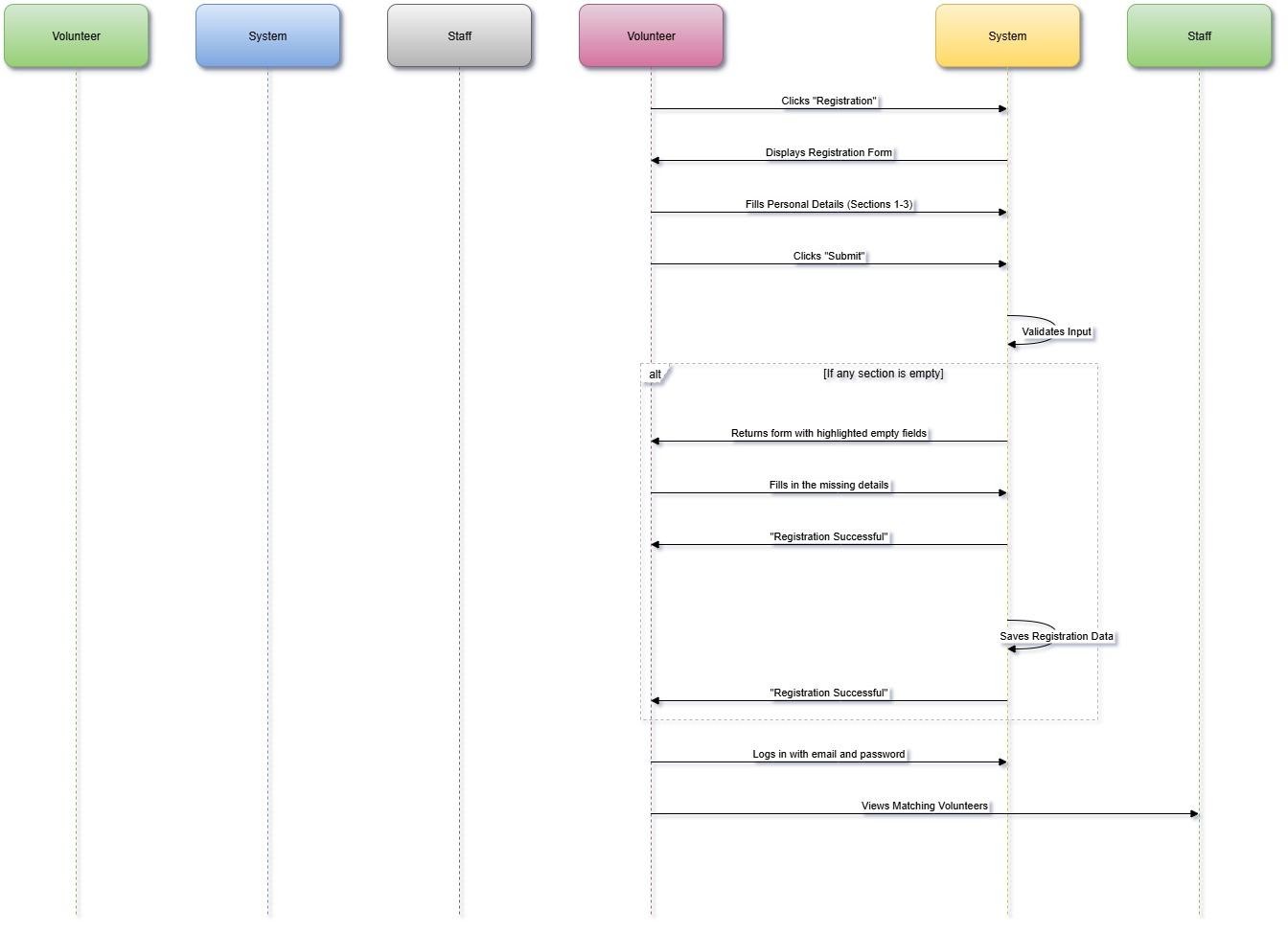
Figure 2: Use Case Description (Register Membership)
(Source: Self-Created in Draw.io)
When one fills in all the fields accurately and submits the filled fields, the system stores the registration information and a message appears which says that the registration has successfully been done. The volunteer now can log into the system by using the email and password. They can amend any skill and need they have or add or delete them. In case the volunteer wants to cancel the registration process at any stage, then the system gives a confirmation and the volunteer can dump the form (Black et al.2023). This use case highlights the points on input validation, user instructions, and system feedback when designing an easy-to-use experience of a volunteer registration. The system of registering the volunteers in the VolBank is aimed at providing the most convenient and smooth process. As soon as the volunteer has entered all the required fields of the form correctly and sent it in, the system accomplishes input validation, so that to check whether the filled information is correct and complete (Caridà et al., 2022). This is an important step in order to prevent anomalies and guarantee quality of information stored. In case there is something wrong with the data, the system tells how to change it and leads the volunteer using the information on what is wrong. When the submission is successful, a notification echoes on the screen and the volunteer is informed that his/her registration was successful.
The immediate feedback allows the volunteer to know that the information he or she gave is having the appropriate representation in the system indicating a good tone in his or her response to the system (Gong and Sun, 2022). Once registered, the volunteer logs in thru his/her email address and password in order to have access to the system. They can add or correct any of their skills or needs listed in their profile and the system is very flexible in the manner of which they can manage the profile. The volunteers are free to introduce new skill sets and erase the irrelevant ones, or adjust the ones they already have, with their portfolios getting updated once their capabilities or requirements change. Also, the system allows the user a chance to cancel the registration process at any stage (Seguin et al., 2022). In case the volunteer decides to leave the registration, he or she is sent a confirmation prompt so that the interest of the volunteer to withdraw is made clear. This confirmation assists in the occurrence of an accidental form submission or cancellations. This is because the system facilitates the ability of a volunteer to easily cancel or amend his or her registration, and it is more user-centric where a user has control of his or her experience (Antelmi et al., 2022). On the whole, this use case helps to highlight the importance of input validation, well instruction of the user, and appropriate feedback of the system in time. In combination, these aspects form the simple and convenient registration process that is unlikely to make a user commit an error to be more satisfied with its use and be more involved in the activity of the platform.
5. Class Diagram
The Class Diagram is meant to declare the inert structure of the VolBank system. It has the principal objects of the system and relations between them. There are four main classes: Volunteer, VolBank Staff, Registration Form and VolunteerMatch. Volunteer class has fields like name, email, password, mobile number, the skills one offers, and the skills that the person requires. It also consists of techniques which are used to enable volunteers to adjust their registration such as addSkill(), addNeed(), removeSkill(), and removeNeed(). The VolBank Staff Class will ensure the administration of the activities of the system and will aid in the interactions with the volunteers. This class has attributes such as staffID, name, role, and methods approveRegistration(), matchVolunteer(), notifyVolunteer() which enable staff to accept registration of the volunteers, match volunteers according to their skills and needs as well as getting in contact with them. Registration Form class manages the process of registering volunteers and contains such attributes as formID, dateCreated and status. It involves functions such as validateFields(), submitForm() and cancelForm() so as to make sure that the information regarding the registration process is validated, submitted or canceled respectively. Finally, the VolunteerMatch class handles the networking of the volunteers according to the skills availed and needed. It has such methods as findMatch(), notifyMatch(), and generateReport() so that the system could determine an appropriate match to the volunteer and notify the corresponding side. Volunteer activity and participation in the system is also reported through the class.
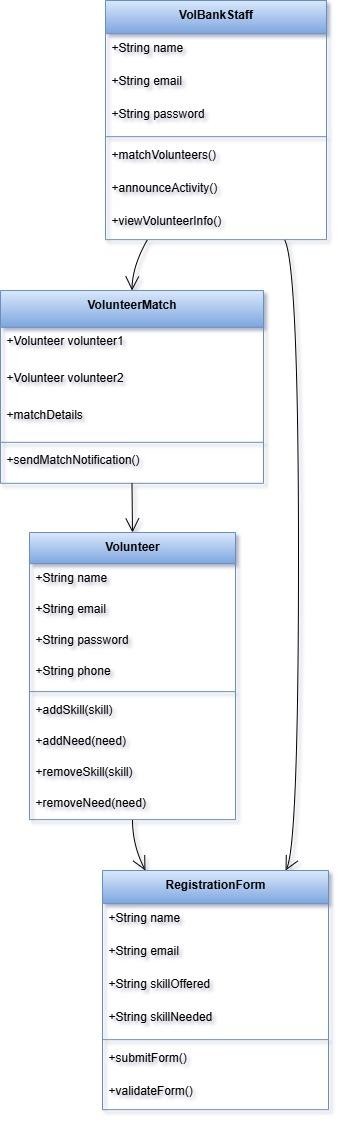
Figure 3: Class Diagram
(Source: Self-Created in Draw.io)
The VolBank Staff includes properties, such as the name, email and password and methods, such as the matchVolunteers (), announceActivity (), viewVolunteerInfo (). The Registration Form class will contain the information about personal information and skills and the ways of sending and validating the form (Galles et al.2021). The VolunteerMatch course keeps the information about two of the volunteers who have already been matched by the staff depending on the skills and needs. This group contains such methods as sendMatchNotification() to inform volunteers about the successful matching. The associations between these classes are shown with the help of association lines. The Registration Form is related to the Volunteer class because the volunteers fill in the form to make the registration. The VolBank Staff class is the related type to the VolunteerMatch and Registration Form classes because staff take care of volunteers, creating matching. There is a relationship between the class Volunteer and Volunteer Match meaning that when a match is done; two volunteers are involved (Ianevski et al.2022). The diagram is important in getting knowledge on the structure of the system and it becomes easy to analyze the components of the system and the interaction between the components of the system.
6. Sequence Diagram
The Sequence Diagram illustrates how dynamic the system of VolBank works in the process "Register Membership". This diagram illustrates relations between the objects of VolBank Staff, System, and Volunteer in the process of registration. The volunteer will start by clicking the button registration and the system will pop a blank registration form (Naghavi et al.2024). The volunteer will fill in his or her personal information and send the form to be validated.
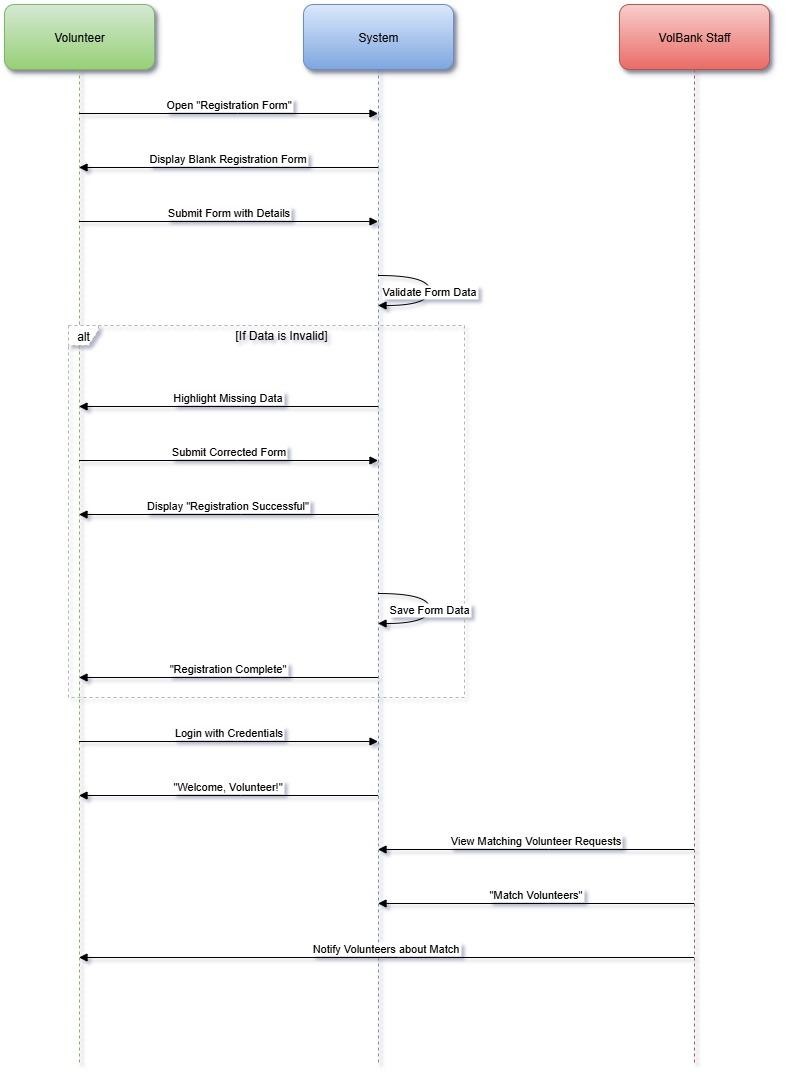
Figure 4: Sequence Diagram
(Source: Self-Created in Draw.io)
The system verifies the data entered after that submission is done, in order to confirm that the contents have been entered accordingly. In case of a certain section missing the system brings back the form to the volunteer who is acknowledged with the missing section. The volunteer corrects this form and posts it back. As soon as the form is filled, the system stores the data about registration and notifies about successful registration.
7. Challenges and Assumptions
During the modeling of the VolBank system, a number of issues, especially on the relationship between various components of the systems arose. As an example, defining a proper way to model interactions among volunteers, the system, and staff needed an intensive study of the goals of the system and the roles of its actors. The other issue that had to be addressed was that the flow of activities in the use case of "Register Membership" would be accurately recorded particularly at the decision points during which volunteers may have to rectify their registration information. There were also assumptions on the functionality of the system. The assumption was that each of the volunteers will be able to give the correct and complete data and that the system will at any time be capable of validating and storing this information without any trouble. Further, an assumption was that the matching process would be performed manually by the workers of the VolBank, without the use of automated algorithms (Maatuk et al.2022). These assumptions refer to the case study given, and they might require reconsideration in case the system would be applied in full scale in real life.
8. Conclusion
Finally, UML diagrams presented in this report can give a detailed model of the VolBank system. The Use Case Diagram will emphasize the communication process between the users of the system and the system, the Class Diagram will show the system structure, and the Sequence Diagram will illustrate the flow of actions used in the process of registering on the site. These diagrams play important roles in the analysis of the system functionality and organizing it. Through this coursework, the topic of system modeling in software design has been highlighted and as a result it will serve as a good basis when it comes to learning aspects of analyzing and modeling complex information systems in practice.
9. References
- Tian, J., Zhang, D., Yao, X., Huang, Y. and Lu, Q., 2023. Global epidemiology of systemic lupus erythematosus: a comprehensive systematic analysis and modelling study. Annals of the rheumatic diseases, 82(3), pp.351-356.
- Benbya, H., Pachidi, S. and Jarvenpaa, S., 2021. Special issue editorial: Artificial intelligence in organizations: Implications for information systems research. Journal of the Association for Information Systems, 22(2), p.10.
- Szymkowiak, A., Melović, B., Dabić, M., Jeganathan, K. and Kundi, G.S., 2021. Information technology and Gen Z: The role of teachers, the internet, and technology in the education of young people. Technology in society, 65, p.101565.
- Wang, H., Paulson, K.R., Pease, S.A., Watson, S., Comfort, H., Zheng, P., Aravkin, A.Y., Bisignano, C., Barber, R.M., Alam, T. and Fuller, J.E., 2022. Estimating excess mortality due to the COVID-19 pandemic: a systematic analysis of COVID-19-related mortality, 2020–21. The Lancet, 399(10334), pp.1513-1536.
- Black, R.J., Cross, M., Haile, L.M., Culbreth, G.T., Steinmetz, J.D., Hagins, H., Kopec, J.A., Brooks, P.M., Woolf, A.D., Ong, K.L. and Kopansky-Giles, D.R., 2023. Global, regional, and national burden of rheumatoid arthritis, 1990–2020, and projections to 2050: a systematic analysis of the Global Burden of Disease Study 2021. The Lancet Rheumatology, 5(10), pp.e594-e610.
- Galles, N.C., Liu, P.Y., Updike, R.L., Fullman, N., Nguyen, J., Rolfe, S., Sbarra, A.N., Schipp, M.F., Marks, A., Abady, G.G. and Abbas, K.M., 2021. Measuring routine childhood vaccination coverage in 204 countries and territories, 1980–2019: a systematic analysis for the Global Burden of Disease Study 2020, Release 1. The Lancet, 398(10299), pp.503-521.
- Ianevski, A., Giri, A.K. and Aittokallio, T., 2022. SynergyFinder 3.0: an interactive analysis and consensus interpretation of multi-drug synergies across multiple samples. Nucleic acids research, 50(W1), pp.W739-W743.
- Naghavi, M., Vollset, S.E., Ikuta, K.S., Swetschinski, L.R., Gray, A.P., Wool, E.E., Aguilar, G.R., Mestrovic, T., Smith, G., Han, C. and Hsu, R.L., 2024. Global burden of bacterial antimicrobial resistance 1990–2021: a systematic analysis with forecasts to 2050. The Lancet, 404(10459), pp.1199-1226.
- Maatuk, A.M., Elberkawi, E.K., Aljawarneh, S., Rashaideh, H. and Alharbi, H., 2022. The COVID-19 pandemic and E-learning: challenges and opportunities from the perspective of students and instructors. Journal of computing in higher education, 34(1), pp.21-38.
- Seguin, J.P., Varghese, D., Anwar, M., Bartindale, T. and Olivier, P., 2022, June. Co-designing digital platforms for volunteer-led migrant community welfare support. In Proceedings of the 2022 ACM Designing Interactive Systems Conference (pp. 247-262).
- Caridà, A., Colurcio, M. and Melia, M., 2022. Digital platform for social innovation: Insights from volunteering. Creativity and Innovation Management, 31(4), pp.755-771.
- Antelmi, A., D’Ambrosio, G., Petta, A., Serra, L. and Spagnuolo, C., 2022. A volunteer computing architecture for computational workflows on decentralized web. IEEE Access, 10, pp.98993-99010.
- Gong, E. and Sun, Y., 2022. Computerbank: A community-based computer donation platform using machine learning and nft. Computer Science & Information Technology, 12, p.2022.
- Halperin, B.A. and McElroy, E., 2023, July. Temporal Tensions in Digital Story Mapping for Housing Justice: Rethinking Time and Technology in Community-Based Design. In Proceedings of the 2023 ACM Designing Interactive Systems Conference (pp. 2469-2488).
- Fiegenbaum, H., Azegele, B. and Seider, S., 2025. Decentralized Internet of Things-Networks for environmental data pipelines: Opportunities and challenges in a community-based urban green space restoration project in Nairobi, Kenya. OSF Preprints, (djgba_v1).
- Oliveira, E., Carvalho, D., Sacramento, E., Branco, A., Antunes, M.J., Pedro, L., Tymoshchuk, O., Almeida, M. and Ramos, F., 2022. Promoting community-based networks through digital media. Observatorio (OBS*), 16(2), pp.1-18.
- Xing, Y., Kelly, R.M., Rogerson, M.J., Waycott, J. and Aslam, K., 2024, May. Designing for inclusive experiences: Investigating opportunities for supporting older adults in community-based social programs. In Proceedings of the 2024 CHI Conference on Human Factors in Computing Systems (pp. 1-20).
- Bloomfield, C., Harreveld, B. and Fisher, R., 2022. ‘You don’t have to feel trapped’: architectural discourses of youth engagement in a community-based learning environment. Smart Learning Environments, 9(1), p.27.
Recently Downloaded Samples by Customers
Introduction: Academic Skills and Studying With Confidence Enhance your academic skills with Assignment Help UK on managing...View and Download
1. Introduction The study area, located on the south coast of the United Kingdom at coordinates 50.622614°N,...View and Download
Introduction: Values, Ethics And Working Collaboratively Tired of assignment anxiety? Rapid Assignment Help connects you...View and Download
Introduction This paper seeks to give a critical analysis of International Student Nurses’ Use of social media for...View and Download
Introduction The paper aims to highlight the key issues being faced while starting up a new venture for which a reference has...View and Download
How Zara Adapts to Micro and Macro Environmental Changes Micro and macro environment plays an important role in the working of...View and Download